

| Jong-Koo Lee | 48 Articles |

Objectives
This study aimed to assess the impact of high-level versus low-level construal messages about the coronavirus disease 2019 (COVID-19) Vaccine Injury Compensation Program (CVICP) on public attitudes toward the program and COVID-19 vaccination. Methods A randomized controlled experimental design was employed. Adults aged 18 to 64 residing in the Republic of Korea were randomly assigned to either an experimental group (high-level construal message) or a control group (low-level construal message). Both groups viewed a 2-minute video about the CVICP, with construal level as the sole variable. Pre- and post-intervention questionnaires evaluated attitudes toward the CVICP and COVID-19 vaccination, including satisfaction, perceived necessity, and perceived effectiveness in enhancing vaccine acceptance. Data were analyzed using the paired t-test, repeated measures 2-way analysis of variance, and multiple linear regression. Results The experimental group showed statistically significant improvements across all 6 attitude measures following exposure to the high-level construal message. By contrast, the control group demonstrated significant improvement in only 3 attitudes: satisfaction with the CVICP, willingness to recommend vaccination, and willingness for future vaccination. A significant difference between groups was observed for perceived effectiveness of the CVICP in enhancing vaccine acceptance (p=0.01), with high-level construal messaging being more impactful. Conclusion High-level construal messages are more effective than low-level messages in shaping public perceptions and addressing vaccine hesitancy. Policymakers and health authorities should incorporate high-level construal elements into communication strategies to build trust and support for vaccination programs.

Objectives
Subacute sclerosing panencephalitis (SSPE) is a rare but fatal neurodegenerative disease caused by persistent measles virus infection. After a significant measles outbreak in 2000–2001, the Republic of Korea implemented a nationwide measles elimination program, which led to a dramatic reduction in measles incidence. This study aimed to evaluate the impact of these measles elimination efforts on the incidence of SSPE in the Republic of Korea. Methods This nationwide, population-based retrospective cohort study identified patients newly diagnosed with measles and SSPE between 2007 and 2022, registered in the Health Insurance Review and Assessment Service (HIRA) and Korea Disease Control and Prevention Agency (KDCA) databases. Population-based incidence rates of measles and SSPE were calculated and compared annually. Results A total of 236 measles cases (HIRA data) and 1,168 measles cases (KDCA data), along with 2,736 SSPE cases, were diagnosed during the study period. Measles incidence significantly declined, reaching zero cases in 2021, while SSPE incidence displayed an upward trend, peaking in 2014. The mean age at SSPE onset was 21.2 years, with a marked male-to-female ratio of 13.0:1. Conclusion SSPE incidence was remarkably low in the post-outbreak period, likely attributable to successful measles control. This study underscores the critical importance of maintaining low measles incidence through sustained vaccination efforts, preventing SSPE and other measles-related complications. Citations
Citations to this article as recorded by

Citations
Citations to this article as recorded by
Citations
Citations to this article as recorded by

This study aimed to establish a foundation for future collaborations aimed at preparing for and responding to infectious diseases by examining the vaccine injury compensation programs (VICPs) of East Asian countries. We reviewed the current status of VICPs in the Republic of Korea, Japan, and Taiwan by searching national government websites and reviewing relevant literature. Additionally, we conducted email inquiries targeting experts from Japan and Taiwan. Through the comprehensive analysis of VICPs in these 3 countries covered various aspects, we identified several similarities and differences in the VICPs across these countries. While the governments of the Republic of Korea, Japan, and Taiwan play a central role in supporting investigations into vaccine injuries and managing compensation procedures based on legal statutes, they differ in terms of financial resources for compensation, the range of vaccines covered, and the criteria for assessing causality. In the Republic of Korea, Japan, and Taiwan, compensation is typically paid in a lump sum, although the specific benefits available vary by country. This study on VICPs in the Republic of Korea, Japan, and Taiwan provides valuable insights for the further development and management of domestic systems.
Citations
Citations to this article as recorded by
Citations
Citations to this article as recorded by

The COVID-19 Vaccine Safety Research Committee (CoVaSC) was established in November 2021 to address the growing need for independent, in-depth scientific evidence on adverse events (AEs) following coronavirus disease 2019 (COVID-19) vaccination. This initiative was requested by the Korea Disease Control and Prevention Agency and led by the National Academy of Medicine of Korea. In September 2022, the COVID-19 Vaccine Safety Research Center was established, strengthening CoVaSC’s initiatives. The center has conducted various studies on the safety of COVID-19 vaccines. During CoVaSC’s second research year, from September 29, 2022 to July 19, 2023, the center was restructured into 4 departments: Epidemiological Research, Clinical Research, Communication & Education, and International Cooperation & Policy Research. Its main activities include (1) managing CoVaSC and the COVID-19 Vaccine Safety Research Center, (2) surveying domestic and international trends in AE causality investigation, (3) assessing AEs following COVID-19 vaccination, (4) fostering international collaboration and policy research, and (5) organizing regular fora and training sessions for the public and clinicians. Causality assessments have been conducted for 27 diseases, and independent research has been conducted after organizing ad hoc committees comprising both epidemiologists and clinical experts on each AE of interest. The research process included protocol development, data analysis, interpretation of results, and causality assessment. These research outcomes have been shared transparently with the public and healthcare experts through various fora. The COVID-19 Vaccine Safety Research Center plans to continue strengthening and expanding its research activities to provide reliable, high-quality safety information to the public.
Citations
Citations to this article as recorded by
Citations
Citations to this article as recorded by
Citations
Citations to this article as recorded by
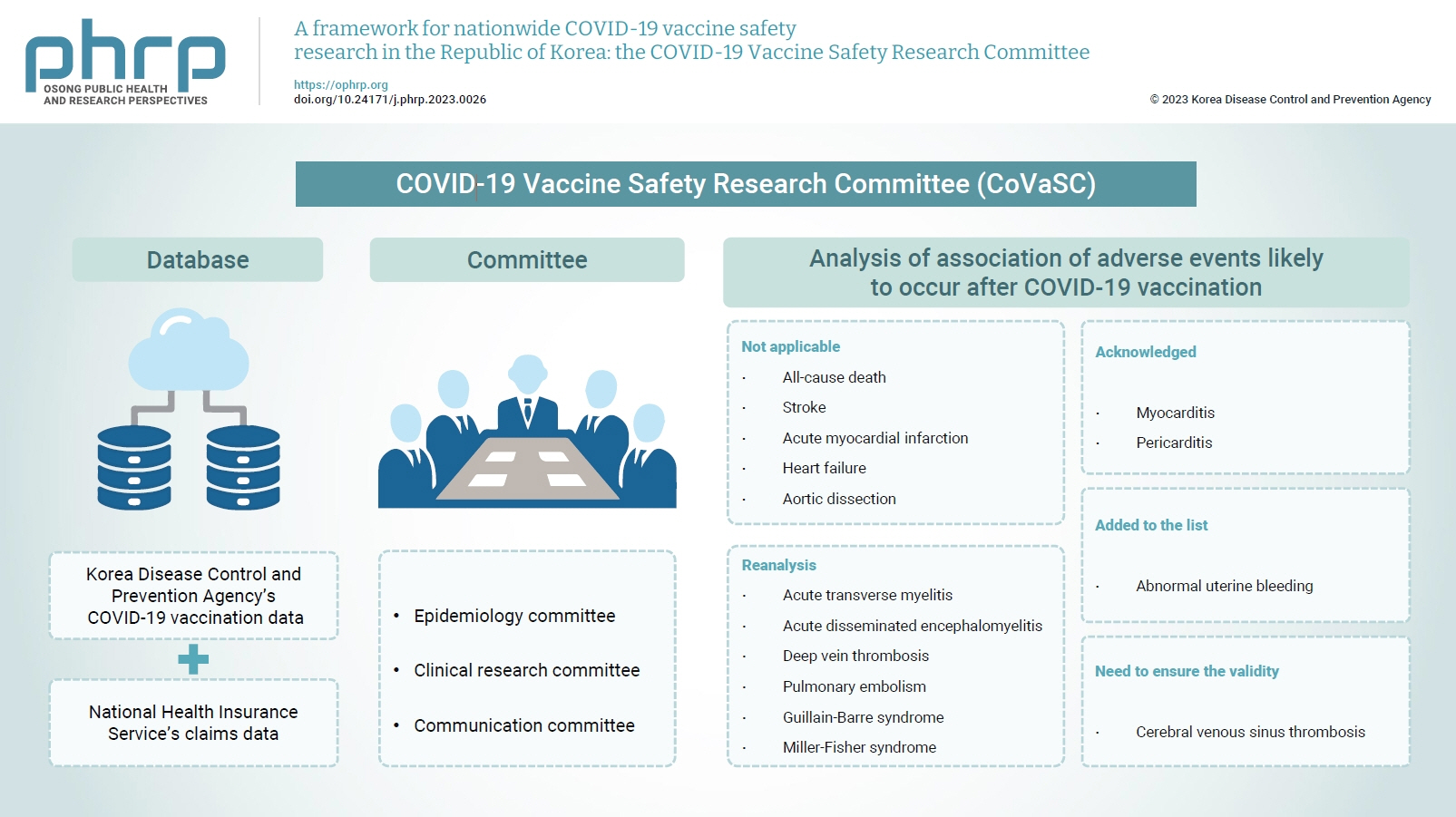
With the introduction of coronavirus disease 2019 (COVID-19) vaccines, the Korea Disease Control and Prevention Agency (KDCA) commissioned the National Academy of Medicine of Korea to gather experts to independently assess post-vaccination adverse events. Accordingly, the COVID-19 Vaccine Safety Research Committee (CoVaSC) was launched in November 2021 to perform safety studies and establish evidence for policy guidance. The CoVaSC established 3 committees for epidemiology, clinical research, and communication. The CoVaSC mainly utilizes pseudonymized data linking KDCA’s COVID-19 vaccination data and the National Health Insurance Service’s claims data. The CoVaSC’s 5-step research process involves defining the target diseases and organizing ad-hoc committees, developing research protocols, performing analyses, assessing causal relationships, and announcing research findings and utilizing them to guide compensation policies. As of 2022, the CoVaSC completed this research process for 15 adverse events. The CoVaSC launched the COVID-19 Vaccine Safety Research Center in September 2022 and has been reorganized into 4 divisions to promote research including international collaborative studies, long-/short-term follow-up studies, and education programs. Through these enhancements, the CoVaSC will continue to swiftly provide scientific evidence for COVID-19 vaccine research and compensation and may serve as a model for preparing for future epidemics of new diseases.
Citations
Citations to this article as recorded by
Citations
Citations to this article as recorded by
Citations
Citations to this article as recorded by
Citations
Citations to this article as recorded by
Citations
Citations to this article as recorded by
Citations
Citations to this article as recorded by
Citations
Citations to this article as recorded by
Citations
Citations to this article as recorded by
Citations
Citations to this article as recorded by
Citations
Citations to this article as recorded by
Citations
Citations to this article as recorded by
Objectives
Our aim was to evaluate Korea’s Pandemic Influenza Preparedness Plan. Methods We conducted a sensitivity analysis on the expected number of outpatients and hospital bed occupancy, with 1,000,000 parameter combinations, in a situation of pandemic influenza, using the mathematical simulation program InfluSim. Results Given the available resources in Korea, antiviral treatment and social distancing must be combined to reduce the number of outpatients and hospitalizations sufficiently; any single intervention is not enough. The antiviral stockpile of 4–6% is sufficient for the expected eligible number of cases to be treated. However, the eligible number assumed (30% for severe cases and 26% for extremely severe cases) is very low compared to the corresponding number in European countries, where up to 90% of the population are assumed to be eligible for antiviral treatment. Conclusions A combination of antiviral treatment and social distancing can mitigate a pandemic, but will only bring it under control for the most optimistic parameter combinations. Citations
Citations to this article as recorded by
The Division of Vaccine-Preventable Disease Control and National Immunization Program of the Korea Centers for Disease Control and Prevention has prepared a plan of action as a guide for key actions that will be taken if a poliovirus outbreak occurs in the Republic of Korea. The history of poliomyelitis and vaccination against poliovirus in the nation was reviewed and the routine surveillance procedures that are currently in place were described. The principles and specific actions for an effective response to a poliovirus outbreak were prepared. The guidelines clearly outline the actions to be taken in case of a polio outbreak. When a suspected case of poliovirus infection is reported, an immediate epidemiological investigation is to be conducted. The response to a poliovirus outbreak includes case isolation, management of potential contacts and immunization. All stakeholders are to be made aware of what key actions should be taken at each stage of the response to a poliovirus outbreak in the nation.
Citations
Citations to this article as recorded by
Objectives
To investigate the possible link between <i>Vibrio vulnificus</i> population size in seawater and water temperature. Methods We collected incidence and water temperature data in coastal regions of Korea and constructed a mathematical model that consisted of three classes; susceptible fish, infected fish available to humans, and infected humans. Results We developed a mathematical model to connect <i>V. vulnificus</i> incidence with water temperature using estimated bacterial population sizes and actual coastal water temperatures. Conclusion Increased <i>V. vulnificus</i> population sizes in marine environments may increase the risk of infection in people who eat at coastal restaurants in Korea. Furthermore, we estimated the near-future number of infected patients using our model, which will help to establish a public-health policy to reduce the disease burden. Citations
Citations to this article as recorded by
Objectives
The aim of this study was to review the epidemiologic data of rubella and congenital rubella syndrome (CRS) supplied by surveillance systems from 2001 to 2009 and to propose measures to improve the quality of the surveillance system in the Republic of Korea. Methods The epidemiological data for rubella and CRS cases reported to the Korea Centers for Disease Control and Prevention from 2001 to 2009 were retrospectively reviewed, and insurance reimbursement data from the Korea National Health Insurance Review Agency were collected for comparison. Results The number of yearly reported rubella cases to the Korea Centers for Disease Control and Prevention from 2001 to 2009 was 128, 24, 8, 24, 15, 12, 35, 30, and 36, respectively. The occurrence of rubella shifted to a slightly higher age group during the 9-year period, i.e. from 0–9 years to 10–19 years. Among the 309 reported rubella cases, three were confirmed cases of CRS. In addition, according to data sourced from Health Insurance Review Agency, 24, 19, 19, 9, and 5 CRS cases were reported for medical insurance reimbursement from 2005 to 2009, respectively. Conclusion According to available surveillance data, the reported cases of rubella and CRS were not high, but a more detailed surveillance with emphasis on susceptible women of childbearing age is necessary for better monitoring and control of rubella and CRS in the Republic of Korea. Citations
Citations to this article as recorded by
|
|


