

| Hyeokjin Lee | 2 Articles |

Objectives
Scrub typhus, an acute disease caused by Orientia tsutsugamushi and transmitted by larval chigger mites, is a representative autumn febrile illness in the Republic of Korea. We examined epidemiological characteristics underlying spatial heterogeneity in Busan Metropolitan City to inform region-specific prevention and control policies. Methods: We analyzed 1,645 confirmed and suspected scrub typhus cases reported in Busan from 2019 to 2023. Crude incidence rates and age-standardized incidence rates (ASIRs) per 100,000 population were calculated using the 2021 mid-year population. The chi-square test assessed associations between disease occurrence and exposure activities within the preceding 30 days. Correlation analyses examined the relationships of ASIR with environmental indicators, including per capita urban forest area, and epidemiological indicators, including prior infectious disease education. Results: The overall mean ASIR in Busan was 8.35 per 100,000 population, below the national average. However, incidence was higher in peri-urban districts, including Gijang-gun (26.12/100,000) and Gangseo-gu (15.02/100,000), than in central urban districts such as Junggu (2.20/100,000). Higher incidence was observed among women and older adults (≥60 years). ASIR correlated strongly with per capita urban forest area (r=0.92; 95% confidence interval, 0.79–0.97; p<0.001). Regional differences were significant for agriculture/forestry, gardening, and general outdoor activities (p<0.001). Districts with higher incidence also displayed higher rates of infectious disease education, although this may reflect reverse causation. Conclusion: In Busan, scrub typhus incidence was concentrated in peri-urban districts. These findings support region-specific prevention strategies, evaluation of infectious disease education, enhanced mite surveillance, and practical protective measures during fieldwork.
Objectives
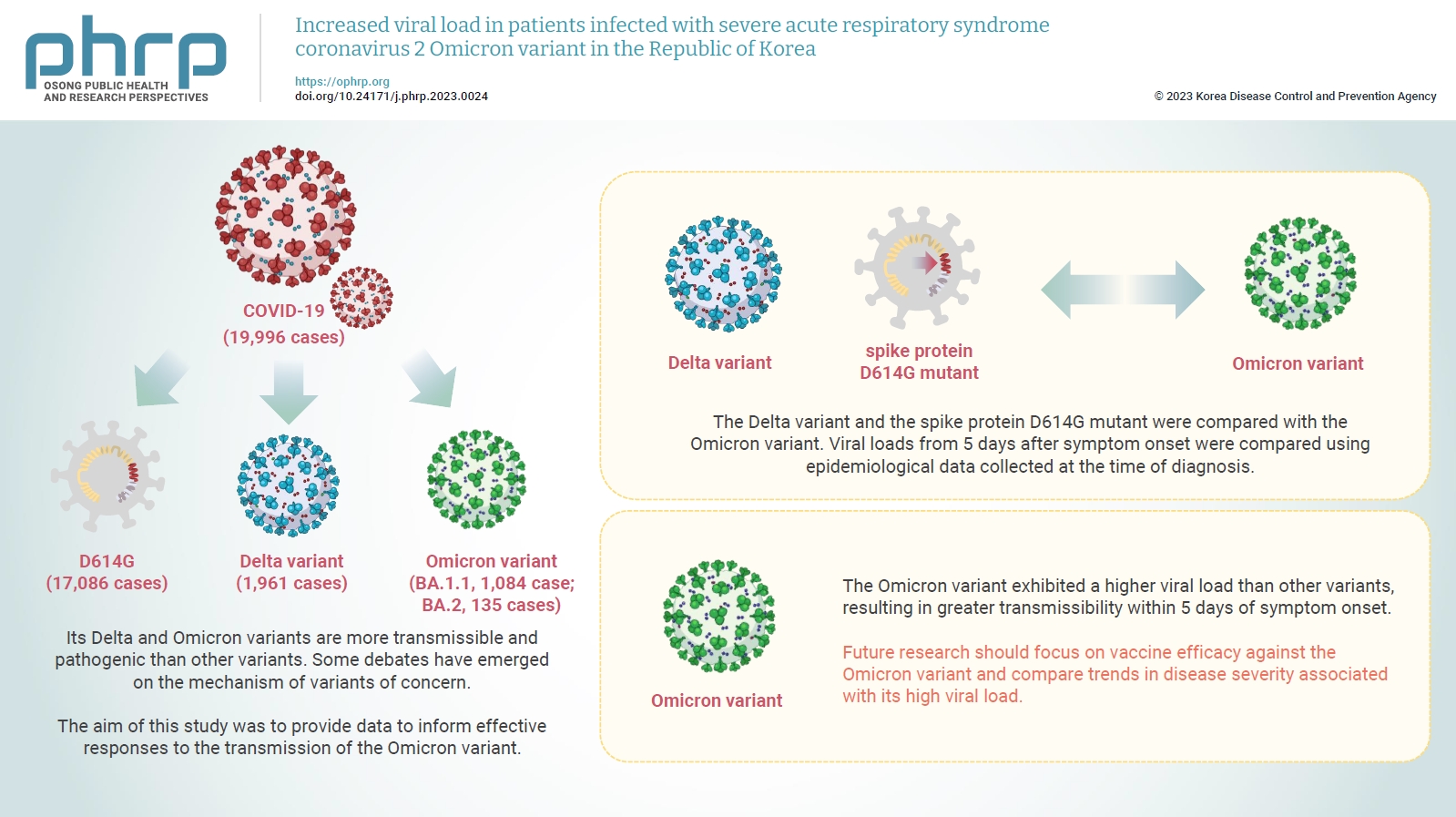
Coronavirus disease 2019 (COVID-19) has been declared a global pandemic owing to the rapid spread of the causative agent, severe acute respiratory syndrome coronavirus 2. Its Delta and Omicron variants are more transmissible and pathogenic than other variants. Some debates have emerged on the mechanism of variants of concern. In the COVID-19 wave that began in December 2021, the Omicron variant, first reported in South Africa, became identifiable in most cases globally. The aim of this study was to provide data to inform effective responses to the transmission of the Omicron variant. Methods The Delta variant and the spike protein D614G mutant were compared with the Omicron variant. Viral loads from 5 days after symptom onset were compared using epidemiological data collected at the time of diagnosis. Results The Omicron variant exhibited a higher viral load than other variants, resulting in greater transmissibility within 5 days of symptom onset. Conclusion Future research should focus on vaccine efficacy against the Omicron variant and compare trends in disease severity associated with its high viral load. Citations
Citations to this article as recorded by

|
|


