

| Geun-Yong Kwon | 5 Articles |
Objectives
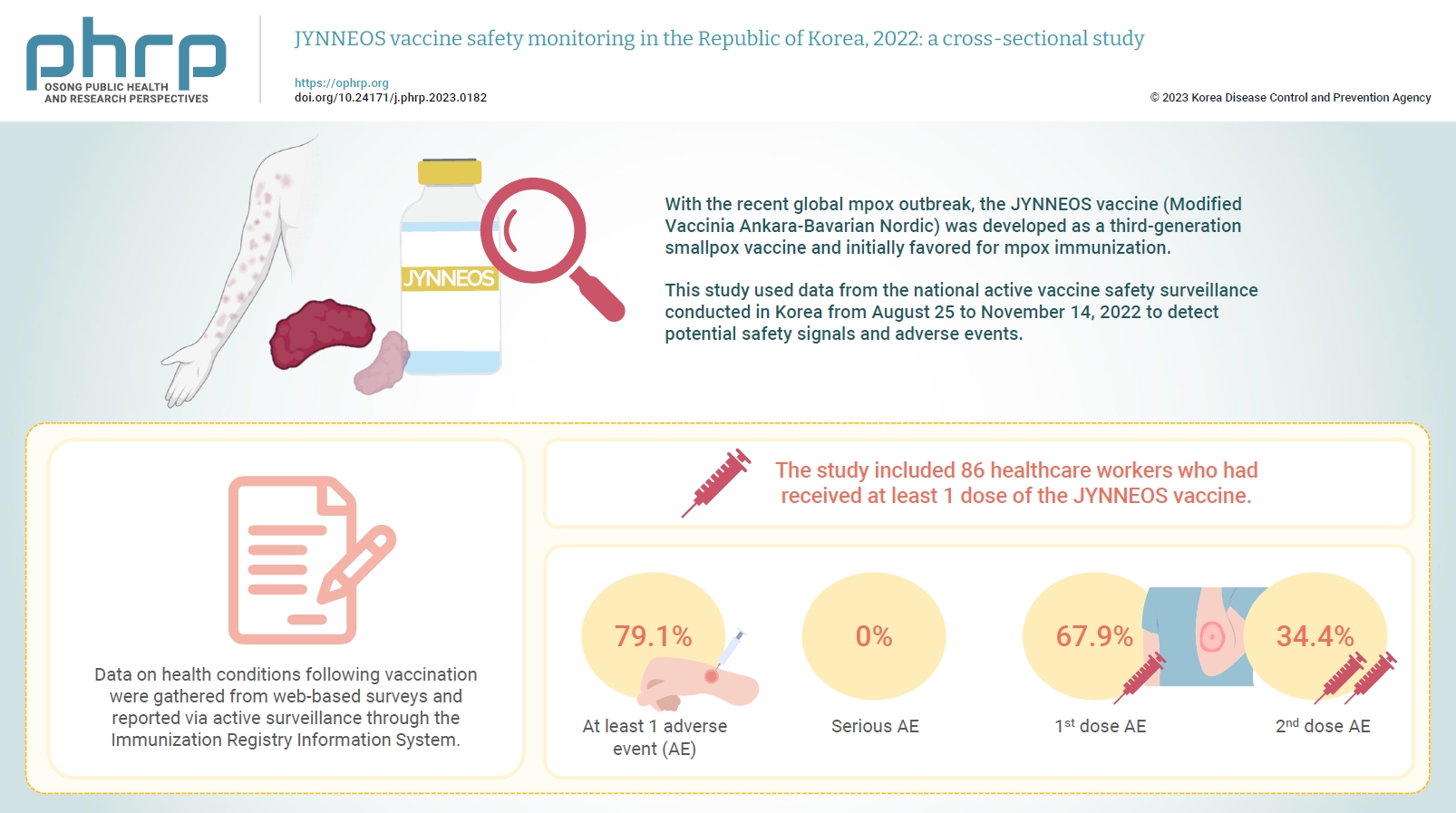
With the recent global mpox outbreak, the JYNNEOS vaccine (Modified Vaccinia Ankara-Bavarian Nordic) was developed as a third-generation smallpox vaccine and initially favored for mpox immunization. Vaccine-associated side effects contribute to vaccine hesitancy. Consequently, tracking adverse events post-immunization is crucial for safety management. This study used data from the national active vaccine safety surveillance conducted in Korea from August 25 to November 24, 2022 to detect potential safety signals and adverse events. Methods: Data on health conditions following vaccination were gathered from web-based surveys and reported via active surveillance through the Immunization Registry Information System. This follow-up system functioned via a text message link, surveying adverse events and health conditions beginning on the second day post-vaccination. Information about specific adverse events, including both local and systemic reactions, was collected. Results: The study included 86 healthcare workers who had received at least 1 dose of the JYNNEOS vaccine. Among the respondents, 79.1% reported experiencing at least 1 adverse event, with the majority being local reactions at the injection site. The incidence of adverse events was higher following the first dose (67.9%) than after the second dose (34.4%). The most frequently reported adverse event for both doses was mild pain at the injection site. Conclusion: The study provides crucial information on the safety of the JYNNEOS vaccine, demonstrating that most adverse events were manageable and predominantly localized to the injection site. Nonetheless, additional research is needed on the safety of various vaccine administration techniques and the vaccine’s effects on broader demographics. Citations
Citations to this article as recorded by

Objectives
Melioidosis is a potentially fatal infectious disease caused by the environmental anaerobic Gram-negative bacillus <i>Burkholderia pseudomallei</i>. Melioidosis is endemic to areas of northern Australia and Southeast Asia. With increasing international travel and migration, imported cases of melioidosis are being reported regularly. Here, we summarize the 11 cases of melioidosis reported in South Korea from 2003 to 2014. Methods Tracing epidemiological investigations were performed on every patient reported to the National Surveillance System since 2011. A systematic literature search was performed to identify melioidosis cases that occurred prior to 2011. Results The overall fatality rate was 36.4%. All the patients had visited Southeast Asia where melioidosis is endemic. The stay in the endemic region ranged from 4 days to 20 years. Of the seven patients who developed initial symptoms after returning to South Korea, the time interval between returning to South Korea and symptom onset ranged from 1 day to 3 years. The remaining four patients developed symptoms during their stay in the endemic region and were diagnosed with melioidosis in South Korea. Seven (63.6%) patients possessed at least one risk factor, all of whom were diabetic. Pneumonia was the most frequent clinical manifestation, but the patients showed a wide spectrum of clinical features, including internal organ abscesses, a mycotic aneurysm of the aorta, and coinfection with tuberculosis. Conclusion An early diagnosis and initiation of the appropriate antibiotics can reduce the mortality of melioidosis. Consequently, increased awareness of the risk factors and clinical features of melioidosis is required. Citations
Citations to this article as recorded by
Objectives
This study aimed to check the status of the contact investigation in congregate settings to eradicate tuberculosis (TB) in the Republic of Korea. Methods The “Integrated System for Disease and Public Health Management” is used for care and follow-up for patients and contacts of TB. We downloaded data for contact investigations conducted from January to December 2013. Results A total of 1,200 contact investigations in congregate settings were carried out by 25 field investigators in 2013. We performed the status of contact investigation, TB, and LTBI rate by age, accept rate of LTBI treatment, and complete rate of LTBI treatment during 2013. A total of 1,547 index TB patients, 149,166 contacts, and 259 additional TB patients were found through the investigation. Kindergartens showed the highest LTBI rate, 19.8%, among educational facilities. The second highest was in elementary schools and the subtotal LTBI rate of educational facilities was 7.8%. Social welfare/correctional facilities and workplaces showed relatively high LTBI rates of 23.8% and 23.6%, respectively. By age, individuals >35 years showed the highest LTBI rate, followed by those aged 0–4 years, 30–34 years, and 5–9 years, with rates of 18.1%, 16.4%, and 15.4% respectively. When comparing the tuberculin skin test (TST) positive conversion ratio by facility, middle school and high school were relatively high compared to the others. The accept rate of LTBI treatment in the workplace was lowest at 63% and the complete rate in elementary schools was lowest at 76.5%. Conclusion TB contact investigation is considered as a meaningful strategy for preventing TB outbreaks in congregate settings and decreasing the prevalence of TB in young people. Results of this study could be used to establish the LTBI management policy. Citations
Citations to this article as recorded by
Objectives
Food- and water-borne disease outbreaks (FBDOs) are an important public health problem worldwide. This study investigated the trends in FBDOs in Korea and established emerging causal pathogens and causal vehicles. Methods We analyzed FBDOs in Korea by year, location, causal pathogens, and causal vehicles from 2007 to 2012. Information was collected from the FBDOs database in the Korean Centers for Disease Control and Prevention. Results During 2007–2012, a total of 1794 FBDOs and 48,897 patients were reported. After 2007, FBDOs and patient numbers steadily decreased over the next 2 years and then plateaued until 2011. However, in 2012, FBDOs increased slightly accompanied by a large increase in the number of affected patients. Our results highlight the emergence of norovirus and pathogenic <i>Escherichia coli</i> other than enterohemorrhagic <i>E. coli</i> (EHEC) in schools in 2012. We found that pickled vegetables is an emerging causal vehicle responsible for this problem. Conclusion On the basis of this study we recommend intensified inspections of pickled vegetable manufacturers and the strengthening of laboratory surveillance of relevant pathogens. Citations
Citations to this article as recorded by
Korea has adopted Epidemic Intelligence Service (EIS) officers through the Field Epidemiology Training Program (FETP) since 1999 for systematic control of emerging and re-emerging infectious diseases. Graduates of medical schools in Korea are selected and serve as public health doctors (PHDs) for their mandatory military service. The duration of service is 3 years and PHDs comprise general practitioners and specialists. Some PHDs are selected as EIS officers with 3 weeks basic FETP training and work for central and provincial public health authorities to conduct epidemiological investigations. The total number of EIS officers is 31 as of 2012. The Korea Centers for Disease Control and Prevention (KCDC) has 12 specialists, whereas specialists and each province has one or two EIS officers to administer local epidemiological investigations in 253 public health centers. The Korean EIS officers have successfully responded and prevented infectious diseases, but there is a unique limitation: the number of PHDs in Korea is decreasing and PHDs are not allowed to stay outside Korea, which makes it difficult to cope with overseas infectious diseases. Furthermore, after 3 years service, they quit and their experiences are not accumulated. KCDC has hired full-time EIS officers since 2012 to overcome this limitation.
Citations
Citations to this article as recorded by
|
|


