

| Eun Jung Jang | 3 Articles |
Objectives
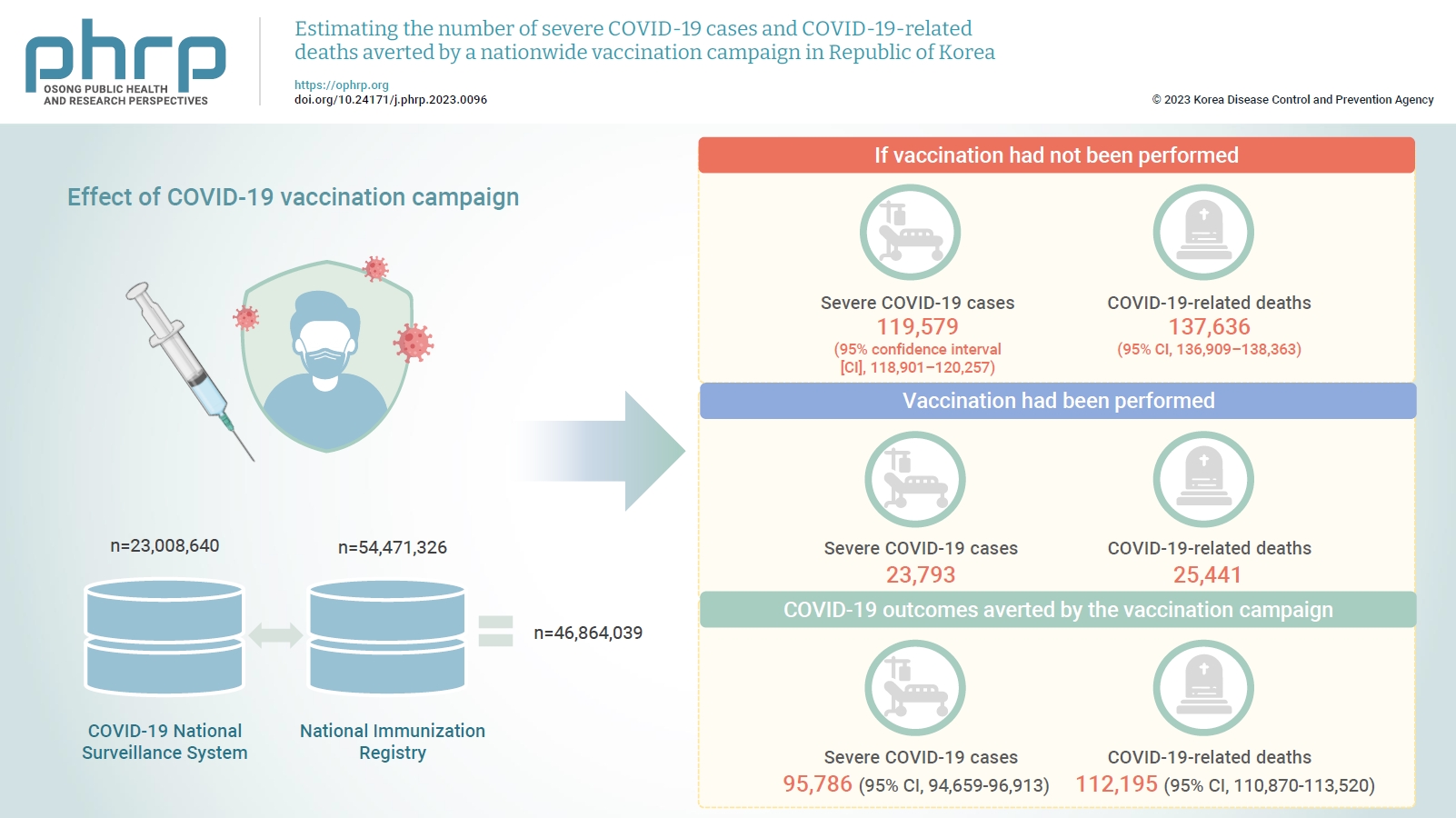
The Korea Disease Control and Prevention Agency promotes vaccination by regularly providing information on its benefits for reducing the severity of coronavirus disease 2019 (COVID-19). This study aimed to analyze the number of averted severe COVID-19 cases and COVID-19-related deaths by age group and quantify the impact of Republic of Korea’s nationwide vaccination campaign. Methods We analyzed an integrated database from the beginning of the vaccination campaign on February 26, 2021 to October 15, 2022. We estimated the cumulative number of severe cases and COVID-19-related deaths over time by comparing observed and estimated cases among unvaccinated and vaccinated groups using statistical modeling. We compared daily age-adjusted rates of severe cases and deaths in the unvaccinated group to those in the vaccinated group and calculated the susceptible population and proportion of vaccinated people by age. Results There were 23,793 severe cases and 25,441 deaths related to COVID-19. We estimated that 119,579 (95% confidence interval [CI], 118,901–120,257) severe COVID-19 cases and 137,636 (95% CI, 136,909–138,363) COVID-19-related deaths would have occurred if vaccination had not been performed. Therefore, 95,786 (95% CI, 94,659–96,913) severe cases and 112,195 (95% CI, 110,870–113,520) deaths were prevented as a result of the vaccination campaign. Conclusion We found that, if the nationwide COVID-19 vaccination campaign had not been implemented, the number of severe cases and deaths would have been at least 4 times higher. These findings suggest that Republic of Korea’s nationwide vaccination campaign reduced the number of severe cases and COVID-19 deaths. Citations
Citations to this article as recorded by

Objectives
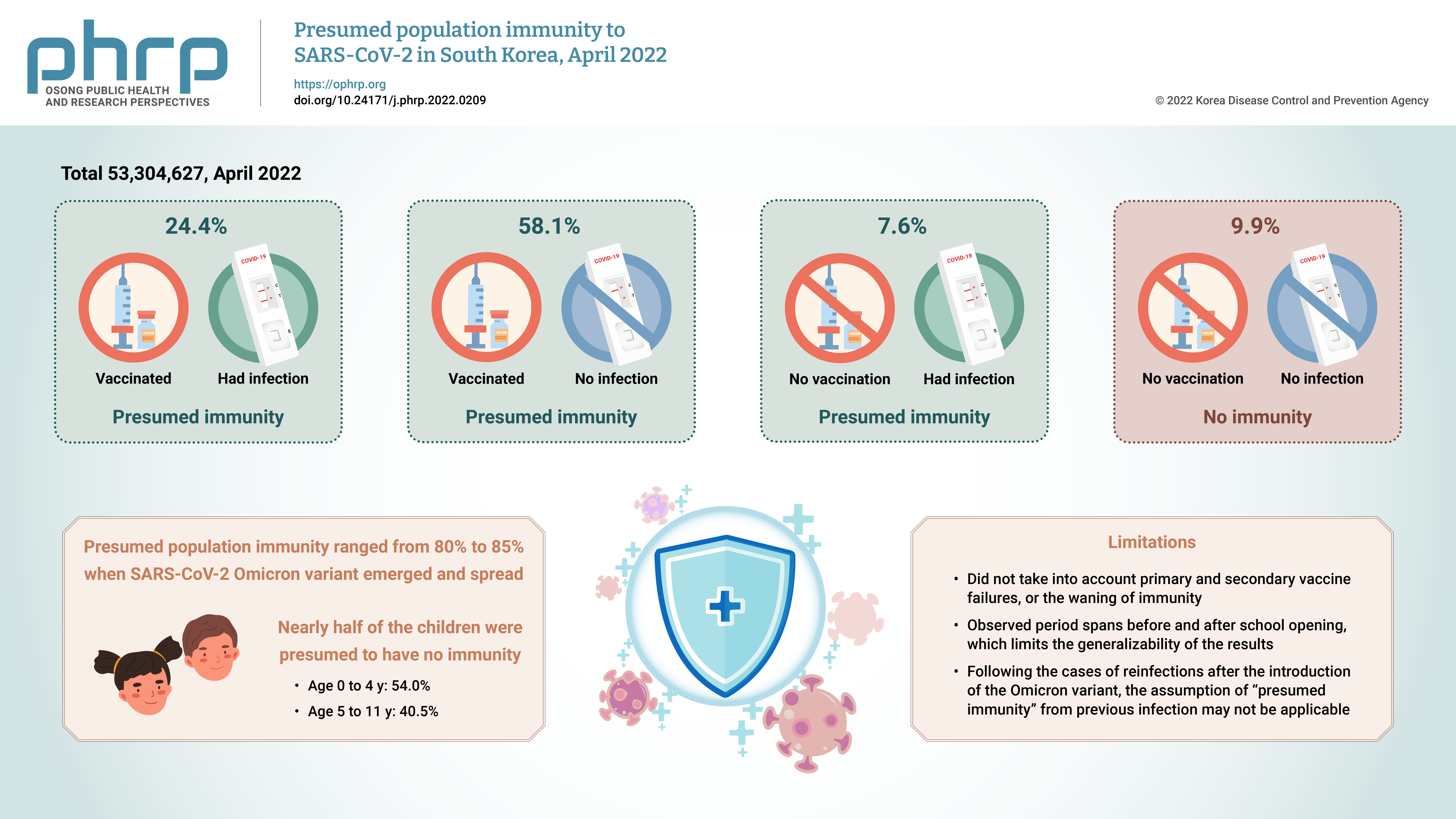
We estimated the overall and age-specific percentages of the Korean population with presumed immunity against severe acute respiratory syndrome coronavirus 2 (SARSCoV-2) as of April 2022 using the national registry. Methods We used the national coronavirus disease 2019 (COVID-19) infection and vaccination registry from South Korea, as described to define individuals with a previous history of COVID-19 infection, vaccination, or both, as persons with presumed immunity. Results Of a total of 53,304,627 observed persons, 24.4% had vaccination and infection, 58.1% had vaccination and no infection, 7.6% had infection and no vaccination, and 9.9% had no immunity. The SARS-CoV-2 Omicron variant emerged at a time when the presumed population immunity ranged from 80% to 85%; however, nearly half of the children were presumed to have no immunity. Conclusion We report a gap in population immunity, with lower presumed protection in children than in adults. The approach presented in this work can provide valuable informed tools to assist vaccine policy-making at a national level. Citations
Citations to this article as recorded by
Objectives
Recent genetic association studies have provided convincing evidence that several novel loci and single nucleotide polymorphisms (SNPs) are associated with the risk of developing type 2 diabetes mellitus (T2DM). The aims of this study were: 1) to develop a predictive model of T2DM using genetic and clinical data; and 2) to compare misclassification rates of different models. Methods We selected 212 individuals with newly diagnosed T2DM and 472 controls aged in their 60s from the Korean Genome and Epidemiology Study. A total of 499 known SNPs from 87 T2DM-related genes were genotyped using germline DNA. SNPs were analyzed for significant association with T2DM using various classification algorithms including Quest (Quick, Unbiased, Efficient, Statistical tree), Support Vector Machine, C4.5, logistic regression, and K-nearest neighbor. Results We tested these models using the complete Korean Genome and Epidemiology Study cohort (<i>n</i> = 10,038) and computed the T2DM misclassification rates for each model. Average misclassification rates ranged at 28.2–52.7%. The misclassification rates for the logistic and machine-learning algorithms were lower than the statistical tree algorithms. Using 1-to-1 matched data, the misclassification rate of the statistical tree QUEST algorithm using body mass index and SNP variables was the lowest, but overall the logistic regression performed best. Conclusions The K-nearest neighbor method exhibited more robust results than other algorithms. For clinical and genetic data, our “multistage adjustment” model outperformed other models in yielding lower rates of misclassification. To improve the performance of these models, further studies using warranted, strategies to estimate better classifiers for the quantification of SNPs need to be developed. Citations
Citations to this article as recorded by
|
|


