Artificial intelligence (AI) is rapidly reshaping general surgery. The central challenge is no longer whether AI can generate clinically useful outputs, but how those outputs can be implemented safely, responsibly, and transparently. Safe adoption requires more than technical performance; it requires robust clinical governance, multidisciplinary oversight, and continuous evaluation throughout the implementation life cycle. This Perspective proposes a risk-based paradigm for responsible AI adoption in general surgery, emphasizing structured problem definition, context-dependent risk classification, local validation, collaborative clinician–AI decision-making, and ongoing post-deployment surveillance while preserving patient safety, professional accountability, clinician judgment, and public trust [
1–
16].
AI is entering surgical care through imaging triage, risk prediction, documentation support, patient communication, education, and emerging decision-support tools. For general surgery, the central question is no longer whether AI can produce useful outputs, but how hospitals should introduce it without weakening clinical judgment, accountability, equity, or patient safety. This Perspective argues that AI adoption in general surgery should be managed as a public health and clinical-governance process, not simply as a technology purchase [
1,
8,
17,
18].
Surgical context matters because general surgery involves emergency decision-making, complex perioperative pathways, cancer care, postoperative surveillance, and multidisciplinary coordination. AI may influence acute abdomen triage, prioritization of computed tomography in suspected bowel ischemia or perforation, postoperative detection of sepsis or anastomotic leak, discharge planning after major abdominal procedures, and surgical oncology pathways in which imaging, staging, tumor biology, frailty, and operative risk must be considered together. These examples illustrate why governance must be built into surgical workflows rather than applied as a generic digital-health checklist [
12,
13,
17].
Reporting and evaluation standards, including FUTURE-AI, DECIDE-AI, CONSORT-AI, and SPIRIT-AI, emphasize transparency, human factors, monitoring, and clear descriptions of how AI systems are used in clinical pathways [
1–
4]. For surgical services, these principles should be translated into departmental pathways because emergency presentations, incomplete information, evolving physiology, and time pressure can magnify errors.
First, the surgical problem should be defined before any tool is piloted. Departments should specify the workflow gap, target user, decision point, expected output, and intended clinical action. An AI alert for high-risk abdominal pain, for example, is not useful unless the team knows who receives the alert, how quickly senior surgical review occurs, and how disagreement with the algorithm is documented. AI should be adopted only when it addresses a defined clinical or organizational gap better than simpler alternatives, such as staffing, pathway redesign, standard operating procedures, training, or improved communication [
6,
14].
Second, AI use cases should be classified by clinical risk. Low-risk uses may include grammar editing, scheduling support, or draft patient education materials that clinicians check before use. Moderate-risk uses include structured discharge prompts, postoperative deterioration alerts, and risk calculators when they trigger review without independently changing care. High-risk uses include diagnostic triage, operative decision support, radiology prioritization in emergency surgery, and recommendations that may affect intensive care unit transfer, timing of reoperation, or emergency surgery. Risk depends not only on the AI system but also on the clinical setting, degree of autonomy, time sensitivity, and consequences of error. Representative risk levels and minimum safeguards are summarized in
Table 1 [
1,
2,
8,
9].
Third, local validation is essential. Performance reported in published studies or vendor materials does not guarantee safe performance in a specific hospital. Technical validation should examine accuracy, calibration, false-negative events, false-positive burden, and subgroup performance. For generative AI, clinical validation should determine whether model outputs align with surgical decision points and improve recognition, escalation, or documentation without creating unsafe delays. Implementation evaluation should assess workflow fit, usability, user trust, alert fatigue, override behavior, and escalation pathways. Local evaluation may include retrospective testing on local datasets, silent-mode prospective evaluation, simulation with representative cases, or supervised pilot deployment [
2,
5–
7].
Fourth, deployment should preserve human accountability, and oversight should be substantive rather than symbolic. AI output should be presented as collaborative intelligence: a structured partnership in which computational analysis supports, but does not replace, surgical expertise, ethical judgment, and contextual reasoning [
10]. Interfaces should display relevant input data, output time, limitations, and uncertainty where available. Clinicians must be able to override AI suggestions without an excessive documentation burden. Because automation bias and overreliance may occur under time pressure or institutional expectations, outputs should not be displayed as definitive recommendations when uncertainty is substantial [
5,
7,
10].
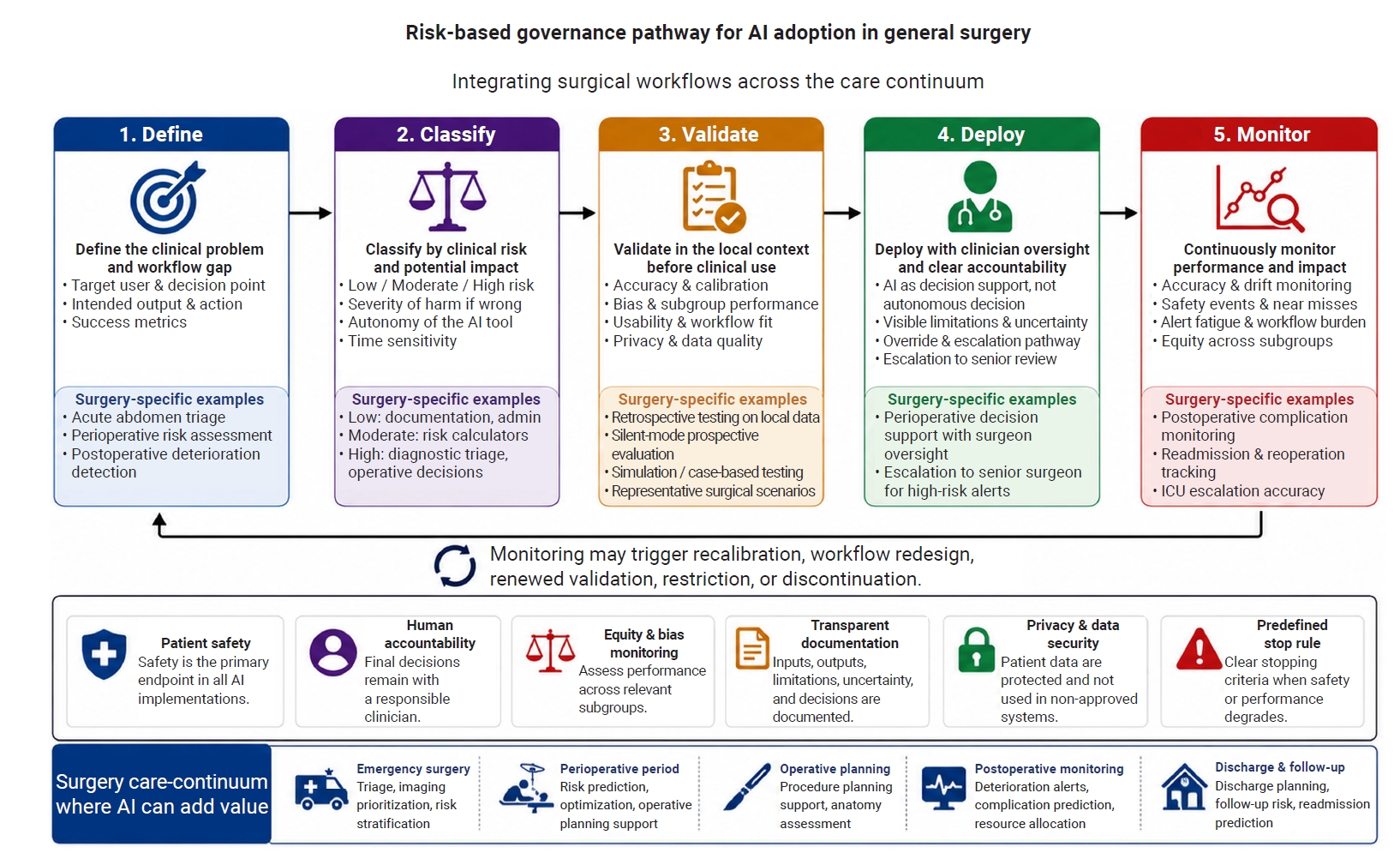
Fifth, monitoring should continue after implementation. AI performance can drift when patient populations, coding practices, imaging protocols, staffing patterns, or clinical pathways change. Departments should audit accuracy, false-negative events, alert overrides, delays in care, documentation burden, user feedback, subgroup performance, and adverse events. Audit intervals should be proportionate to risk; high-risk tools may require early review after pilot deployment and regular governance review thereafter. Governance committees should have the authority to recalibrate, restrict, pause, or retire tools when safety expectations are not met (
Figure 1). A departmental deployment checklist is provided in
Table 2 [
1,
6,
7,
11].
Generative AI warrants separate caution. Large language models may help draft discharge instructions, operative notes, clinic letters, and educational outlines under clinician supervision. These administrative or documentation-related uses carry a different risk profile from patient-facing advice, consent counseling, triage, treatment selection, or operative planning. Acceptable assisted drafting should require clinician verification, source checking when evidence is summarized, and exclusion of patient identifiers not approved for use. Unsafe substitution includes independent diagnosis, unsupervised consent counseling, therapeutic recommendations, or generation of operative plans without surgeon verification [
19,
20].
Surgical oncology illustrates the need for transparent expert deliberation. AI may help synthesize imaging, pathology, biomarkers, staging, frailty, operative risk, and guideline options for multidisciplinary tumor boards. However, oncologic decisions often require clinicians to balance competing goals, such as resectability, neoadjuvant therapy, organ preservation, patient preference, and perioperative risk. AI should therefore support multidisciplinary discussion rather than replace the tumor board or obscure the reasoning behind recommendations [
12,
13].
Equity should be treated as a safety outcome. Surgical datasets may encode differences in referral pathways, imaging access, language, socioeconomic status, and documentation quality. If these patterns are not examined, AI may reproduce or amplify disparities. Smaller hospitals may have insufficient sample sizes for reliable subgroup analysis; regional or multicenter collaboration may therefore be necessary for shared validation, benchmarking, and safety surveillance [
8,
11,
18].
Institutional readiness is also necessary for safe implementation. Even technically accurate systems may fail if they disrupt workflow, increase documentation burden, reduce clinician trust, or generate recommendations that are difficult to interpret during time-sensitive care. Surgical departments should therefore evaluate not only technical performance but also usability, staff training requirements, interoperability with existing electronic systems, escalation pathways, and clinician confidence in day-to-day practice [
7,
9,
13–
16].
Institutional preparedness should extend beyond individual departments. AI procurement and health technology assessment should consider cost, reimbursement, interoperability, maintenance, cybersecurity, training, medicolegal responsibility, vendor update cycles, and measurable value for patients and health systems. Digital and robotic technologies in surgery require evaluation models that look beyond acquisition cost and assess clinical value, workflow impact, safety, and sustainability [
11]. Regulatory and legal considerations should be addressed before deployment, including privacy compliance, auditability, liability for AI-influenced decisions, documentation standards, and procedures for reporting safety events [
8,
11].
Finally, public trust should be treated as part of safe AI adoption. Surgical patients should understand how AI influences clinical pathways, particularly prioritization, discharge planning, and operative decision support. Maintaining confidence in clinical care requires transparent communication, identifiable clinician responsibility, and governance structures that reinforce AI as assistive decision support rather than a replacement for professional judgment. Safe implementation therefore depends not only on algorithmic performance but also on accountability, institutional oversight, and preservation of trust in the clinician–patient relationship [
5,
6,
10,
14–
16].
This Perspective does not claim that a specific AI product improves surgical outcomes. Instead, it proposes that general surgery departments adopt a staged pathway: establish a local AI governance group, classify current and planned AI use cases, define prohibited uses, create a validation pathway, deploy AI as collaborative decision support, and monitor performance with predefined stopping rules. Such a pathway may help surgical teams use AI-based innovation while preserving professional judgment, measurable value, and public trust [
1,
6,
10,
14].
HIGHLIGHTS
Artificial intelligence (AI) adoption in general surgery requires risk-based clinical governance. Local validation and continuous monitoring are essential before and after deployment. AI should support, not replace, surgical judgment and identifiable clinician accountability. Patient safety, equity, transparency, privacy, and public trust should guide implementation.
Article information
Ethics Approval
Not applicable.
Conflicts of Interest
The author has no conflicts of interest to declare.
Availability of Data
All data generated and analyzed during this study are included in this published article. Additional data may be requested from the corresponding author.
Figure 1.Risk-based governance pathway for artificial intelligence (AI) adoption in general surgery. The figure summarizes a staged pathway for surgical problem definition, clinical-risk classification, local validation, supervised deployment as collaborative intelligence, and continuous monitoring. Surgery-specific examples include emergency general surgery, perioperative risk, operative planning, postoperative monitoring, and escalation to senior surgical review. Cross-cutting safeguards include patient safety, human accountability, privacy and cybersecurity, equity and bias monitoring, transparent documentation, regulatory and legal review, health technology assessment, and predefined stopping rules. The figure was created by the author using Python 3.11, Matplotlib, and Pillow. ICU, intensive care unit.
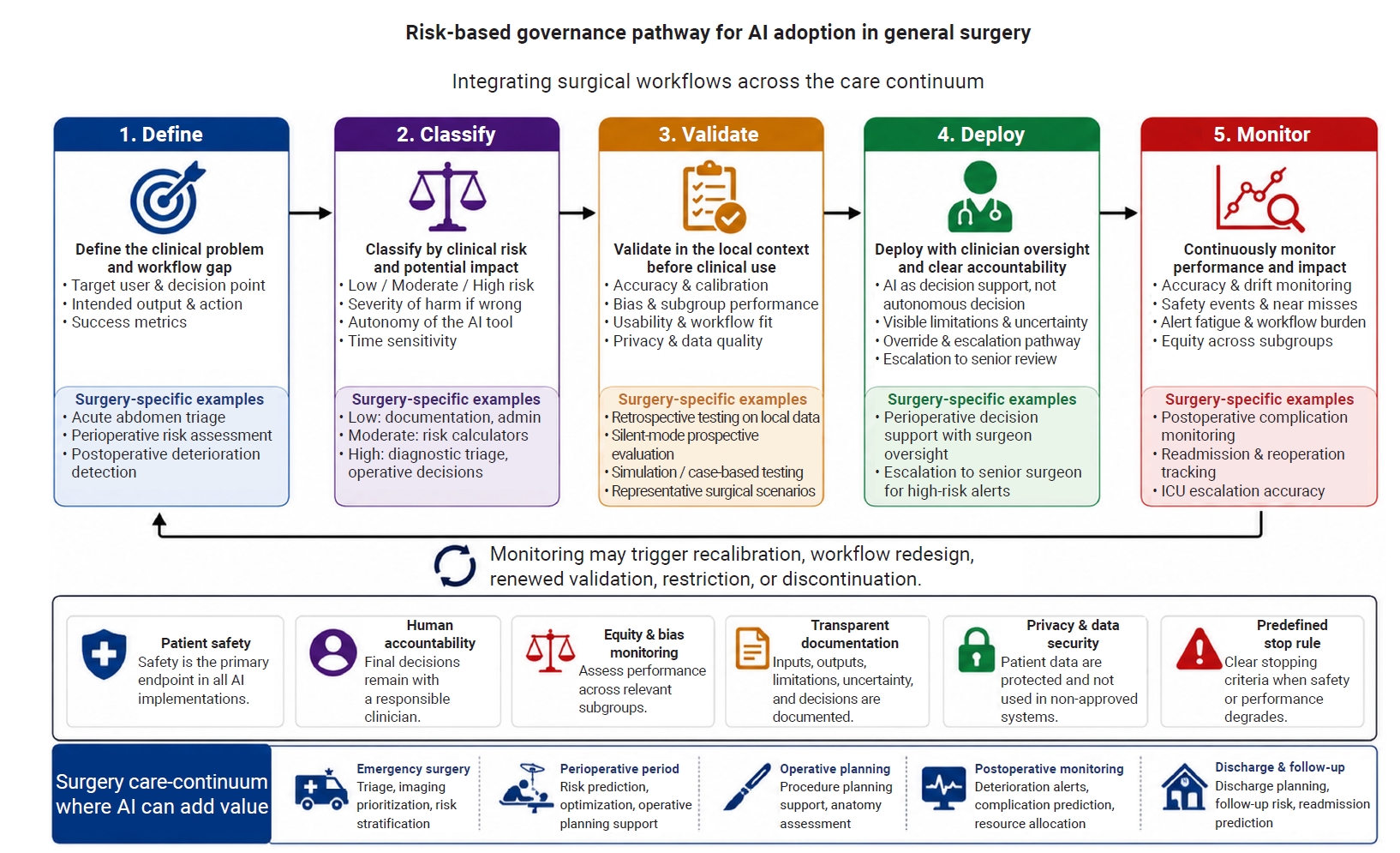
Table 1.Risk-based safeguards for artificial intelligence use in general surgery
Table 1.
| Risk level |
Representative surgical uses |
Context factors/risk determinants |
Minimum safeguards |
Primary safety concern |
| Low |
Grammar editing; scheduling support; draft education materials |
Output is verified by a clinician before use and does not directly influence diagnosis, operative planning, escalation, or discharge decisions. |
Clinician review; privacy-approved system; no autonomous clinical action |
Unverified or misleading text |
| Moderate |
Risk calculators; discharge prompts; postoperative deterioration alerts used as review prompts |
May become higher risk if output changes escalation, ICU transfer, reoperation timing, or discharge without review. Supports clinical decisions but does not determine action when independently reviewed; consequences of error are limited and time pressure is lower than in emergency triage. |
Local validation; visible limitations; override pathway; periodic audit |
False reassurance or alert fatigue |
| High |
Emergency diagnostic triage; operative decision support; emergency radiology prioritization; treatment-sequencing suggestions |
Time-sensitive care, high autonomy, or institutional pressure to follow output; serious consequences of false-negative or delayed action; direct effect on operative planning, senior review, escalation, or patient outcomes. |
Multidisciplinary governance; prospective or silent-mode validation; escalation pathway; predefined stop rule |
Delayed or unsafe clinical decisions |
Table 2.Departmental checklist before AI deployment in general surgery
Table 2.
| Checkpoint |
Minimum requirement |
| Clinical problem |
A specific surgical workflow gap, target user, decision point, and intended action are defined. |
| Risk level |
The use case is classified by clinical setting, autonomy, time sensitivity, and consequences of error. |
| Local validation |
Retrospective testing on local datasets should be followed, where feasible, by silent-mode prospective evaluation, representative-case simulation, or supervised pilot implementation before routine use. |
| Clinical evaluation |
Accuracy, calibration, discrimination, reliability, false-negative risk, false-positive burden, and subgroup performance are assessed using predefined metrics. |
| Implementation evaluation |
Workflow integration, usability, clinician trust, alert fatigue, escalation behavior, documentation burden, and user acceptance are evaluated before wider deployment. |
| Human–AI collaboration/human accountability |
Clinicians can inspect inputs, uncertainty, and limitations; override outputs without excessive burden; and remain identifiable as final decision-makers. Interfaces should make uncertainty visible and allow meaningful override rather than symbolic supervision. |
| Generative AI boundaries/transparency |
Approved drafting uses and prohibited uses, such as unsupervised consent counseling or operative planning, are defined. Relevant inputs, outputs, uncertainty, limitations, version information, and the date/time of output generation are visible whenever possible. |
| Privacy and legal review |
Patient data handling, cybersecurity, auditability, liability, documentation, and vendor updates are reviewed. Identifiable patient data are processed only within institutionally approved systems that meet privacy, cybersecurity, and data-governance requirements. |
| Equity monitoring |
Subgroup performance is assessed locally where feasible or through regional/multicenter collaboration. Performance is reviewed across clinically relevant subgroups where feasible. Smaller hospitals should consider regional or multicenter collaboration for benchmarking and safety surveillance. |
| Post-deployment audit |
False-negative events, alert overrides, delays in care, adverse events, workflow impact, documentation burden, user feedback, and subgroup performance are reviewed at predefined, risk-based intervals. |
| Stop rule |
The department can pause, restrict, recalibrate, or retire the tool if safety expectations are not met. |
References
- 1. Lekadir K, Frangi AF, Porras AR, et al. FUTURE-AI: international consensus guideline for trustworthy and deployable artificial intelligence in healthcare. BMJ 2025;388:e081554.
- 2. Vasey B, Nagendran M, Campbell B, et al. Reporting guideline for the early-stage clinical evaluation of decision support systems driven by artificial intelligence: DECIDE-AI. Nat Med 2022;28:924−33.
- 3. Liu X, Cruz Rivera S, Moher D, et al. Reporting guidelines for clinical trial reports for interventions involving artificial intelligence: the CONSORT-AI extension. Nat Med 2020;26:1364−74.
- 4. Cruz Rivera S, Liu X, Chan AW, et al. Guidelines for clinical trial protocols for interventions involving artificial intelligence: the SPIRIT-AI extension. Nat Med 2020;26:1351−63.
- 5. Nagendran M, Chen Y, Lovejoy CA, et al. Artificial intelligence versus clinicians: systematic review of design, reporting standards, and claims of deep learning studies. BMJ 2020;368:m689.
- 6. Kelly CJ, Karthikesalingam A, Suleyman M, et al. Key challenges for delivering clinical impact with artificial intelligence. BMC Med 2019;17:195.
- 7. Sutton RT, Pincock D, Baumgart DC, et al. An overview of clinical decision support systems: benefits, risks, and strategies for success. NPJ Digit Med 2020;3:17.
- 8. Wang Y, Li N, Chen L, et al. Guidelines, consensus statements, and standards for the use of artificial intelligence in medicine: systematic review. J Med Internet Res 2023;25:e46089.
- 9. Kermansaravi M, Chiappetta S, Shahabi Shahmiri S, et al. International expert consensus on the current status and future prospects of artificial intelligence in metabolic and bariatric surgery. Sci Rep 2025;15:9312.
- 10. Kermansaravi M, Kermansaravi A, Kroh M, et al. Collaborative intelligence in metabolic and bariatric surgery: integrating human expertise and artificial intelligence for better outcomes. Obes Surg 2025;35:2787−9.
- 11. Marano L, Oviedo RJ, Nappo G, et al. Rethinking health technology assessment in robotic surgery: an EFISDS-TROGSS position paper. Official position paper of the European Federation-International Society for Digestive Surgery (EFISDS) and The Robotic Global Surgical Society (TROGSS). J Robotic Surg 2026;20:596.
- 12. Malerba S, Vladimirov M, Goyal A, et al. Artificial intelligence applications in gastric cancer surgery: bridging early diagnosis and responsible precision medicine. J Clin Med 2026;15:2208.
- 13. Nardone V, Marmorino F, Germani MM, et al. The role of artificial intelligence on tumor boards: perspectives from surgeons, medical oncologists and radiation oncologists. Curr Oncol 2024;31:4984−5007.
- 14. Rimoli E, Vashist Y, Marano L. The Swiss army knife illusion: preserving the human dimension in the age of AI. Curr Probl Surg 2026;78:102025.
- 15. World Health Organization (WHO) (CH). Ethics and governance of artificial intelligence for health: guidance on large multi-modal models [Internet]. WHO; 2025 [cited 2026 Aug 12]. Available from: https://www.who.int/publications/i/item/9789240084759.
- 16. Sendak MP, D'Arcy J, Kashyap S, et al. A path for translation of machine learning products into healthcare delivery. EMJ Innov 2020;10:1−14.
- 17. Morris MX, Fiocco D, Caneva T, et al. Current and future applications of artificial intelligence in surgery: implications for clinical practice and research. Front Surg 2024;11:1393898.
- 18. Rajpurkar P, Chen E, Banerjee O, et al. AI in health and medicine. Nat Med 2022;28:31−8.
- 19. Asgari E, Montana-Brown N, Dubois M, et al. A framework to assess clinical safety and hallucination rates of LLMs for medical text summarisation. NPJ Digit Med 2025;8:274.
- 20. Jung KH. Large language models in medicine: clinical applications, technical challenges, and ethical considerations. Healthc Inform Res 2025;31:114−24.