Introduction
Public health surveillance, early detection, rapid response, and prevention of disease spread are essential components of any outbreak investigation [
1]. Effective outbreak management in India’s heterogeneous population requires both technical expertise and strong community engagement [
2]. Strengthening outbreak detection and response remains a public health priority for India and the South-East Asia Region, and this effort requires the involvement of the country’s diverse health systems. Over the past decade, the Ministry of Ayush has implemented a dedicated public health strategy through national and research programs, strengthened regulatory and quality standards, and expanded primary and tertiary care. Extensive research on Ayush medicines during the coronavirus disease 2019 (COVID-19) pandemic, along with population-level assessments, has contributed to the evidence base for traditional medicine [
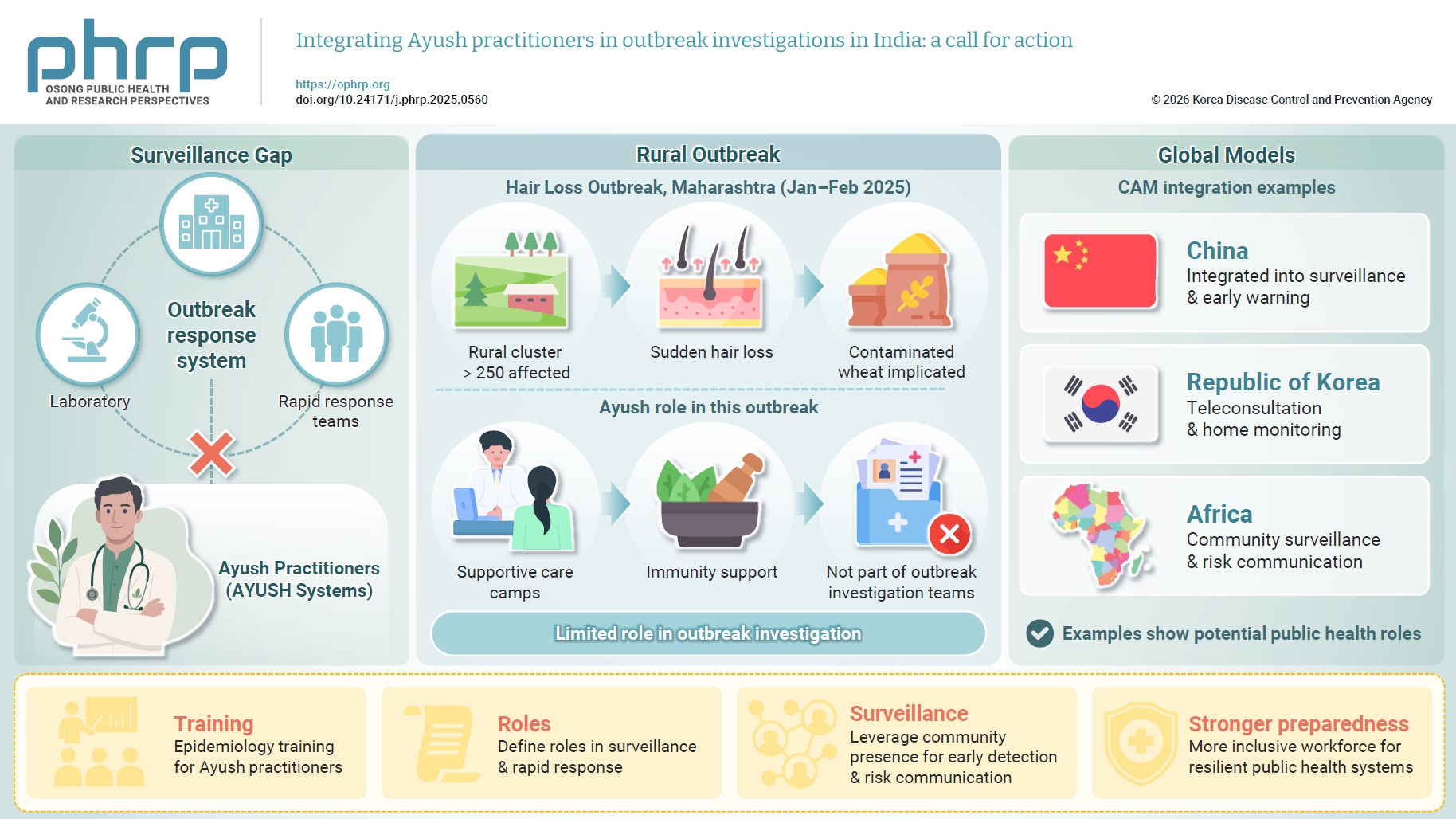
3]. During COVID-19, the Ministry of Ayush issued advisories and guidelines for each system of medicine, and Ayush practitioners participated in preventive care through the distribution of Kabasura Kudineer and Ayush-64 in communities. These preventive measures and immunity-enhancing advisories gained public trust and contributed to substantial behavioral change. However, Ayush practitioners were not formally included in outbreak investigation teams. This gap remained evident during the sudden hair-loss outbreak in rural Maharashtra. This manuscript aims to examine the potential for integrating Ayush practitioners into outbreak investigations, using a rural case study and international practices to support policy recommendations for India.
Case Example: Sudden Hair Loss in Rural Maharashtra
A cluster of sudden hair loss was first reported in Bondgaon village in Shegaon Tehsil, Buldhana District, Maharashtra, in early January 2025. By February, more than 250 people from nearby villages had reported similar complaints. Affected individuals described itching of the scalp followed by rapid hair shedding, often progressing to complete loss of scalp and beard hair within 3 days. No other symptoms were reported. Biopsy findings did not indicate fungal infection or seborrheic dermatitis, although treatment was initially administered for suspected fungal disease. Villagers consumed mixed diets that included wheat, bhajira, channa, brinjal, fish, and prawns, and they relied on water from wells, rivers, and local dams for drinking. Some water samples showed elevated nitrate levels and increased total dissolved solids. The clinical presentation and clustering pattern were atypical compared with previously reported cases of alopecia areata in northern India.
In northern India, alopecia areata reportedly affects adult men younger than 40 years more often than females; however, onset during childhood is reportedly higher among women and girls. The incidence of severe alopecia is higher in males and boys at younger ages [
4]. Severe alopecia is uncommon, and the most frequent forms of temporary hair loss include androgenetic alopecia, telogen effluvium, alopecia areata, and traction alopecia [
5,
6]. Acute telogen effluvium presents as sudden scalp hair loss occurring 2–3 months after a triggering event such as fever, surgery, starvation, or blood loss, with daily shedding ranging from fewer than 100 to more than 1,000 strands. It reduces hair density but does not cause complete baldness and usually resolves within several months [
6,
7].
No clear triggers were identified in this case. Therefore, it was considered an undiagnosed disease of unknown etiology. Many undiagnosed diseases occur in rural settings [
8]. Outbreaks in rural settings have received limited attention in the scientific literature. Public health authorities and epidemiologists face particular challenges when investigating undiagnosed diseases of unknown etiology, especially in rural areas [
9].
The Indian Council of Medical Research initiated an outbreak investigation and collected samples, including food, water, hair products, hair, and nails, to identify the possible cause. However, Dr Bawaskar, a renowned physician, collected water, soil, and food samples and conducted a study in Buldhana District. He found high levels of selenium in the wheat distributed through the Public Distribution System. The selenium content was estimated to be 600 times higher than the normal limit, and this was identified as the primary cause of baldness. Subsequently, the government withdrew the distributed wheat batch, and hair regrowth was observed among affected individuals [
10].
The Integrated Disease Surveillance Program of the National Centre for Disease Control, Directorate General of Health Services, Ministry of Health and Family Welfare, Government of India, has established a structured approach to outbreak detection and response, with designated officers at both the state and district levels responsible for monitoring and responding to potential threats [
2]. However, Ayush is not included within this outbreak management framework. During coronavirus disease 2019 (COVID-19), rather than being involved in disease surveillance or contact tracing, Ayush practitioners were used primarily for the clinical management of mild-to-moderate cases [
11]. There are multiple examples of Ayush systems being used for preventive care; for example, the Government of Tamil Nadu routinely distributes the Siddha medicine Nilavembu Kudineer during dengue and chikungunya outbreaks [
12]. Likewise, Ayush medical camps were conducted in Buldhana District to alleviate hair loss, boost immunity, and reduce severity. However, the outcomes of these camps have not been systematically documented. Ayush practitioners contributed to supportive care but were not engaged in epidemiological assessment.
Call for Action on Integrating Ayush Practitioners in Public Health
Several countries have involved complementary and alternative medicine (CAM) practitioners in outbreak investigations and public health emergencies. Traditional Chinese medicine practitioners were involved in COVID-19-related activities across hospital and community settings, working with allopathic teams in triage, surveillance, and patient management during both prevention and treatment phases [
13,
14]. In the Republic of Korea, Korean medicine practitioners participate in early triage, home-based monitoring, and teleconsultations through a dual system that places biomedicine and Korean medicine within the same public health framework [
15]. Several African countries, including Uganda and Ghana, have involved local healers in community-level surveillance and risk communication during outbreaks such as Ebola, consistent with the World Health Organization (WHO) Traditional Medicine Strategy [
16]. To address surveillance inequities, the WHO Workforce 2030 strategy promotes diverse workforce composition, including the integration of community-based and mid-level practitioners into interprofessional monitoring systems.
The lack of formal epidemiology training for Ayush practitioners, the absence of a clear policy framework, and weak transdisciplinary coordination are key barriers to the inclusion of Ayush in outbreak investigations and public health emergencies. Ayush practitioners possess foundational qualifications relevant to outbreak investigations, yet they remain underutilized. Ayush graduate programs in India include basic training in public health, epidemiology, and community medicine. Ayush systems were involved during chikungunya, dengue, and COVID-19 outbreaks. Ayush practitioners were also deployed for health promotion and immunity-boosting interventions under the National Ayush Mission.
Targeted training programs could prepare Ayush professionals for defined outbreak-response roles such as contact tracing, syndromic surveillance, and risk communication. Establishing a dedicated Ayush track within India’s Field Epidemiology Training Program and including Ayush practitioners in mock drills, rapid response exercises, and district-level teams could strengthen their readiness for field deployment. Training in the use of Integrated Disease Surveillance Programme reporting tools, together with the assignment of defined roles within rapid response teams, would create a structured pathway for their involvement in public health emergencies.
India has over 770,000 registered Ayush practitioners, many of whom already work in rural and underserved areas. These practitioners represent an underused but potentially valuable public health resource in India. Integration of traditional, complementary, and alternative medicine in 3 Indian states has shown that interpersonal trust, cooperation, and mutual recognition can be developed between Ayush and biomedical systems [
17]. Lessons from global CAM integration suggest that the involvement of these practitioners in outbreak investigations is both feasible and potentially beneficial. With structured training, digital enablement, and policy inclusion, India could transform Ayush practitioners from peripheral care providers into frontline public health allies.