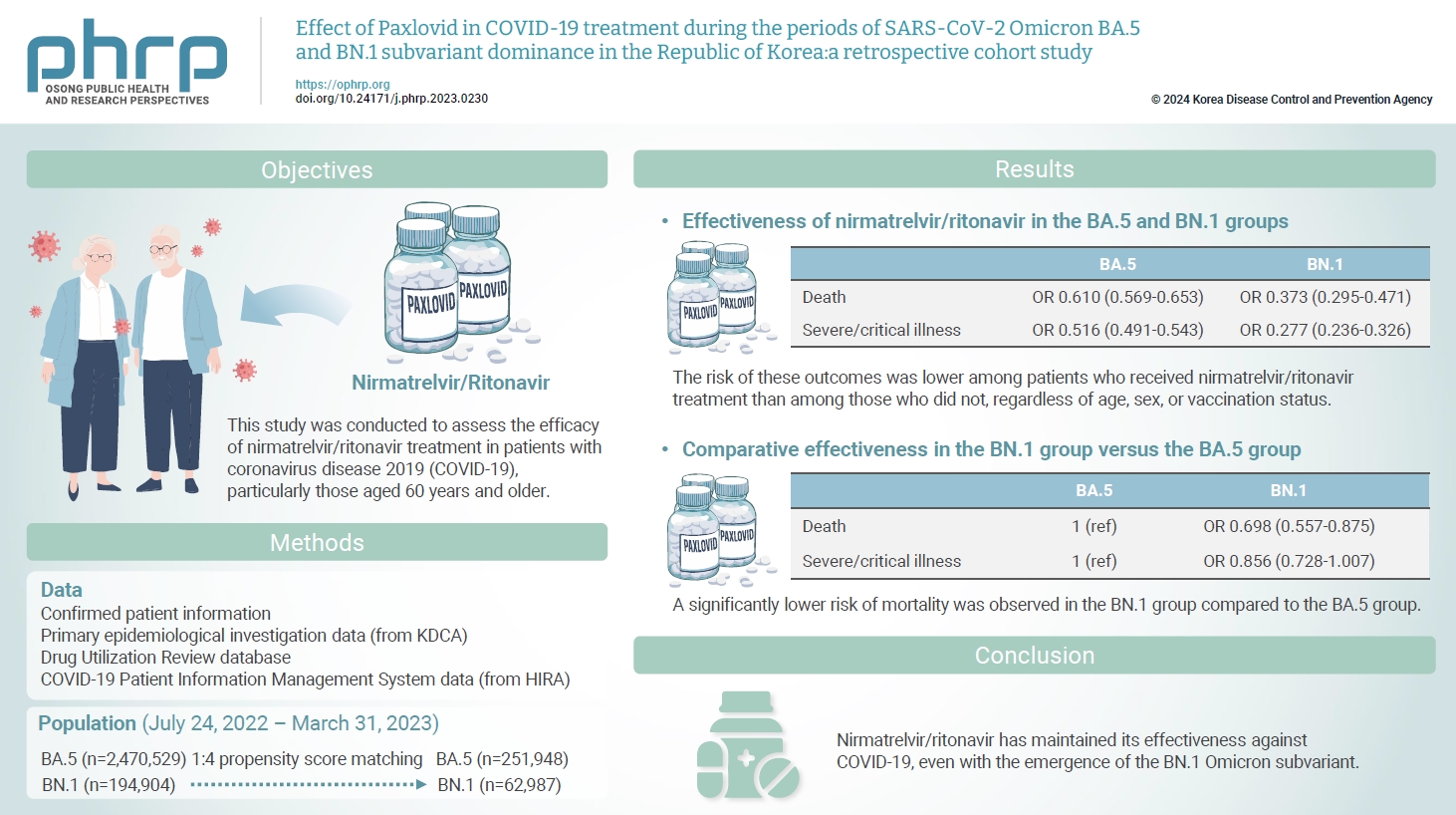
Objectives This study was conducted to assess the efficacy of nirmatrelvir/ritonavir treatment in patients with coronavirus disease 2019 (COVID-19), particularly those aged 60 years and older. Using real-world data, the period during which the BN.1 Omicron variant was dominant was compared to the period dominated by the BA.5 variant. Methods: In this retrospective cohort study, data were collected regarding 2,665,281 patients infected with severe acute respiratory syndrome coronavirus 2 between July 24, 2022, and March 31, 2023. Propensity score matching was utilized to match patients who received nirmatrelvir/ ritonavir in a 1:4 ratio between BN.1 and BA.5 variant groups. Multivariable logistic regression analysis was employed to assess the effects of nirmatrelvir/ritonavir within these groups. Results: Compared to the prior period, the efficacy of nirmatrelvir/ritonavir did not significantly differ during the interval of Omicron BN.1 variant dominance in the Republic of Korea. Among patients treated with nirmatrelvir/ritonavir, a significantly lower risk of mortality was observed in the BN.1 group (odds ratio [OR], 0.698; 95% confidence interval [CI], 0.557–0.875) compared to the BA.5 group. However, this treatment did not significantly reduce the risk of severe or critical illness, including death, for those in the BN.1 group (OR, 0.856; 95% CI, 0.728–1.007). Conclusion: Nirmatrelvir/ritonavir has maintained its effectiveness against COVID-19, even with the emergence of the BN.1 Omicron subvariant. Consequently, we strongly recommend the administration of nirmatrelvir/ritonavir to patients exhibiting COVID-19-related symptoms, irrespective of the dominant Omicron variant or their vaccination status, to mitigate disease severity and decrease the risk of mortality.
Citations
Citations to this article as recorded by
Effectiveness of Nirmatrelvir/Ritonavir for Outpatients in the Era of Omicron, Vaccination, and Previous Infection: A Meta-analysis Mark Ebell, Peter Kurotschka Journal of General Internal Medicine.2026; 41(12): 3516. CrossRef
Severity of COVID-19 Omicron Variants: A Global Systematic Review Deepa Malhotra, Rajeev M. Nepal, Irini Zografaki, Moe H. Kyaw, Pinelopi Nikolopoulou, Rodrigo Sini de Almeida, Santiago M. C. Lopez, Stephen Wiblin, Fraser Williams, Sophie Pope, Isabelle Whittle, Fiona Pearson, Daniel Curcio Infectious Diseases and Therapy.2026; 15(7): 1827. CrossRef
Nirmatrelvir/Ritonavir Efficacy in Immunocompetent Patients with Confirmed Omicron Variant of Severe Acute Respiratory Syndrome Coronavirus 2: An Updated Systematic Review and Meta-analysis Elnaz Khani, Hoda Afsharirad, Ali Taghizadeh Yadegari, Meysam Zarezadeh, Hila Asham, Hossein Bannazadeh-Baghi, Taher Entezari-Maleki Journal of Research in Pharmacy Practice.2026;[Epub] CrossRef



 First
 Prev


