Objectives This study aimed to investigate the relationship between blood microbiota, specifically bacterial DNA, and cognitive decline in individuals with subjective cognitive decline (SCD) and amnestic mild cognitive impairment (aMCI). The objective was to identify potential microbial signatures that could serve as biomarkers for cognitive deterioration. Methods: Forty-seven participants were recruited, including 13 with aMCI, 20 with SCD, and 14 normal cognition (NC). Blood samples were collected, and microbial DNA was analyzed using 16S rRNA sequencing on the Illumina MiSeq platform. Bioinformatics analyses—including α- and β-diversity measures and differential abundance testing (using edgeR)—were employed to assess microbial diversity and differences in bacterial composition among groups. Logistic regression models were used to evaluate the predictive impact of the microbiota on cognitive decline. Results: Microbial diversity differed significantly between groups, with NC exhibiting the highest α-diversity. Both the aMCI and SCD groups showed reduced diversity. Taxa such as Bacteroidia, Alphaproteobacteria, and Clostridia were significantly decreased in the aMCI group compared to NC (p< 0.05). In contrast, Gammaproteobacteria increased significantly in the aMCI group compared to both NC and SCD, indicating progressive microbial changes from SCD to aMCI. No significant differences were found between the NC and SCD groups. Conclusion: Distinct bacterial taxa—particularly the increase in Gammaproteobacteria along with decreases in Bacteroidia, Alphaproteobacteria, and Clostridia—are associated with the progression of cognitive decline. These findings suggest that blood microbiota could serve as potential biomarkers for the early detection of aMCI. However, the small sample size and the lack of control for confounding factors such as diet and medication limit the findings. Larger studies are needed to validate these results and further explore the role of microbiota in neurodegeneration.
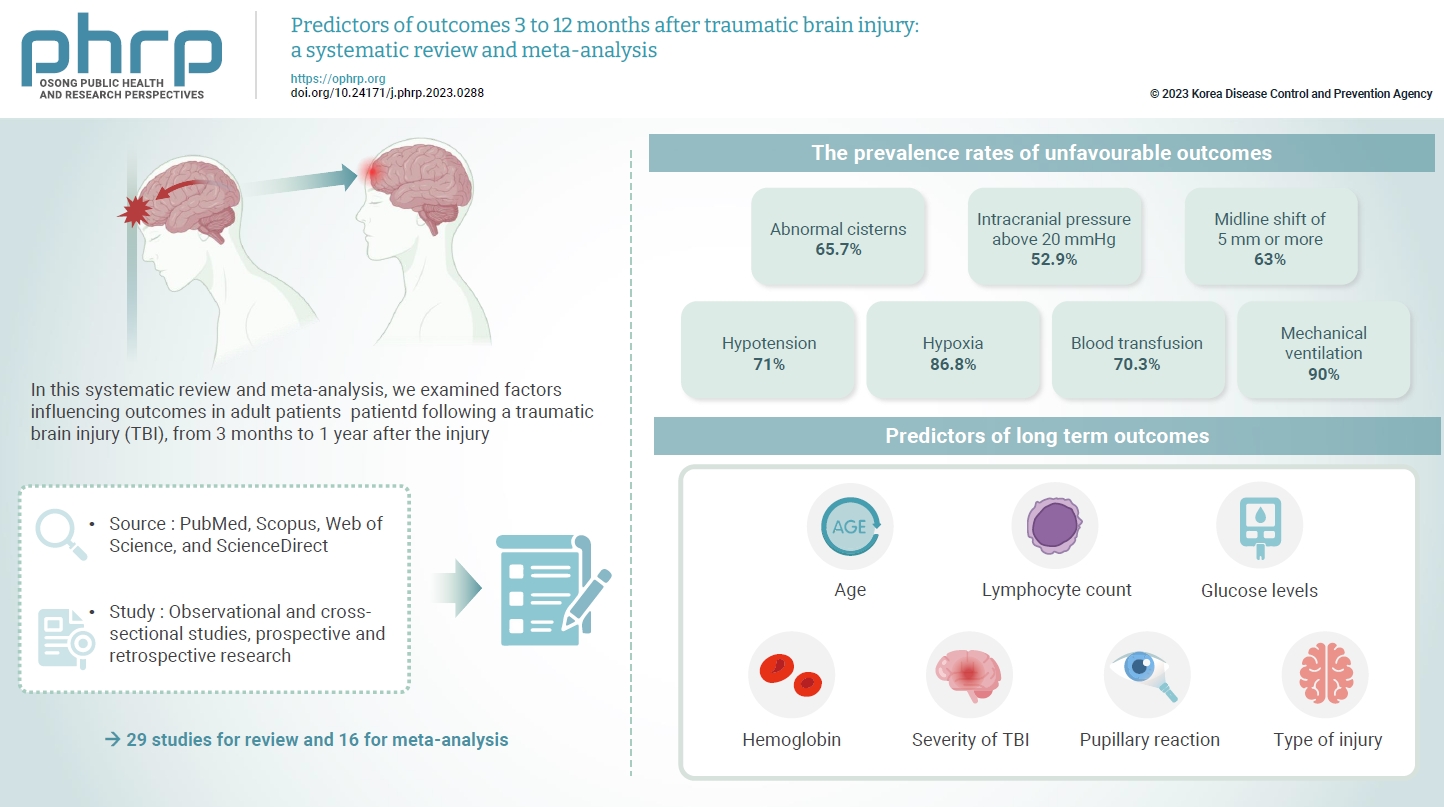
The exact factors predicting outcomes following traumatic brain injury (TBI) remain elusive. In this systematic review and meta-analysis, we examined factors influencing outcomes in adult patients with TBI, from 3 months to 1 year after injury. A search of four electronic databases—PubMed, Scopus, Web of Science, and ScienceDirect—yielded 29 studies for review and 16 for meta-analysis, in accordance with the Preferred Reporting Items for Systematic Reviews and Meta-Analysis guidelines. In patients with TBI of any severity, mean differences were observed in age (8.72 years; 95% confidence interval [CI], 4.77–12.66 years), lymphocyte count (−0.15 109/L; 95% CI, −0.18 to −0.11), glucose levels (1.20 mmol/L; 95% CI, 0.73–1.68), and haemoglobin levels (−0.91 g/dL; 95% CI, −1.49 to −0.33) between those with favourable and unfavourable outcomes. The prevalence rates of unfavourable outcomes were as follows: abnormal cisterns, 65.7%; intracranial pressure above 20 mmHg, 52.9%; midline shift of 5 mm or more, 63%; hypotension, 71%; hypoxia, 86.8%; blood transfusion, 70.3%; and mechanical ventilation, 90%. Several predictors were strongly associated with outcome. Specifically, age, lymphocyte count, glucose level, haemoglobin level, severity of TBI, pupillary reaction, and type of injury were identified as potential predictors of long-term outcomes.
Citations
Citations to this article as recorded by
Premorbid physical activity and recovery following an isolated acute traumatic brain injury: an exploratory study Naomie Maltais, Elaine de Guise, Maude Laguë-Beauvais, Laurence Trépanier, Jehane H. Dagher Global Neurological Insights.2026; 1(1): 100003. CrossRef
Association Between Sex and Mortality After Traumatic Brain Injury: A Systematic Review and Meta-Analysis Elise Beijer, Floor J. Mansvelder, Romein W. G. Dujardin, Nicole P. Juffermans, Linda J. Schoonmade, Leo M. G. Geeraedts, Frank W. Bloemers, Charissa E. van den Brom, Patrick Schober Neurocritical Care.2026; 45(1): 395. CrossRef
The severity of traumatic brain injury impacts the response to non-pharmacological treatment for post-traumatic amnesia: A retrospective observational study Èlia Vilageliu-Jordà, Antonia Enseñat-Cantallops, Alberto García-Molina Applied Neuropsychology: Adult.2026; : 1. CrossRef
Predictors of In-Hospital Mortality in Traumatic Acute Subdural Hematoma: The Role of Admission International Normalized Ratio, Imaging Parameters and Neurological Severity Serban Iancu Papacocea, Miruna Ioana Lazăr, Romica Cergan, Ioana Anca Badarau, Toma Marius Papacocea Biomedicines.2026; 14(6): 1388. CrossRef
A Systematic Review of Clinical Outcome Trajectories from 3 to 12 Months Following Mild or Moderate Traumatic Brain Injury Carl Marincowitz, Fiona Lecky, Abdullah Pandor, Ruth Wong, Thomas Shanahan, Michael Tonkins, Rajiv Singh, James Piercy, Andrew Maas, Lindsay Wilson Journal of Neurotrauma.2026;[Epub] CrossRef
Distinct Five-Year Latent Class Trajectories and Predictors of Functional Cognitive Independence Following Traumatic Brain Injury: A TBI Model Systems Study Evan D. Feigel, Charlotte B. Luster, Chris W. Lewis, Brenna Finegan, Michael J. Mastrodicasa, Maëlle-Marie Troadec, David Guo, Ben Olsen, Ignacio Fuentes, Joseph T. Giacino, Regina Barzilay, Daniel H. Daneshvar Neurotrauma Reports.2026;[Epub] CrossRef
Traumatic Brain Injury and Artificial Intelligence: Shaping the Future of Neurorehabilitation—A Review Seun Orenuga, Philip Jordache, Daniel Mirzai, Tyler Monteros, Ernesto Gonzalez, Ahmed Madkoor, Rahim Hirani, Raj K. Tiwari, Mill Etienne Life.2025; 15(3): 424. CrossRef
<p>Murine typhus is one of the most prevalent rickettsial infections in the world, caused by the bacterial genus <italic>Rickettsia</italic>. Though the disease manifests a relatively benign clinical course with fever, rash, and headache being the 3 classic symptoms, neurological complications may arise in patients that could become permanent. In this case study, a patient with a brain abscess caused by <italic>R typhi</italic> infection is described. Based upon the recent reemergence of arthropod-borne disease, the findings in this case are significant; <italic>R typhi</italic> can cause a brain abscess that mimics a brain tumor, which delays the diagnosis and appropriate management of the disease. Murine typhus should always be considered when performing the differential diagnosis of brain abscesses in South Korea.</p>
Citations
Citations to this article as recorded by
Meningoencephalitis in Flea-Borne Typhus: A Report of Two Cases and a Review of CNS Complications Camille E. Spears, Divya Chandramohan, Melinda B. Tanabe, Nicholas C. Anstead, Emily L. M. Turkily, Lucas S. Blanton, Thelma Akien, Christopher L. Dayton, James C. Saca, Gregory M. Anstead Pathogens.2026; 15(6): 590. CrossRef
Brain Abscess Mimicking Brain Tumors: A Systematic Review of Individual Patient's Data Anis Choucha, Matteo De Simone, Nathan Beucler, Solenne Hulot, Jean-Christophe Lagier, Henry Dufour Asian Journal of Neurosurgery.2025; 20(02): 291. CrossRef
Meningoencephalitis and retinal vasculitis due to rickettsial infection Louisa Lehner, Stephan Thurau, Konstantin Pusl, Steffen Tiedt, Florian Schöberl, Robert Forbrig, Günter Höglinger, Michael Strupp Journal of Neurology.2024; 271(3): 1469. CrossRef
Typhus group Rickettsia community-acquired bacterial central nervous system infections: We must think outside the box! Pauline B. Roxas, Justice Cruz, Nicole Rae Horelka, Cesar Burgos, Jana Radwanski, Fernando Baires, Miguel Sierra-Hoffman, Heike Hesse, Amy C. Madril Journal of the Neurological Sciences.2024; 466: 123281. CrossRef
Giant Actinomyces brain abscess in an immunocompetent child: A management strategy Nicole H. Chicoine, Jackson Griffith-Linsley, Joling Goh, John J. Manaloor, Jeffrey S. Raskin Surgical Neurology International.2021; 12: 325. CrossRef
<sec>
<title>Objectives</title>
<p>The aims of this meta-analysis were to examine intervention methods of qualitatively, well-designed studies from the past 10 years for treating visuo-spatial neglect (VSN) in patients who had suffered a stroke, and to evaluate the combined effects of intervention.</p></sec>
<sec>
<title>Methods</title>
<p>Studies published between 2008 and 2017 on the theme of VSN were collected from PubMed, CINAHL, and MEDLINE, representative academic databases and search engines. The PEDro scale was used for evaluating the quality of methodology. The sample size, mean, and standard deviation of identified studies were used for meta-analysis.</p></sec>
<sec>
<title>Results</title>
<p>Eight studies were selected for analysis. The PEDro scores of the selected studies were ≥ 7, with 237 subjects analyzed. The results of intervention were classified into “mental function” and “activity and participation” based on the International Classification of Functioning, Disability and Health. The analyzed effect sizes for combined outcomes, mental function and, activity and participation, were 0.728 (medium effect size), 0.850 (large effect size), and 0.536 (medium effect size), respectively.</p></sec>
<sec>
<title>Conclusion</title>
<p>Intervention methods for treating VSN had a short-term effect on cognitive function (visual perception). In particular, non-invasive brain stimulation therapy showed a large effect size for VSN treatment.</p></sec>
Citations
Citations to this article as recorded by
Non-pharmacological interventions for spatial neglect or inattention following stroke and other non-progressive brain injury Verity Longley, Christine Hazelton, Calvin Heal, Alex Pollock, Kate Woodward-Nutt, Claire Mitchell, Gorana Pobric, Andy Vail, Audrey Bowen Cochrane Database of Systematic Reviews.2021;[Epub] CrossRef
Neural Mechanisms of Spatial Attention Deficits in Trauma Stefanie R. Russman Block, Daniel H. Weissman, Chandra Sripada, Mike Angstadt, Elizabeth R. Duval, Anthony P. King, Israel Liberzon Biological Psychiatry: Cognitive Neuroscience and .2020; 5(10): 991. CrossRef
Updated Approach to Stroke Rehabilitation Leroy R. Lindsay, Diane A. Thompson, Michael W. O’Dell Medical Clinics of North America.2020; 104(2): 199. CrossRef
Implementing a Rehabilitation Protocol for Spatial Neglect Assessment and Treatment in an Acute Care Hospital Kimberly Hreha, Peii Chen, Jennifer LaRosa, Christopher Santos, Cindy Gocon, A.M. Barrett Journal of Acute Care Physical Therapy.2020; 11(2): 59. CrossRef
Alertness Training Improves Spatial Bias and Functional Ability in Spatial Neglect Thomas Van Vleet, Paolo Bonato, Eric Fabara, Sawsan Dabit, Sarah‐Jane Kim, Christopher Chiu, Antonio Luigi Bisogno, Michael Merzenich, Maurizio Corbetta, Joseph DeGutis Annals of Neurology.2020; 88(4): 747. CrossRef




 First
 Prev


