Objectives The onset of common mental disorders (CMDs) is most prevalent among youth; thus, mental health management is crucial. We examined differences in risk and risk factor determinants regarding CMDs prevalence among youth in rural and urban Indonesia. Methods: This cross-sectional study utilized data from the 2018 Indonesia National Health Survey. The population comprised 122,114 respondents, aged 15 to 24 years, who had completed the 20-item Self-Report Questionnaire along with providing demographic and health behavior data. Chi-square testing and logistic regression were employed for analysis. Results: The CMDs risk was higher among urban than rural youth. Risk factors impacting both populations included being female, having a lower education level, consuming fewer than 7 portions of vegetables weekly, smoking, and drinking alcohol (p<0.05). Consuming under 7 portions of fruit weekly and being in the highest or lowest wealth quintile were significant risk factors only in urban youth, while unemployment and divorce were significant only among rural respondents (p<0.05). Marriage was protective against CMDs among rural participants. Conclusion: Being male, possessing a college degree, consuming at least 7 portions of vegetables weekly, not smoking, and not consuming alcohol were associated with reduced CMDs risk in urban and rural youth. Among rural youth, marriage and employment were linked to decreased risk, whereas divorce displayed the opposite relationship. In urban populations, consuming at least 7 portions of fruit weekly and belonging to neither the highest nor the lowest economic quintile were protective factors. Management strategies for CMDs in young people must address these considerations.
Citations
Citations to this article as recorded by
Development and Psychometric Evaluation of the MHI-9: A Brief Dual-Factor Mental Health Screener for Nonclinical Filipino University Students Benedict G. Antazo Measurement and Evaluation in Counseling and Devel.2026; 59(4): 404. CrossRef
Sociodemographic and Geographic Influences of Mental Health Literacy: A Cross-Sectional Survey Among Community Health Clinic Attendees in Tshwane, South Africa Oratilwe Penwell Mokoena, Eric Maimela, Dumisile Priscilla Madlala, Thembelihle Sam Ntuli International Journal of Environmental Research an.2026; 23(2): 228. CrossRef
Depression, Anxiety and Stress Among Students at the University of Pristina-Kosovska Mitrovica, Kosovo and Metohija, Serbia Danijela Ilic, Jovana Milosevic, Jovana Todorovic, Zorica Terzic-Supic, Ilija Dragojevic, Mirjana Stojanovic-Tasic, Emilija Novakovic, Tijana Spasojevic, Svetozar Memarovic, Milivoje Galjak, Kristina Rakic, Mirijana Virijevic, Kristina Stevanovic, Jelena Healthcare.2026; 14(7): 958. CrossRef
Interrelated adolescent-level food insecurity and common mental health disorders in Harari Region, Ethiopia: A cross-sectional study Kasiye Shiferaw, Gari Hunduma, Yadeta Dessie, Tesfaye Assebe Yadeta, Biftu Geda, Negussie Deyessa, Othman A. Alfuqaha PLOS One.2026; 21(5): e0348774. CrossRef
Explaining Suicidal Behavior Among Adolescents in the Urban Community Context: Insights From a School‐Based Study in Depok City, Indonesia Dicky C. Pelupessy, Dimas B. Prasetyo, Amelia Putri, Ferena Debineva, Susanne Argamaso, Sabrina Arredondo Mattson, Beverly Kingston, Shr‐Jie Wang Journal of Community Psychology.2026;[Epub] CrossRef
Healthcare, caregiver and human capital costs associated with anxiety and depression among Indonesian youths Karen Arulsamy, Elmeida Effendy, Sarah Mardhiyah, Mustafa M Amin, M Surya Husada, Vita Camellia, Anne-Claire Stona, Eric Andrew Finkelstein BMJ Paediatrics Open.2025; 9(1): e003632. CrossRef
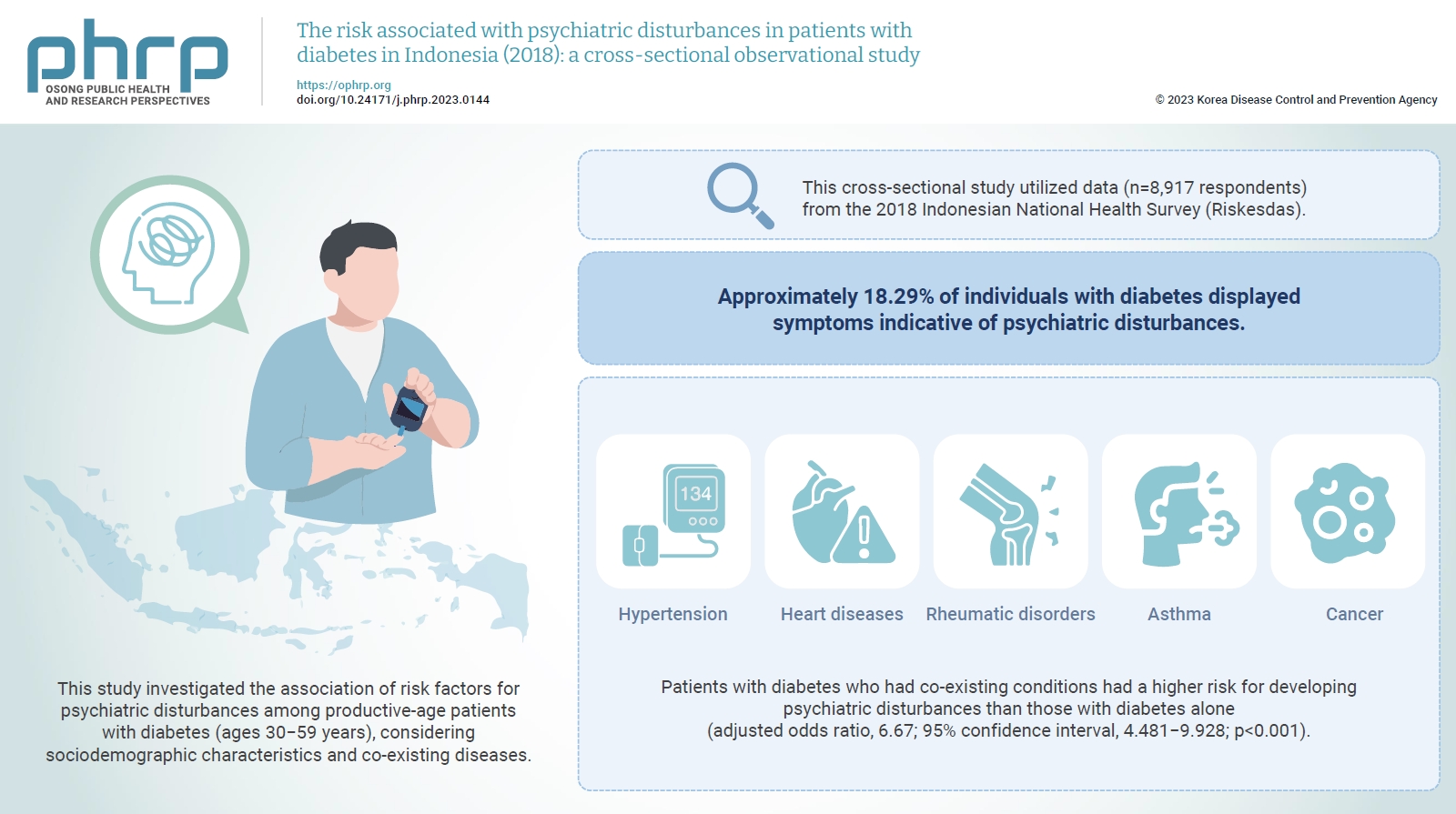
Objectives The global prevalence of psychiatric disturbances is rising, detrimentally affecting the quality of care and treatment outcomes for individuals, particularly those with diabetes.This study investigated the association of risk factors for psychiatric disturbances among productive-age patients with diabetes (ages 30−59 years), considering sociodemographic characteristics and co-existing diseases. The risk factors considered included sociodemographic factors (e.g., residence, age, sex, marital status, education, and occupation) and co-existing diseases (e.g., hypertension, heart disease, stroke, renal failure, rheumatism, asthma, and cancer). Methods: This cross-sectional study utilized data from the 2018 Indonesian National Health Survey (Riskesdas). The study population comprised respondents aged between 30 and 59 years who had diabetes and had completed the 20-question self-reporting questionnaire (SRQ-20). After the exclusion of incomplete SRQ-20 data, the sample included 8,917 respondents. Data were analyzed using logistic regression. Results: Approximately 18.29% of individuals with diabetes displayed symptoms indicative of psychiatric disturbances. After adjusting for sociodemographic factors such as age, sex, education level, occupation, marital status, and place of residence, patients with diabetes who had co-existing conditions such as hypertension, heart diseases, rheumatic disorders, asthma, or cancer had a higher risk for developing psychiatric disturbances than those with diabetes alone (adjusted odds ratio, 6.67; 95% confidence interval, 4.481−9.928; p<0.001). Conclusion: The elevated risk of psychiatric disturbances among patients with diabetes who had comorbidities underscores the importance of addressing mental health issues in the management of diabetes, especially in patients with concurrent disease conditions.
Citations
Citations to this article as recorded by
The impact of dietary consumption on hypertension in indonesia: An analysis of indonesian health survey 2023 Cici A. Yanti, Ratna Djuwita, Evi Martha, Besral, Debby Ratno Kustanto, Noor Mastura Mohd Mujar Journal of Education and Health Promotion.2025;[Epub] CrossRef
Investigating the association between physical fitness and blood pressure among healthcare workers in Indonesia Wahyu Sulistiadi, Riswandy Wasir, Astriana, Badra Al Aufa, Sri Rahayu, Wasir Thalib, Fadilah Aulia Rahma Discover Social Science and Health.2024;[Epub] CrossRef
Correction to “The risk associated with psychiatric disturbances in patients with diabetes in Indonesia (2018): a cross-sectional observational study” [Osong Public Health Res Perspect 2023;14(5):368–78] Siti Isfandari, Betty Roosihermiatie, Sulistyowati Tuminah, Laurentia Konadi Mihardja Osong Public Health and Research Perspectives.2023; 14(6): 530. CrossRef



 First
 Prev


