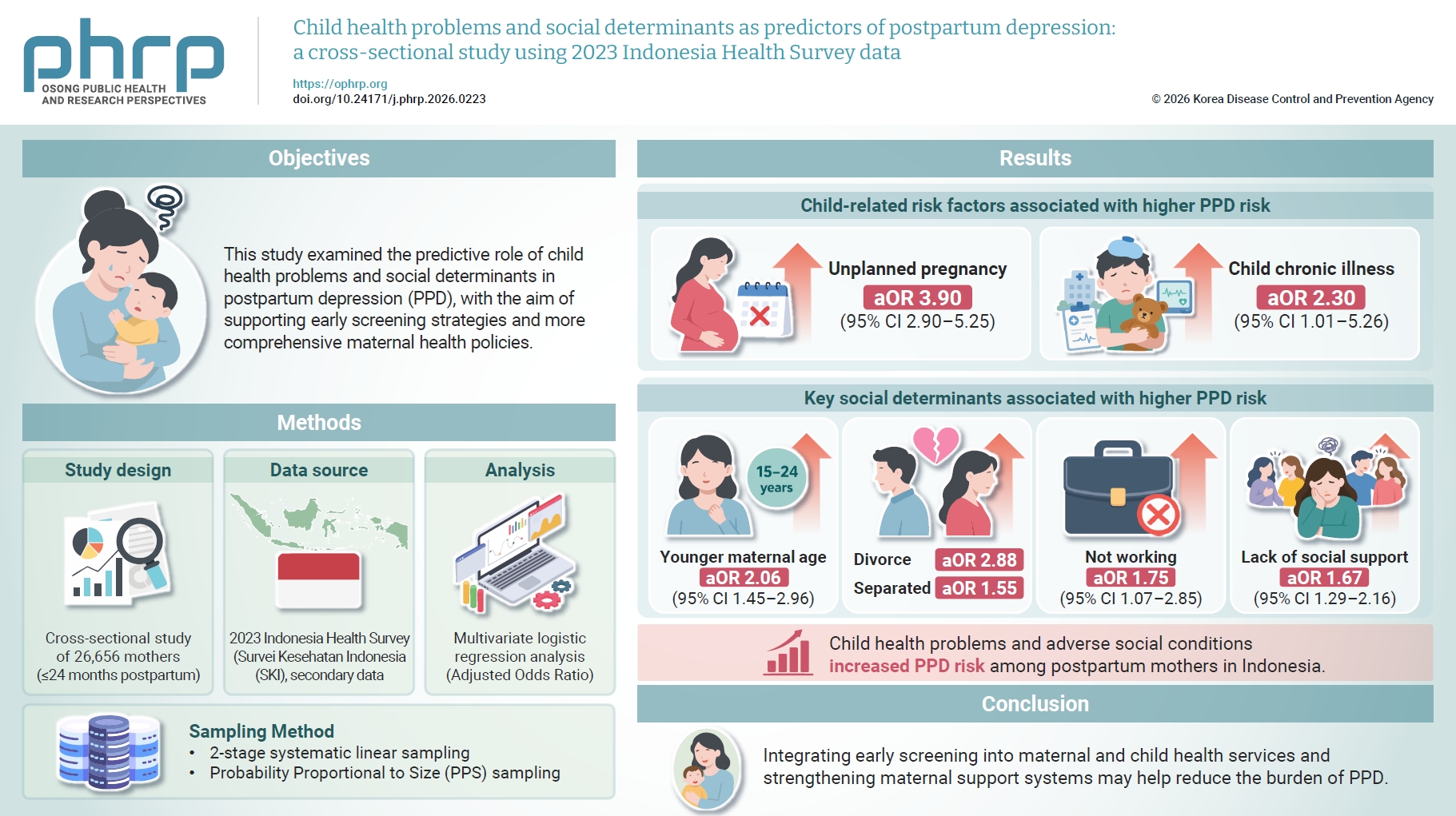
Objectives This study examined the predictive role of child health problems and social determinants in postpartum depression (PPD), with the aim of supporting early screening strategies and more comprehensive maternal health policies. Methods: This cross-sectional study used secondary data from the 2023 Indonesia Health Survey, conducted by the Indonesian Ministry of Health. The analysis included 26,656 postpartum women aged at least 15 years who had given birth within the previous 24 months. PPD was assessed using the Mini International Neuropsychiatric Interview. Multiple logistic regression was used to analyze the data. Results: Child health problems were among the strongest factors associated with PPD in Indonesia. Having had an unplanned pregnancy was associated with higher odds of PPD (adjusted odds ratio [aOR], 3.90; 95% confidence interval [CI], 2.90–5.25; p < 0.001), as was having a child with chronic illness (aOR, 2.30; 95% CI, 1.01–5.26; p= 0.048). Social risk factors, including younger maternal age, divorce or separation from a partner, unemployment, and lack of social support, were also associated with PPD in Indonesia. Conclusion: Child health problems and adverse social conditions were significantly associated with postpartum mental health in Indonesia. Integrating early screening into maternal and child health services and strengthening maternal support systems may help reduce the burden of PPD.
Objectives This study investigated the correlation between food insecurity and infectious diseases among toddlers in Indonesia.
Methods This research employed a cross-sectional study design using data from the 2021 Indonesian Nutrition Status Survey, which included a sample of 84,115 toddlers. Food insecurity levels were assessed using the food insecurity experience scale, developed by the Food and Agriculture Organization. The dependent variable, infectious disease, was defined as a toddler experiencing 1 or more of the following conditions: acute respiratory infections, diarrhea, pneumonia, measles, or worms. Multivariate analysis was conducted using multiple logistic regression to determine adjusted odds ratios (ORs).
Results The findings indicate that 23.78% of toddlers experienced at least 1 infectious disease. While more than half of the respondents were food secure, 26.5% faced mild food insecurity, 13.6% moderate food insecurity, and 6.5% severe food insecurity. Toddlers from households experiencing mild, moderate, and severe food insecurity had higher risks of infectious diseases compared to those from food-secure households, with adjusted ORs of 1.367 (95% confidence interval [CI], 1.308–1.428), 1.490 (95% CI, 1.399–1.588), and 1.500 (95% CI, 1.374–1.638), respectively.
Conclusion In conclusion, more severe food insecurity is correlated with an increased risk of toddlers suffering infectious diseases.
Citations
Citations to this article as recorded by
From pantry to physiology: A narrative review linking food insecurity to biological dysfunction Liahm Blank, Joshua Khorsandi, Nicole Kang, Kaloyan Momchilov, Itai Blank, Kavita Batra Dialogues in Health.2026; 8: 100308. CrossRef
Structural Equation Modelling of Socioeconomic Status on Malnutrition Among Urban Preschoolers: Multi-Group Analysis of Hungary and Indonesia Arie Dwi Alristina, Éva Kovács, Diyah Arini, Helga Judit Feith International Journal of Environmental Research an.2026; 23(7): 858. CrossRef
Implementasi Gerakan Kebun Gizi Keluarga (GK2) Sebagai Upaya Ketahanan Pangan dan Gizi Keluarga di Desa Gading Watu, Kabupaten Gresik Noveansyah Maskur Nurgah, Dhuha Nuri Samsiyah, Shafa Dwi Candra Syahputra, Aisyah Rahmah Maulidiyah , Rambu Breathy Salwasty Ananda Tamu Rambu, Intan Adinda Putri, Nabil Habib Abdillah, Devita Astrid Renata, Nurul I.A. Cahyo Wibowo, Muchammad Bachrul Ulu Journal of Community Development.2026; 7(2): 1. CrossRef
Prematurity and Low Birth Weight Among Food-Secure and Food-Insecure Households: A Comparative Study in Surabaya, Indonesia Arie Alristina, Nour Mahrouseh, Anggi Irawan, Rizky Laili, Alexandra Zimonyi-Bakó, Helga Feith Nutrients.2025; 17(15): 2479. CrossRef
Objectives The aim of this study was to investigate the relationship between the number of patient comorbidities and the delays in seeking treatment for coronary heart disease (CHD). Methods: This longitudinal study utilized secondary data from the Non-Communicable Disease Risk Factor (NCDRF) cohort study conducted in Bogor City. Individuals who participated in the NCDRF cohort study and were diagnosed with CHD within the 6-year study period met the inclusion criteria. Respondents who were not continuously monitored up to the 6th year were excluded. The final sample included data from respondents with CHD who participated in the NCDRF cohort study and were monitored for the full 6-year duration. The final logistic regression analysis was conducted on data collected from 812 participants. Results: Among the participants with CHD, 702 out of 812 exhibited a delay in seeking treatment. The risk of a delay in seeking treatment was significantly higher among individuals without comorbidities, with an odds ratio (OR) of 3.5 (95% confidence interval [CI], 1.735–7.036; p<0.001). Among those with a single comorbidity, the risk of delay in seeking treatment was still notable (OR, 2.6; 95% CI, 1.259–5.418; p=0.010) when compared to those with 2 or more comorbidities. These odds were adjusted for age, sex, education level, and health insurance status. Conclusion: The proportion of patients with CHD who delayed seeking treatment was high, particularly among individuals with no comorbidities. Low levels of comorbidity also appeared to correlate with a greater tendency to delay in seeking treatment.
Citations
Citations to this article as recorded by
Role of common mental disorders in uncontrolled hypertension: a longitudinal study in Bogor City, Indonesia Tri Wurisastuti, Indri Yunita Suryaputri, Rofingatul Mubasyiroh, Wahyu Pudji Nugraheni Korean Journal of Family Medicine.2026; 47(1): 81. CrossRef
2026 Heart Disease and Stroke Statistics: A Report of US and Global Data From the American Heart Association Latha P. Palaniappan, Norrina B. Allen, Zaid I. Almarzooq, Cheryl A.M. Anderson, Pankaj Arora, Christy L. Avery, Carissa M. Baker-Smith, Nisha Bansal, Maria E. Currie, Rebecca S. Earlie, Wenjun Fan, Jessica L. Fetterman, Bethany Barone Gibbs, Debra G. Hea Circulation.2026;[Epub] CrossRef
Blood Glucose Variability and Postoperative Organ Function in Coronary Artery Bypass Grafting: A Prospective Cohort Study of Microcirculatory Perfusion and Oxygenation Arif Mansjoer, Idrus Alwi, Em Yunir, Dita Aditianingsih, Kuntjoro Harimurti, Alida Roswita Harahap, Dudy Arman Hanafy, Taufik Indrajaya, Suhendro Suwarto Journal of Cardiothoracic and Vascular Anesthesia.2026; 40(11): 3648. CrossRef
Adherence to Inhalation Therapy Among COPD Patients: A Cross-Sectional Study in a Tertiary Hospital in Quito, Ecuador Juan Izquierdo-Condoy, Fernando Gualpa Álvarez, Estefania Morales-Lapo, Washington Arias Calvache, Jessica Bermúdez Moreira, Katherine Quinga-Chiguano, Esteban Ortiz-Prado International Journal of Chronic Obstructive Pulmo.2025; Volume 20: 399. CrossRef
Prevalence of Electrocardiographic Abnormalities in Patients with Acute Pulmonary Embolism: A Systematic Review and Meta-Analysis Sarunsorn Krintratun, Wuttipong Srichuachom, Wachira Wongtanasarasin Journal of Clinical Medicine.2025; 14(13): 4750. CrossRef
Prevalence and Factors Related to Pre-Hospital Delay in Young Patients with ST-Elevation of Myocardial Infarction (STEMI) Nooraniza Mohd Kassim, Rosna Abdul Raman, Soh Kim Lam Malaysian Journal of Medicine and Health Sciences.2025;[Epub] CrossRef




 First
 Prev


