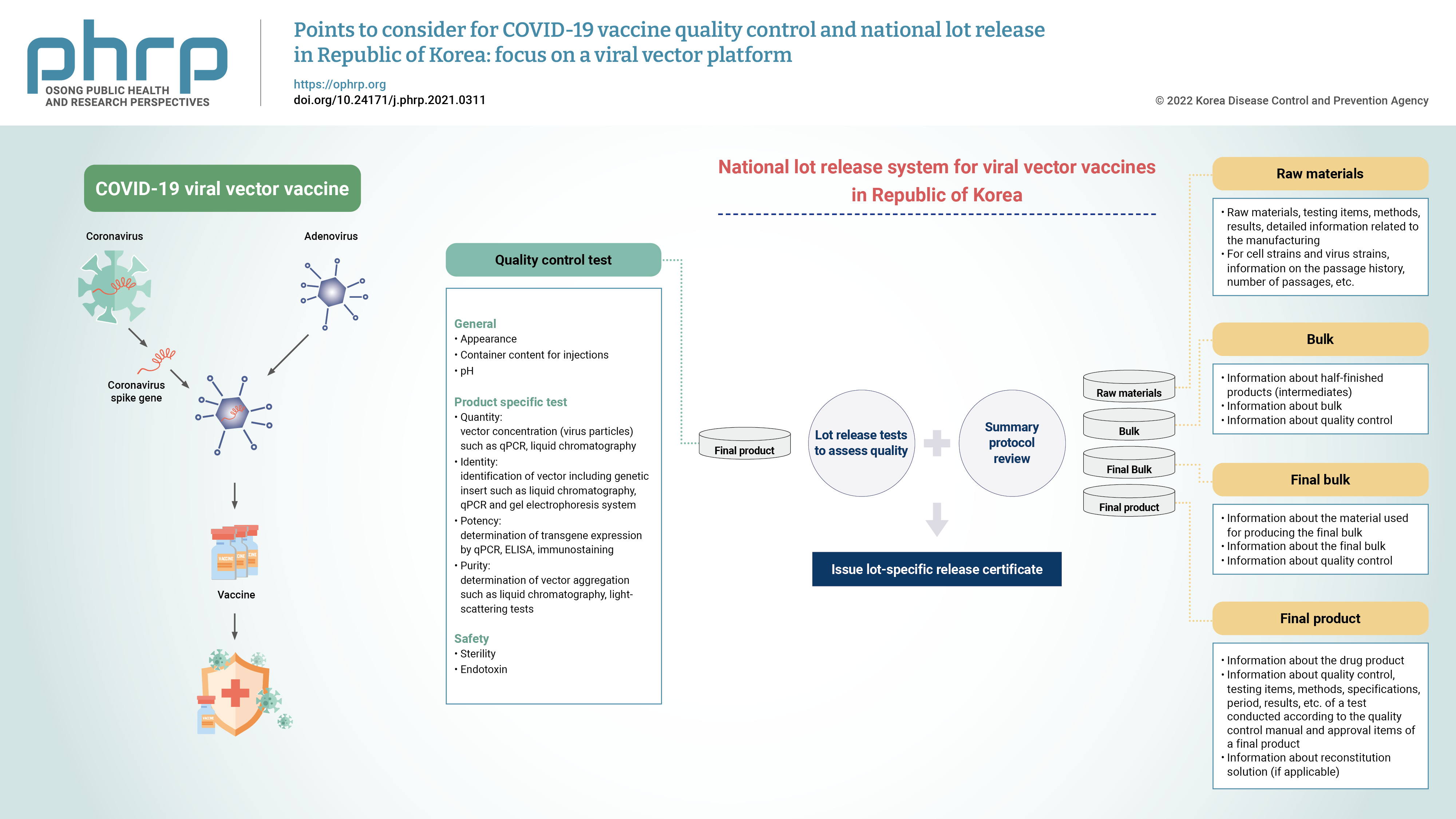
Due to the global public health crisis caused by the coronavirus disease 2019 (COVID-19) pandemic, the importance of vaccine development has increased. In particular, a rapid supply of vaccines and prompt deployment of vaccination programs are essential to prevent and overcome the spread of COVID-19. As a part of the vaccine regulations, national lot release is regulated by the responsible authorities, and this process involves the assessment of the lot before a vaccine is marketed. A lot can be released for use when both summary protocol (SP) review and quality control testing are complete. Accelerated lot release is required to distribute COVID-19 vaccines in a timely manner. In order to expedite the process by simultaneously undertaking the verification of quality assessment and application for approval, it is necessary to prepare the test methods before marketing authorization. With the prolonged pandemic and controversies regarding the effectiveness of the COVID-19 vaccine against new variants, public interest for the development of a new vaccine are increasing. Domestic developers have raised the need to establish standard guidance on the requirements for developing COVID-19 vaccine. This paper presents considerations for quality control in the manufacturing process, test items, and SP content of viral vector vaccines.
Citations
Citations to this article as recorded by
Development of an identity test for COVID-19 mRNA vaccines using SARS-CoV-2 NAT standard Miran Jo, Eunjo Lee, Ho Jung Oh, Jin Tae Hong, Kyung Hee Sohn Biosafety and Health.2025; 7(4): 224. CrossRef
<p>The Second Meeting of the National Control Laboratories for Vaccines and Biologicals in the Western Pacific, was jointly organized by the National Institute of Food and Drug Safety Evaluation of the Ministry of Food and Drug Safety in the Republic of Korea, and by the World Health Organization Regional Office for the Western Pacific.</p>
<p>In the National Lot Release Systems session countries including Canada, China, Japan, Malaysia, Vietnam, and the Republic of Korea, all shared information on their current Lot Release Systems, including current practices and developments in risk-based official lot release of vaccines.</p>
<p>In the session on Quality Control of Blood Products, experts from the National Institute for Biological Standards and Control shared quality control and research results for; blood coagulation factor VIII products, and the measurement of procoagulant activity in immunoglobulin products. Representatives from Japan proposed a regional collaborative study to test aggregated immunoglobulin free from complement activity. A cell-based Japanese encephalitis vaccine potency assay was proposed by representatives from Korea and they also called for voluntary participation of other National Control Laboratories in a collaborative study, on the first Korean <italic>Gloydius</italic> anti-venom standard. Participants agreed in general to continue communicating, and coordinate presentation of the study results.</p>
Citations
Citations to this article as recorded by
A collaborative study to establish the second national standard for hepatitis B immunoglobulin in Korea Chan Woong Choi, Su Kyoung Seong, Ki Won Han, Hyun Jeong Kim, Kyung Hee Sohn, Sun Bo Shim, Yun Su Bang, JungHwan Cho, In Soo Shin Biologicals.2023; 82: 101679. CrossRef
Report on the seventh meeting of national control laboratories for vaccines and biologicals of the WHO Western Pacific and South-East Asia member states Sun Bo Shim, Chan Woong Choi, Jin Ho Shin, Jong Won Kim, Silke Schepelmann, Jae Ho Jung, Harish Chander, Ratih Pujilestari, Madoka Kuramitsu, Masaki Ochiai, Nee Yuan Qi, Geraldine N. Dimapilis, Luu Thi Dung, Hyung Sil Moon, In Soo Shin Biologicals.2023; 84: 101712. CrossRef
Personalized medicine is emerging as a main paradigm for risk prediction, pre-diagnosis, and effective prevention and treatment of disease. A large number of human biospecimens and their clinical data are essential resources for the success of personalized medicine as well as other biomedical research. The National Biobank of Korea (NBK) has collected well-annotated and high quality human biospecimens, and distributes them to the Korean biomedical scientists, through the Korea Biobank Project (KBP). The ultimate goal of NBK activities is to promote biomedical research and public health. As of December- 2011, the NBK has collected various human biospecimens from 525,416 participants including 325,952 Korean populations and 199,464 patients. The purpose of this paper is to introduce the KBP and quality control programs for collection of human biospecimens with high quality of NBK.
Citations
Citations to this article as recorded by
Genome-based medicine in Korea: the Korea National Institute of Health infrastructure for precision medicine Hyun-Young Park Childhood Kidney Diseases.2026; 30(1): 15. CrossRef
Data Resource Profile: The Statistics of the Korea National Health and Nutrition Examination Survey (KNHANES) Biobank Project Hye Ah Lee, Hye Ryun Kim, Hyunjin Park, So-Young Jung, Jae-Pil Jeon, Bomi Park, Keum Ji Jung, Sun Ha Jee, Sung-Mi Shim, Hyesook Park Journal of Korean Medical Science.2025;[Epub] CrossRef
Gaylussacin, a stilbene glycoside, inhibits chronic obstructive pulmonary disease in mice Hye-Young Min, Jeong Yeon Sim, Jee Hwan Ahn, Nae-Won Kang, Hye-Jin Boo, Jina Kim, Na-Young Yu, Marta Bottacin, Jungmoo Huh, Choon-Sik Park, Jong-Sook Park, Suckchang Hong, Sungyong You, Dae-Duk Kim, Ho-Young Lee Redox Biology.2025; 85: 103744. CrossRef
Evaluation of penalized and machine learning methods for asthma disease prediction in the Korean Genome and Epidemiology Study (KoGES) Yongjun Choi, Junho Cha, Sungkyoung Choi BMC Bioinformatics.2024;[Epub] CrossRef
Urinary microbiome-based metagenomic signature for the noninvasive diagnosis of hepatocellular carcinoma Eun Ju Cho, Boram Kim, Su Jong Yu, Suk Kyun Hong, YoungRok Choi, Nam-Joon Yi, Kwang-Woong Lee, Kyung-Suk Suh, Jung-Hwan Yoon, Taesung Park British Journal of Cancer.2024; 130(6): 970. CrossRef
Assessment of the Impact of Preanalytical DNA Integrity on the Genome Data Quality Sung-Mi Shim, Meehee Lee, Jae-Pil Jeon Biopreservation and Biobanking.2024; 22(5): 517. CrossRef
Gene–Smoking Interaction Analysis for the Identification of Novel Asthma-Associated Genetic Factors Junho Cha, Sungkyoung Choi International Journal of Molecular Sciences.2023; 24(15): 12266. CrossRef
Multi-omics reveals microbiome, host gene expression, and immune landscape in gastric carcinogenesis Chan Hyuk Park, Changjin Hong, A-reum Lee, Jaeyun Sung, Tae Hyun Hwang iScience.2022; 25(3): 103956. CrossRef
Biobank for multidrug-resistant tuberculosis research: importance of sequential samples Yoohyun Hwang, Jiyeon Kim, Seungkyu Park, Sungweon Ryoo Pathogens and Disease.2021;[Epub] CrossRef
Comparison between Cervical Ureaplasma spp. Colonization and the Intensity of Inflammatory Mediators in the Amniotic Fluid Retrieved during Cesarean Delivery in Preterm Birth Jingon Bae, Shin Kim, Ilseon Hwang, Jaehyun Park International Journal of Environmental Research an.2021; 19(1): 107. CrossRef
Contributions of the UK biobank high impact papers in the era of precision medicine Peter Glynn, Philip Greenland European Journal of Epidemiology.2020; 35(1): 5. CrossRef
Axes of a revolution: challenges and promises of big data in healthcare Smadar Shilo, Hagai Rossman, Eran Segal Nature Medicine.2020; 26(1): 29. CrossRef
Is the Random Forest Algorithm Suitable for Predicting Parkinson’s Disease with Mild Cognitive Impairment out of Parkinson’s Disease with Normal Cognition? Haewon Byeon International Journal of Environmental Research an.2020; 17(7): 2594. CrossRef
Application of Machine Learning Technique to Distinguish Parkinson’s Disease Dementia and Alzheimer’s Dementia: Predictive Power of Parkinson’s Disease-Related Non-Motor Symptoms and Neuropsychological Profile Haewon Byeon Journal of Personalized Medicine.2020; 10(2): 31. CrossRef
Exploring the Predictors of Rapid Eye Movement Sleep Behavior Disorder for Parkinson’s Disease Patients Using Classifier Ensemble Haewon Byeon Healthcare.2020; 8(2): 121. CrossRef
DeepVariant-on-Spark: Small-Scale Genome Analysis Using a Cloud-Based Computing Framework Po-Jung Huang, Jui-Huan Chang, Hou-Hsien Lin, Yu-Xuan Li, Chi-Ching Lee, Chung-Tsai Su, Yun-Lung Li, Ming-Tai Chang, Sid Weng, Wei-Hung Cheng, Cheng-Hsun Chiu, Petrus Tang Computational and Mathematical Methods in Medicine.2020; 2020: 1. CrossRef
Mini-Review of Laboratory Operations in Biobanking: Building Biobanking Resources for Translational Research Mine S. Cicek, Janet E. Olson Frontiers in Public Health.2020;[Epub] CrossRef
Development of a depression in Parkinson's disease prediction model using machine learning Haewon Byeon World Journal of Psychiatry.2020; 10(10): 234. CrossRef
Aspects of Modern Biobank Activity – Comprehensive Review Wiktor Paskal, Adriana M. Paskal, Tomasz Dębski, Maciej Gryziak, Janusz Jaworowski Pathology & Oncology Research.2018; 24(4): 771. CrossRef
Optimization of RNA Extraction from Formalin-Fixed Paraffin-Embedded Blocks for Targeted Next-Generation Sequencing Yoojin Choi, Aeree Kim, Jinkyoung Kim, Jinhwan Lee, Soo Yeon Lee, Chungyeul Kim Journal of Breast Cancer.2017; 20(4): 393. CrossRef
Biobank Regulation in South Korea Won Bok Lee Journal of Law, Medicine & Ethics.2016; 44(2): 342. CrossRef
Standard based Deposit Guideline for Distribution of Human Biological Materials in Cancer Patients Hwa Jeong Seo, Hye Hyeon Kim, Jeong Soo Im, Ju Han Kim Asian Pacific Journal of Cancer Prevention.2014; 15(14): 5545. CrossRef
Basis for Korean Genome Study Hae-Wol Cho, Chaeshin Chu Osong Public Health and Research Perspectives.2012; 3(3): 119. CrossRef



 First
 Prev


