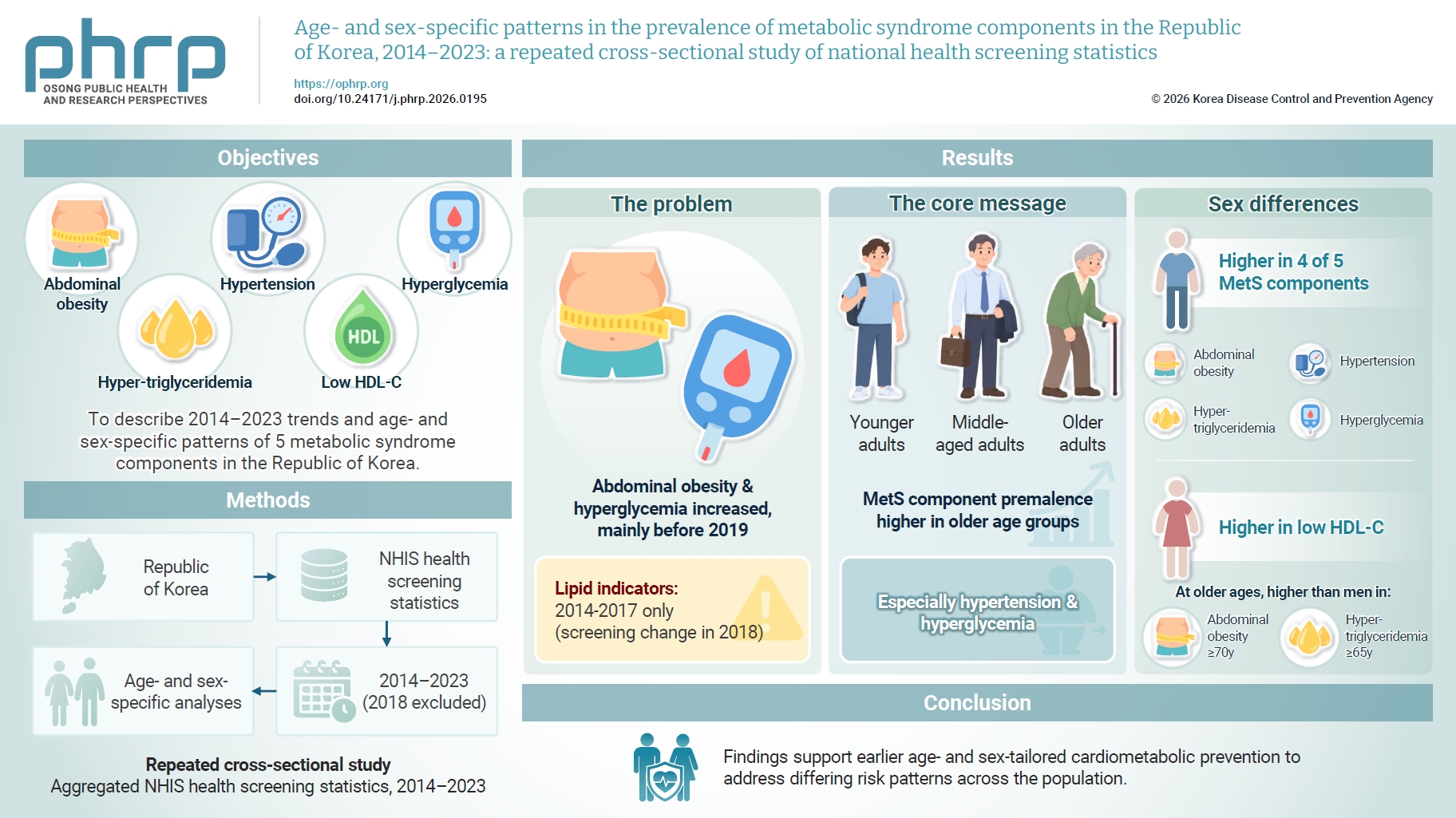
Objectives This study described 10-year trends in the prevalence of 5 metabolic syndrome (MetS) components and examined age- and sex-specific patterns in the Republic of Korea using aggregated national health screening statistics from 2014 to 2023. Methods: This repeated cross-sectional study used publicly available aggregated data from the National Health Screening Statistical Yearbook of the National Health Insurance Service. Annual prevalence estimates were summarized overall and by age group and sex. Linear and segmented regression summarized trends, and age- and sex-standardized prevalence was estimated. The 2018 yearbook tabulated risk factors only for examinees receiving the dyslipidemia panel (restricted from 2018 to men aged ≥24 years and women aged ≥40 years); therefore, 2018 was excluded, and lipid indicators were analyzed for 2014–2017. Results: From 2014 to 2023, crude prevalence increased for abdominal obesity (21.0% to 25.5%) and hyperglycemia (34.7% to 40.1%), mainly before 2019, and for hypertension (42.3% to 45.1%), although less after age standardization. In 2014–2017, hypertriglyceridemia increased (30.0% to 32.2%), whereas low high-density lipoprotein (HDL) cholesterol changed little (22.5% to 22.1%). Prevalence was higher in older age groups, especially for hypertension and hyperglycemia. Men had a higher prevalence of 4 components, and women of low HDL cholesterol. Conclusion: MetS components showed heterogeneous temporal, age-specific, and sex-specific patterns in Korean national health screening statistics. Increases in abdominal obesity and hyperglycemia, mainly before 2019, support earlier age- and sex-tailored cardiometabolic prevention, whereas lipid indicators were comparable only for 2014–2017. Individual-level longitudinal studies are needed to clarify these trends.
<sec><title>Objectives</title><p>Many economically advanced countries have attempted to minimize public expenditures and pursue privatization based on the principles of neo-liberalism. However, Korea has moved contrary to this global trend. This study examines why and how the Korean health care system was formed, developed, and transformed into an integrated, single-insurer, National Health Insurance (NHI) system.</p></sec><sec><title>Methods</title><p>We describe the transition in the Korean health care system using an analytical framework that incorporates such critical variables as government economic development strategies and the relationships among social forces, state autonomy, and state power. This study focuses on how the relationships among social forces can change as a nation’s economic development or governing strategy changes in response to changes in international circumstances such as globalization.</p></sec><sec><title>Results</title><p>The corporatist Social Health Insurance (SHI) system (multiple insurers) introduced in 1977 was transformed into the single-insurer NHI in July 2000. These changes were influenced externally by globalization and internally by political democratization, keeping Korea’s private-dominant health care provision system unchanged over several decades.</p></sec><sec><title>Conclusion</title><p>Major changes such as integration reform occurred, when high levels of state autonomy were ensured. The state’s power (its policy capability), based on health care infrastructures, acts to limit the direction of any change in the health care system because it is very difficult to build the infrastructure for a health care system in a short timeframe.</p></sec>
Citations
Citations to this article as recorded by
Estimation of the benefit from pre‐emptive genotyping based on the nationwide cohort data in South Korea Ki Young Huh, Sejung Hwang, Joo Young Na, Kyung‐Sang Yu, In‐Jin Jang, Jae‐Yong Chung, Seonghae Yoon Clinical and Translational Science.2024;[Epub] CrossRef
ASSESSMENT OF TÜRKİYE'S PROVINCES WITH HEALTH INFRASTRUCTURE INDICATORS USING DESCRIPTIVE ANALYSIS AND HEALTH INDEX Ahmet Bahadır Şimşek Hacettepe Sağlık İdaresi Dergisi.2024; 27(3): 363. CrossRef
Lessons from health insurance responses in counteracting COVID-19: a qualitative comparative analysis of South Korea and three influential countries Hey Jin Ko, Eunji Yun, Boryung Ahn, Hyejin Lee, Won Mo Jang, Jin Yong Lee Archives of Public Health.2023;[Epub] CrossRef
Role of Primary Care and Challenges for Public–Private Cooperation during the Coronavirus Disease 2019 Pandemic: An Expert Delphi Study in South Korea Woo-young Shin, Changsoo Kim, Sei Young Lee, Won Lee, Jung-ha Kim Yonsei Medical Journal.2021; 62(7): 660. CrossRef
The sociopolitical context of the COVID-19 response in South Korea Hani Kim BMJ Global Health.2020; 5(5): e002714. CrossRef
Post-COVID healthcare reform in India: What to expect? Soham D. Bhaduri Journal of Family Medicine and Primary Care.2020; 9(11): 5427. CrossRef
The Story of Korean Health Insurance System Hae-Wol Cho, Chaeshin Chu Osong Public Health and Research Perspectives.2017; 8(4): 235. CrossRef



 First
 Prev


