Objectives The prevalence of hepatitis B in the Republic of Korea has declined, yet the disease burden persists. After various changes in targets and methods, the national hepatitis B surveillance system now exclusively monitors acute cases. We aimed to assess the alignment of this system with its intended purpose and to recommend improvements supporting the national strategic plan for viral hepatitis management.
Methods This study assessed acute hepatitis B cases reported to the Korean Disease Control and Prevention Agency’s mandatory surveillance system over a 10-year period (2013–2022). It evaluated 5 factors from the Centers for Disease Control and Prevention’s Updated Guidelines for Evaluating Public Health Surveillance Systems: simplicity, positive predictive value, data quality, timeliness, and usefulness.
Results The nonspecific nature of acute hepatitis B symptoms, along with the complexity of diagnostic criteria, indicated a high potential for misreporting. The surveillance system demonstrated a high positive predictive value (94.4%), with data quality and timeliness also rated high. However, data following the onset of the coronavirus disease 2019 pandemic indicate the need for improvement. Moreover, given the relative importance of specific characteristics of chronic infectious diseases, only limited interventions are implementable through the current surveillance system.
Conclusion The evaluation of the Republic of Korea’s acute hepatitis B surveillance system revealed high positive predictive value, data quality, and timeliness. However, improvements can be made in the misreporting of chronic cases and the system’s usefulness. More accurate reflection of the characteristics of acute hepatitis B cases is essential for better management of viral hepatitis.
Citations
Citations to this article as recorded by
International Infectious Disease Surveillance Systems and Implications for Korea: Case of Bacterial Gastroenteritis Minsol Jo, Yerin Heo, Dong-Sook Kim, Inmyung Song Journal of Health Informatics and Statistics.2026; 51(1): 1. CrossRef
The burden of chronic hepatitis B and C in 2022 and progress towards elimination: a global report Fuqiang Cui, Diana Faini, Devin Razavi-Shearer, Homie Razavi, Casimir Manzengo Mingiedi, Monica Alonso Gonzalez, Ahmed Sabry Alaama, Antons Mozalevskis, Polin Chan, Kiyohiko Izumi, Mohamed Amine Ghrabi, Meg Doherty, Lesi Olufunmilayo, Niklas Luhmann, Cath The Lancet Gastroenterology & Hepatology.2026; 11(6): 509. CrossRef
HepPlus: Protocol for a prospective multicenter observational study of a web-based platform to support Hepatitis B and C management in Thailand Pitchaya Chairuengjitjaras, Ketsarapohn Sudchit, Nattapat Boonsiripiyachok, Pisit Tangkijvanich Sage Open Chronic Disease.2026;[Epub] CrossRef
Identifying Gaps and Challenges in Acute Hepatitis B Surveillance in the Country of Georgia: Comprehensive Surveillance System Evaluation Lika Karichashvili, Ketevan Galdavadze, Khatuna Zakhashvili, Maia Tsereteli, Ekaterine Ruadze, Sophia Surguladze, Pawel Stefanoff JMIR Public Health and Surveillance.2025; 11: e72888. CrossRef
From Paper to Digital: Performance and Challenges of the Electronic Hepatitis B Surveillance System in Ninh Binh, Northern Vietnam (2017–2022) Hien T. Nguyen, Thai Q. Pham, Duc M. Hoang, Quang D. Tran, Giang T. Chu, Thuong T. Nguyen, Nam H. Le, Huyen T. Nguyen, Khanh C. Nguyen, Florian Vogt Tropical Medicine and Infectious Disease.2024; 9(12): 299. CrossRef
Effects of SARS-CoV-2 Spike S1 Subunit on the Interplay Between Hepatitis B and Hepatocellular Carcinoma Related Molecular Processes in Human Liver Giovanni Colonna Livers.2024; 5(1): 1. CrossRef
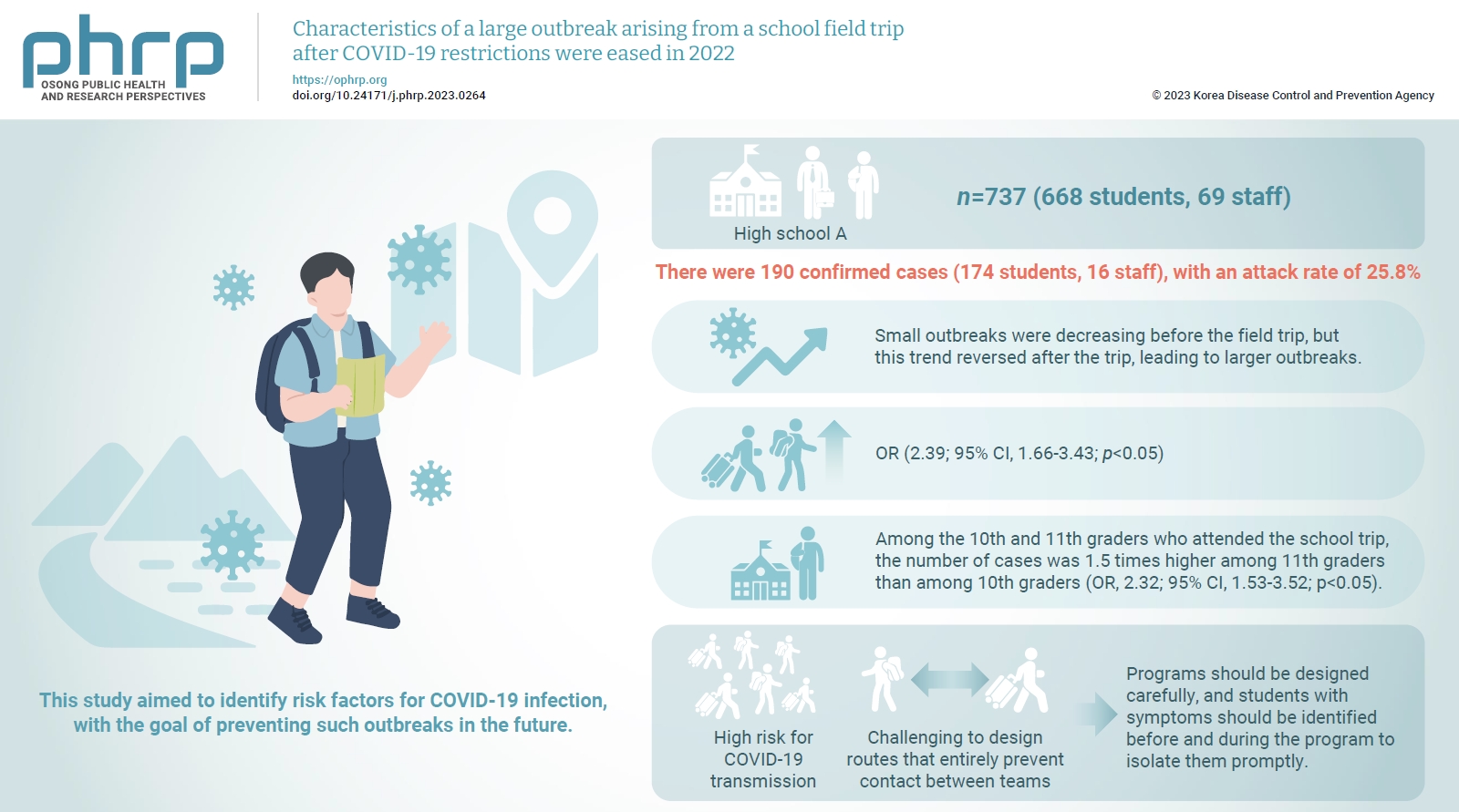
Objectives This study analyzed a large outbreak of coronavirus disease 2019 (COVID-19) that occurred during a high school field trip in the Jeonbuk region and aimed to identify risk factors for COVID-19 infection, with the goal of preventing such outbreaks in the future. Methods: A retrospective cohort study of 737 participants, including 668 students and 69 staff at High School A, was designed to describe the epidemiological characteristics of this large COVID-19 outbreak. Logistic regression analysis was performed to calculate relative risks (odds ratios [ORs]) and 95% confidence intervals (CIs). Results: There were 190 confirmed cases (174 students, 16 staff), with an attack rate of 25.8%. Small outbreaks were decreasing before the field trip, but this trend reversed after the trip, leading to larger outbreaks. Logistic regression showed an OR of 2.39 (95% CI, 1.66–3.43; p<0.05) for COVID-19 infection among field trip participants. Among them, 11th graders had an OR of 2.32 (95% CI, 1.53–3.52; p<0.05) compared to 10th graders, while no significant risk difference was found within same-grade teams. Conclusion: There was a high risk for COVID-19 transmission during extracurricular activities with a large number of participants, such as field trips, even after the nationwide Omicron variant epidemic subsided. Even when students are separated into teams and follow different routes, it is challenging to design routes that entirely prevent contact between teams. Thus, programs should be designed carefully, and students with symptoms should be identified before and during the program to isolate them promptly.
Citations
Citations to this article as recorded by
Uncommon pathogen, common activity: Streptococcus pneumoniae conjunctivitis outbreak traced to a primary school field trip Xiaojian Duan, Xiaobin Ren, Kai Song, Jiayun Wang, Yi Wang, Yuanming Zhang, Li Ren, Liangliang Huo, Jing Wang Frontiers in Public Health.2026;[Epub] CrossRef



 First
 Prev


