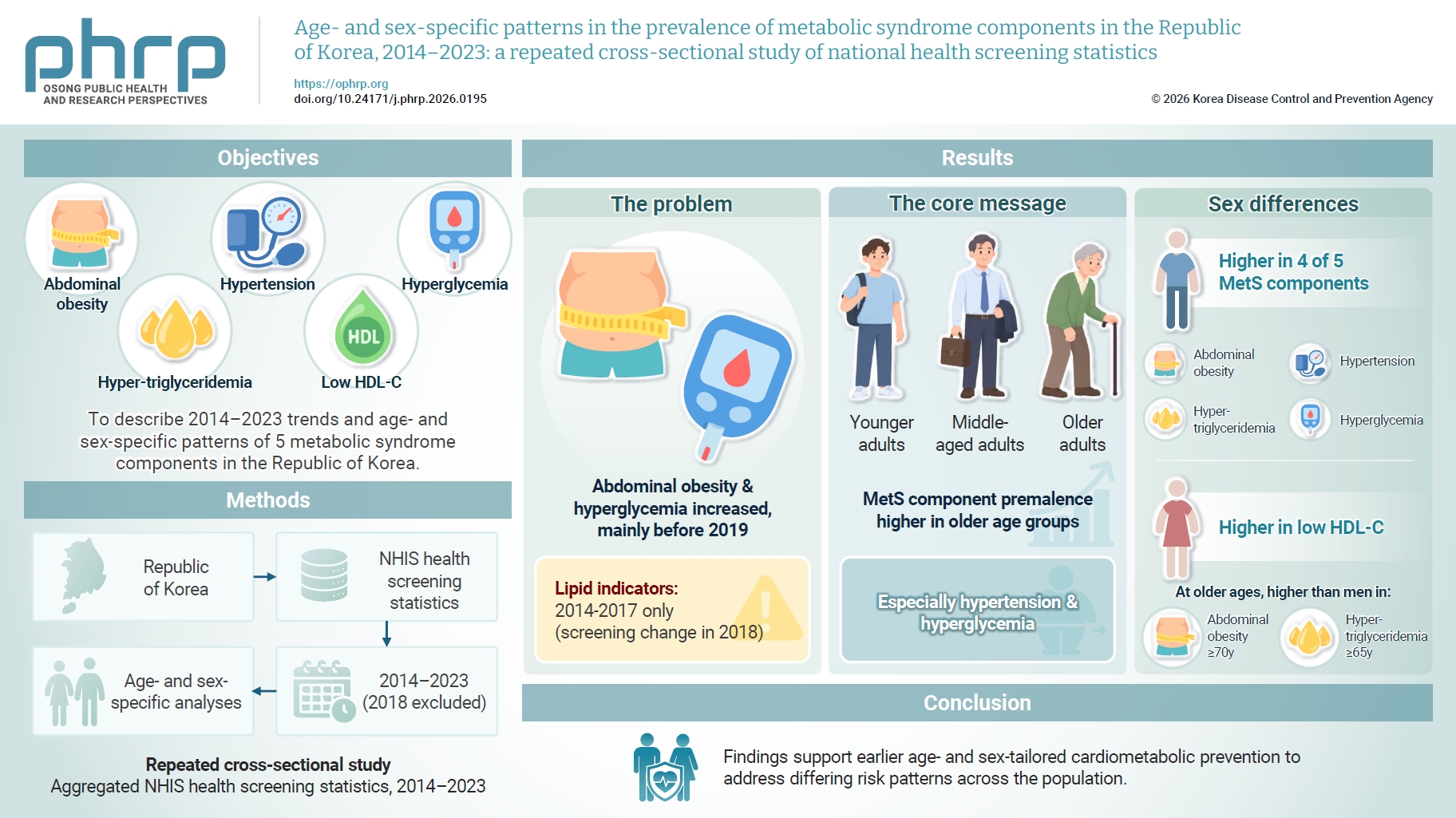
Objectives This study described 10-year trends in the prevalence of 5 metabolic syndrome (MetS) components and examined age- and sex-specific patterns in the Republic of Korea using aggregated national health screening statistics from 2014 to 2023. Methods: This repeated cross-sectional study used publicly available aggregated data from the National Health Screening Statistical Yearbook of the National Health Insurance Service. Annual prevalence estimates were summarized overall and by age group and sex. Linear and segmented regression summarized trends, and age- and sex-standardized prevalence was estimated. The 2018 yearbook tabulated risk factors only for examinees receiving the dyslipidemia panel (restricted from 2018 to men aged ≥24 years and women aged ≥40 years); therefore, 2018 was excluded, and lipid indicators were analyzed for 2014–2017. Results: From 2014 to 2023, crude prevalence increased for abdominal obesity (21.0% to 25.5%) and hyperglycemia (34.7% to 40.1%), mainly before 2019, and for hypertension (42.3% to 45.1%), although less after age standardization. In 2014–2017, hypertriglyceridemia increased (30.0% to 32.2%), whereas low high-density lipoprotein (HDL) cholesterol changed little (22.5% to 22.1%). Prevalence was higher in older age groups, especially for hypertension and hyperglycemia. Men had a higher prevalence of 4 components, and women of low HDL cholesterol. Conclusion: MetS components showed heterogeneous temporal, age-specific, and sex-specific patterns in Korean national health screening statistics. Increases in abdominal obesity and hyperglycemia, mainly before 2019, support earlier age- and sex-tailored cardiometabolic prevention, whereas lipid indicators were comparable only for 2014–2017. Individual-level longitudinal studies are needed to clarify these trends.


 First
 Prev


