

| Sun-Whan Park | 2 Articles |
Objectives
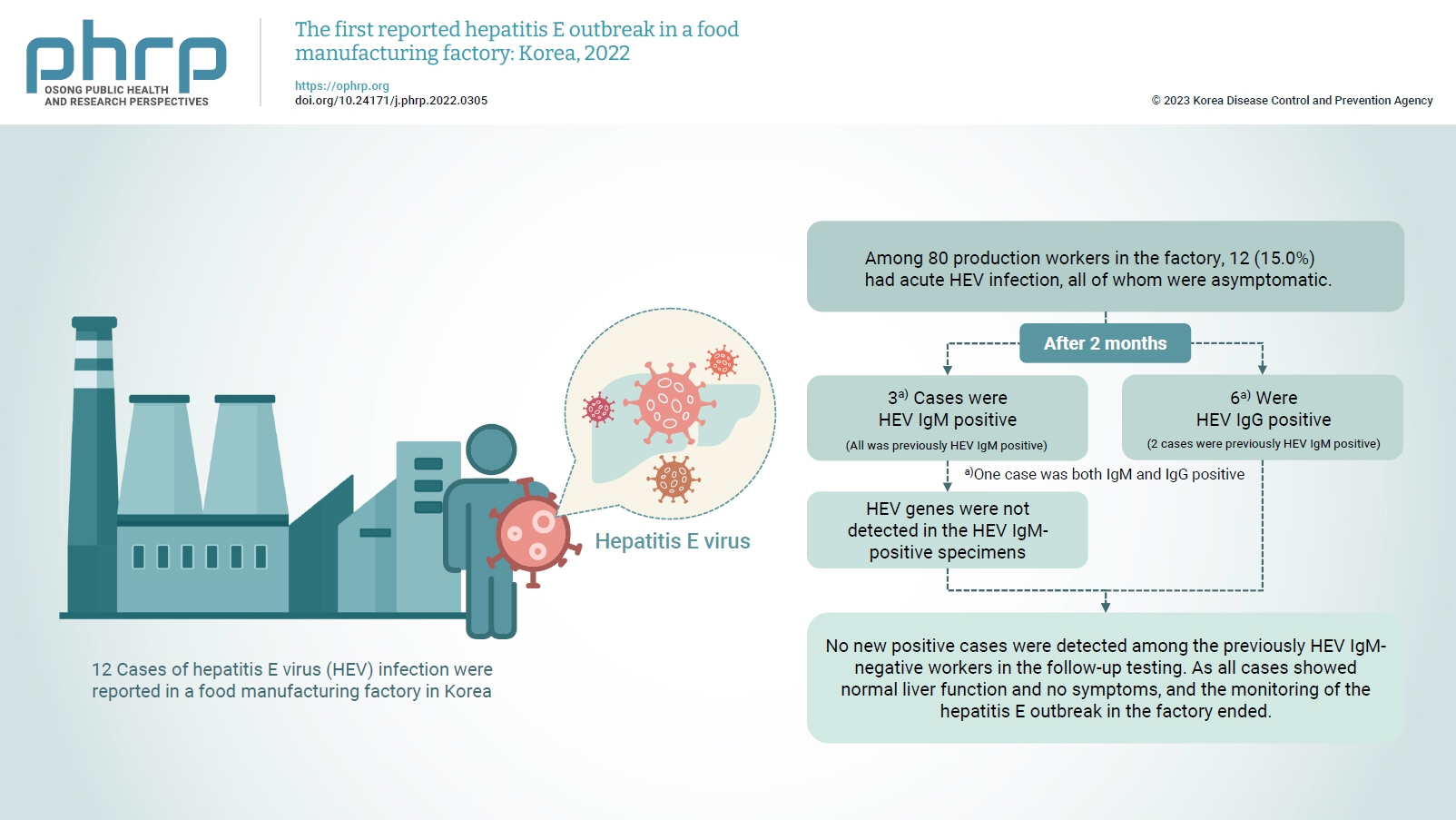
On February 16, 2022, 12 cases of hepatitis E virus (HEV) infection were reported in a food manufacturing factory in Korea. The aim of this study was to identify additional cases and to determine the source of this HEV outbreak. Methods: This study was an in-depth investigation of 12 HEV immunoglobulin M (IgM)-positive cases and their demographic, clinical, and epidemiological characteristics. On-site specimens were collected from the environment and from humans, and a follow-up investigation was conducted 2 to 3 months after the outbreak. Results: Among 80 production workers in the factory, 12 (15.0%) had acute HEV infection, all of whom were asymptomatic. The follow-up investigation showed that 3 cases were HEV IgMpositive, while 6 were HEV IgG-positive. HEV genes were not detected in the HEV IgM-positive specimens. HEV genes were not detected in the food products or environmental specimens collected on-site. HEV was presumed to be the causative pathogen. However, it could not be confirmed that the source of infection was common consumption inside the factory. Conclusion: This was the first domestic case of an HEV infection outbreak in a food manufacturing factory in Korea. Our results provide information for the future control of outbreaks and for the preparation of measures to prevent domestic outbreaks of HEV infection. Citations
Citations to this article as recorded by

Objectives
Ebola and Marburg viruses (EBOVs and MARVs, respectively) are causative agents of severe hemorrhagic fever with high mortality rates in humans and nonhuman primates. In 2014, there was a major Ebola outbreak in various countries in West Africa, including Guinea, Liberia, Republic of Sierra Leone, and Nigeria. EBOV and MARV are clinically difficult to diagnose and distinguish from other African epidemic diseases. Therefore, in this study, we aimed to develop a method for rapid identification of the virus to prevent the spread of infection. Methods We established a conventional one-step reverse transcription-polymerase chain reaction (RT-PCR) assay for these pathogens based on the Superscript Reverse Transcriptase-Platinum <i>Taq</i> polymerase enzyme mixture. All assays were thoroughly optimized using <i>in vitro</i>-transcribed RNA. Results We designed seven primer sets of nucleocapsid protein (NP) genes based on sequences from seven filoviruses, including five EBOVs and two MARVs. To evaluate the sensitivity of the RT-PCR assay for each filovirus, 10-fold serial dilutions of synthetic viral RNA transcripts of EBOV or MARV NP genes were used to assess detection limits of viral RNA copies. The potential for these primers to cross react with other filoviruses was also examined. The results showed that the primers were specific for individual genotype detection in the examined filoviruses. Conclusion The assay established in this study may facilitate rapid, reliable laboratory diagnosis in suspected cases of Ebola and Marburg hemorrhagic fevers. Citations
Citations to this article as recorded by
|
|


