

| Santi Martini | 2 Articles |
Objectives
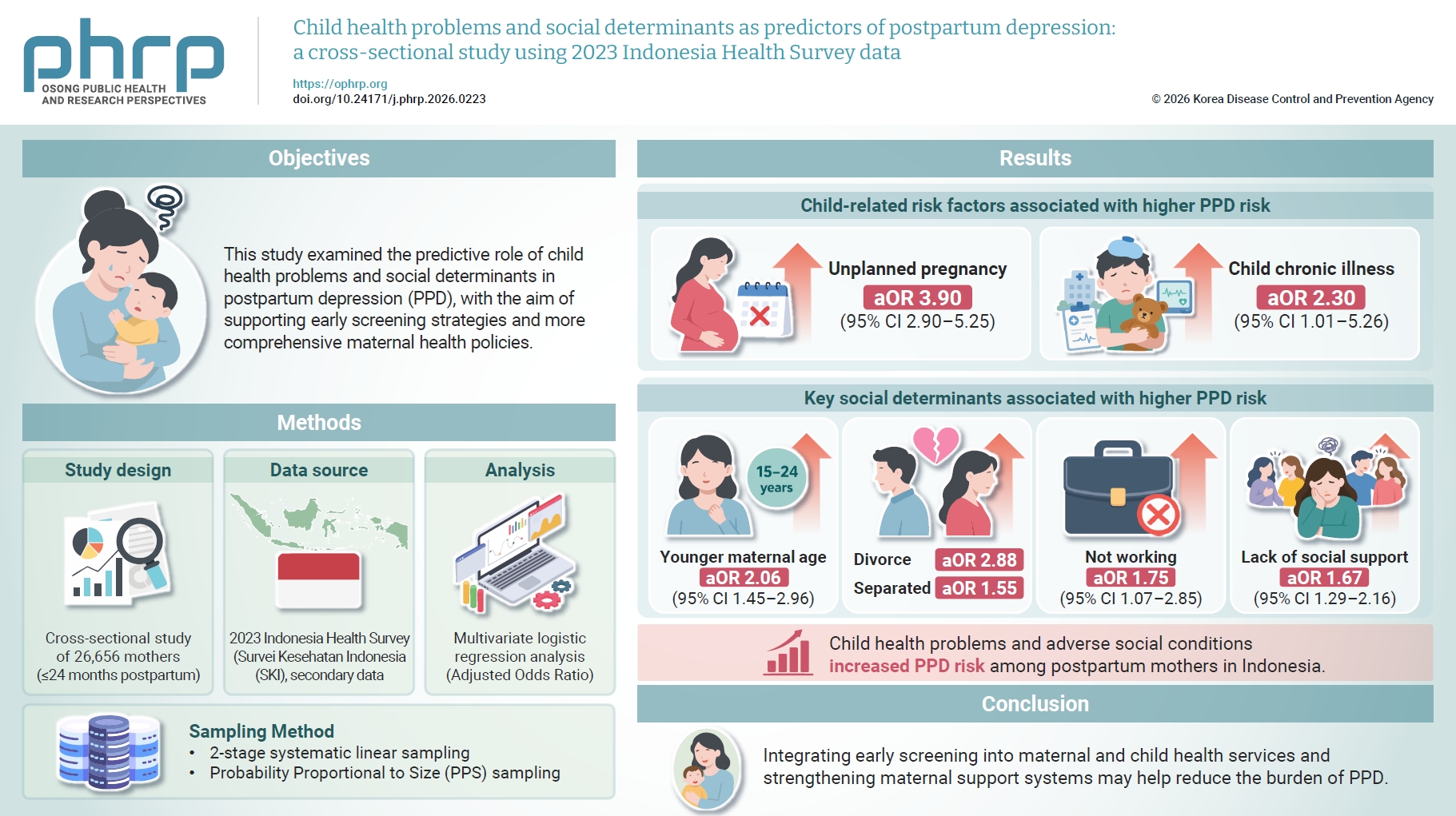
This study examined the predictive role of child health problems and social determinants in postpartum depression (PPD), with the aim of supporting early screening strategies and more comprehensive maternal health policies. Methods: This cross-sectional study used secondary data from the 2023 Indonesia Health Survey, conducted by the Indonesian Ministry of Health. The analysis included 26,656 postpartum women aged at least 15 years who had given birth within the previous 24 months. PPD was assessed using the Mini International Neuropsychiatric Interview. Multiple logistic regression was used to analyze the data. Results: Child health problems were among the strongest factors associated with PPD in Indonesia. Having had an unplanned pregnancy was associated with higher odds of PPD (adjusted odds ratio [aOR], 3.90; 95% confidence interval [CI], 2.90–5.25; p < 0.001), as was having a child with chronic illness (aOR, 2.30; 95% CI, 1.01–5.26; p= 0.048). Social risk factors, including younger maternal age, divorce or separation from a partner, unemployment, and lack of social support, were also associated with PPD in Indonesia. Conclusion: Child health problems and adverse social conditions were significantly associated with postpartum mental health in Indonesia. Integrating early screening into maternal and child health services and strengthening maternal support systems may help reduce the burden of PPD.
<sec><title>Objectives</title><p>The purpose of this study was to evaluate patient factors such as knowledge, attitude, motivation, perception, socio-economic status and travel time to health facilities and assess how these factors affected patients’ decision to pursue cervical cancer screening with visual inspection with acetic acid (VIA).</p></sec><sec><title>Methods</title><p>A total of 80 women of childbearing age who visited Kenjeran and Balongsari Public Health Centers for health assessments were involved in this study. Patients who agreed to participate in the study underwent a verbal questionnaire to evaluate various factors.</p></sec><sec><title>Results</title><p>Bivariate analysis concluded that knowledge, attitude, motivation, perception, socioeconomic status, and travel time to health facilities were significantly different between women who received VIA screening and women who did not receive VIA screening (<italic>p</italic> < 0.05). The factors of knowledge, attitudes, motivation, perception, socio-economic status, and the travel time to health facilities accounted for 2.920-fold, 2.043-fold, 3.704-fold, 2.965-fold, 3.198-fold and 2.386-fold possibility, respectively, of patients to pursue cervical cancer screening with VIA. Multivariate analysis showed that perception, socio-economic status, and travel time to health facilities were the most important factors influencing whether or not women pursued VIA screening.</p></sec><sec><title>Conclusion</title><p>Knowledge, attitude, motivation, perception, socio-economic status, and travel time to health facilities appears to affect women’s’ decision to pursue cervical cancer screening with VIA, with the largest intake being the motivational factor.</p></sec>
Citations
Citations to this article as recorded by

|
|


