

| Maryem Arraji | 3 Articles |

Objectives
This study was performed to evaluate the prevalence of medication adherence and its determinants among Moroccan patients with type 2 diabetes mellitus. Methods: A multicenter cross-sectional survey was conducted from February to June 2024, involving 584 patients from the Casablanca-Settat and Rabat-Sale-Kenitra regions of Morocco. Medication adherence was assessed using the general medication adherence scale. Associations between independent variables and adherence were analyzed using chi-square tests and multivariate logistic regression. Results: Medication adherence was observed in 96.2% of participants. Multivariate analysis revealed significantly lower medication adherence among patients using 2 or more oral antidiabetic drugs (adjusted odds ratio [aOR], 0.026; 95% confidence interval [CI], 0.001–0.642; p=0.026) and those with a diabetes duration of 11 to 15 years (aOR, 0.037; 95% CI, 0.001–0.956; p=0.047). Conclusion: Despite a high overall adherence rate, patients on dual or polytherapy and those with longer disease duration exhibited lower adherence in multivariate analysis. Targeted interventions are needed to improve adherence in these high-risk groups.
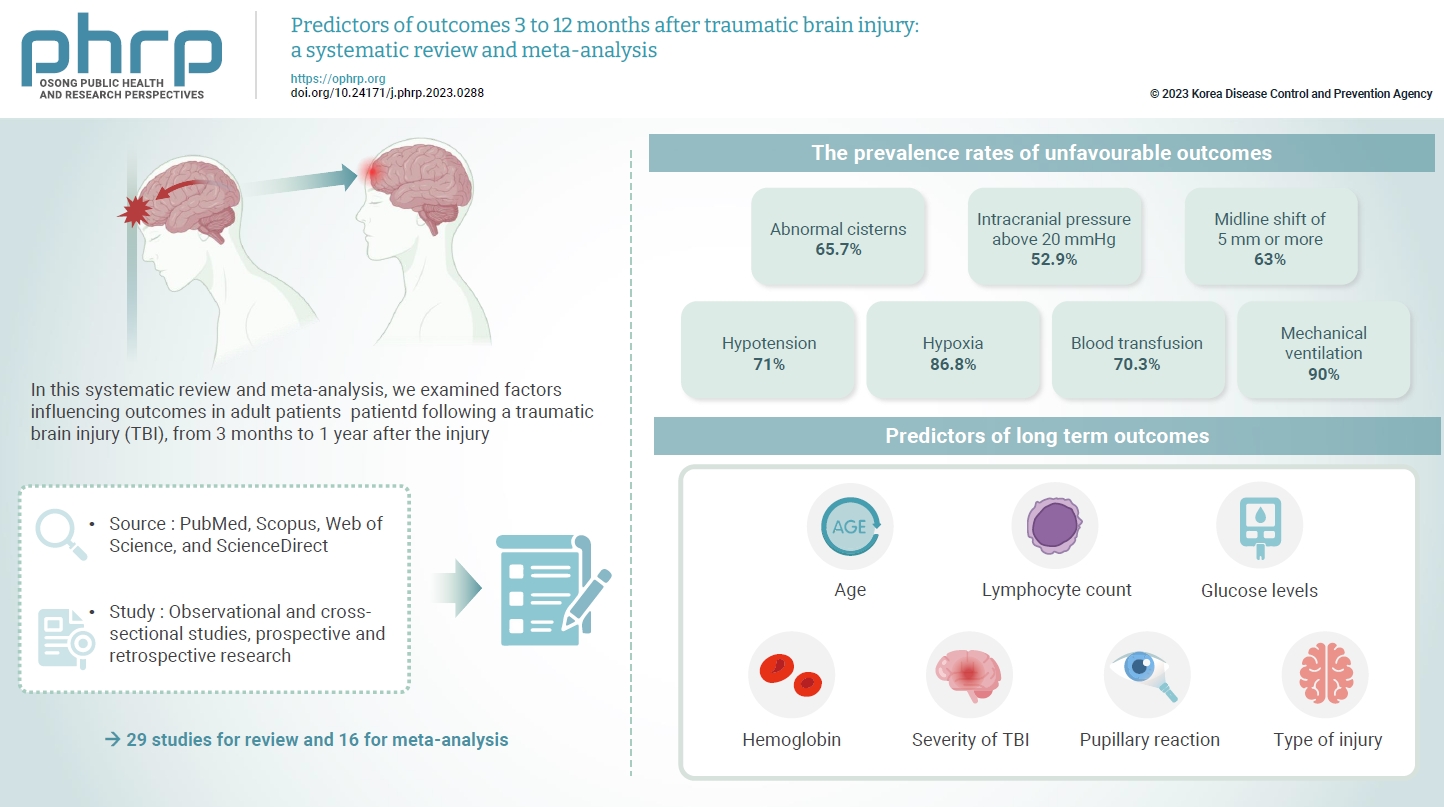
The exact factors predicting outcomes following traumatic brain injury (TBI) remain elusive. In this systematic review and meta-analysis, we examined factors influencing outcomes in adult patients with TBI, from 3 months to 1 year after injury. A search of four electronic databases—PubMed, Scopus, Web of Science, and ScienceDirect—yielded 29 studies for review and 16 for meta-analysis, in accordance with the Preferred Reporting Items for Systematic Reviews and Meta-Analysis guidelines. In patients with TBI of any severity, mean differences were observed in age (8.72 years; 95% confidence interval [CI], 4.77–12.66 years), lymphocyte count (−0.15 109/L; 95% CI, −0.18 to −0.11), glucose levels (1.20 mmol/L; 95% CI, 0.73–1.68), and haemoglobin levels (−0.91 g/dL; 95% CI, −1.49 to −0.33) between those with favourable and unfavourable outcomes. The prevalence rates of unfavourable outcomes were as follows: abnormal cisterns, 65.7%; intracranial pressure above 20 mmHg, 52.9%; midline shift of 5 mm or more, 63%; hypotension, 71%; hypoxia, 86.8%; blood transfusion, 70.3%; and mechanical ventilation, 90%. Several predictors were strongly associated with outcome. Specifically, age, lymphocyte count, glucose level, haemoglobin level, severity of TBI, pupillary reaction, and type of injury were identified as potential predictors of long-term outcomes.
Citations
Citations to this article as recorded by

Objectives
Medication adherence remains a major challenge in the management of type 2 diabetes (T2D), especially in middle-income countries such as Morocco. With the rapid development of artificial intelligence, large language models, including ChatGPT, may offer new opportunities for clinical research through simulated patient profiles. This study examined the feasibility of using ChatGPT to generate culturally contextualized virtual profiles of Moroccan patients with T2D and to apply the validated Moroccan Arabic dialect version of the general medication adherence scale (GMAS). Methods: This exploratory pilot simulation study used ChatGPT-4 to generate 11 virtual profiles based on representative sociodemographic and clinical characteristics of Moroccan patients with T2D. Each profile was administered the validated Moroccan Arabic dialect version of the GMAS. Results: Four profiles (36.4%) showed high adherence, 6 (54.5%) displayed moderate adherence, and 1 (9.1%) exhibited low adherence. Expert evaluations were consistent, with all ratings ≥3 on a 4-point scale, supporting the credibility and cultural appropriateness of the profiles. The simulated patterns reflected real-world trends, with higher adherence among profiles treated with oral antidiabetic drugs, covered by health insurance, and having shorter disease duration, and lower adherence among profiles using insulin, lacking insurance, and having longer disease duration. Conclusion: ChatGPT generated credible, culturally adapted patient profiles that enabled application of a validated psychometric tool in a simulated environment. This rapid, low-cost approach may support exploratory research, healthcare training, and intervention design. Comparative studies using real patient data are needed to confirm validity.
|
|


