

| Jungyeon Yu | 3 Articles |
Objectives
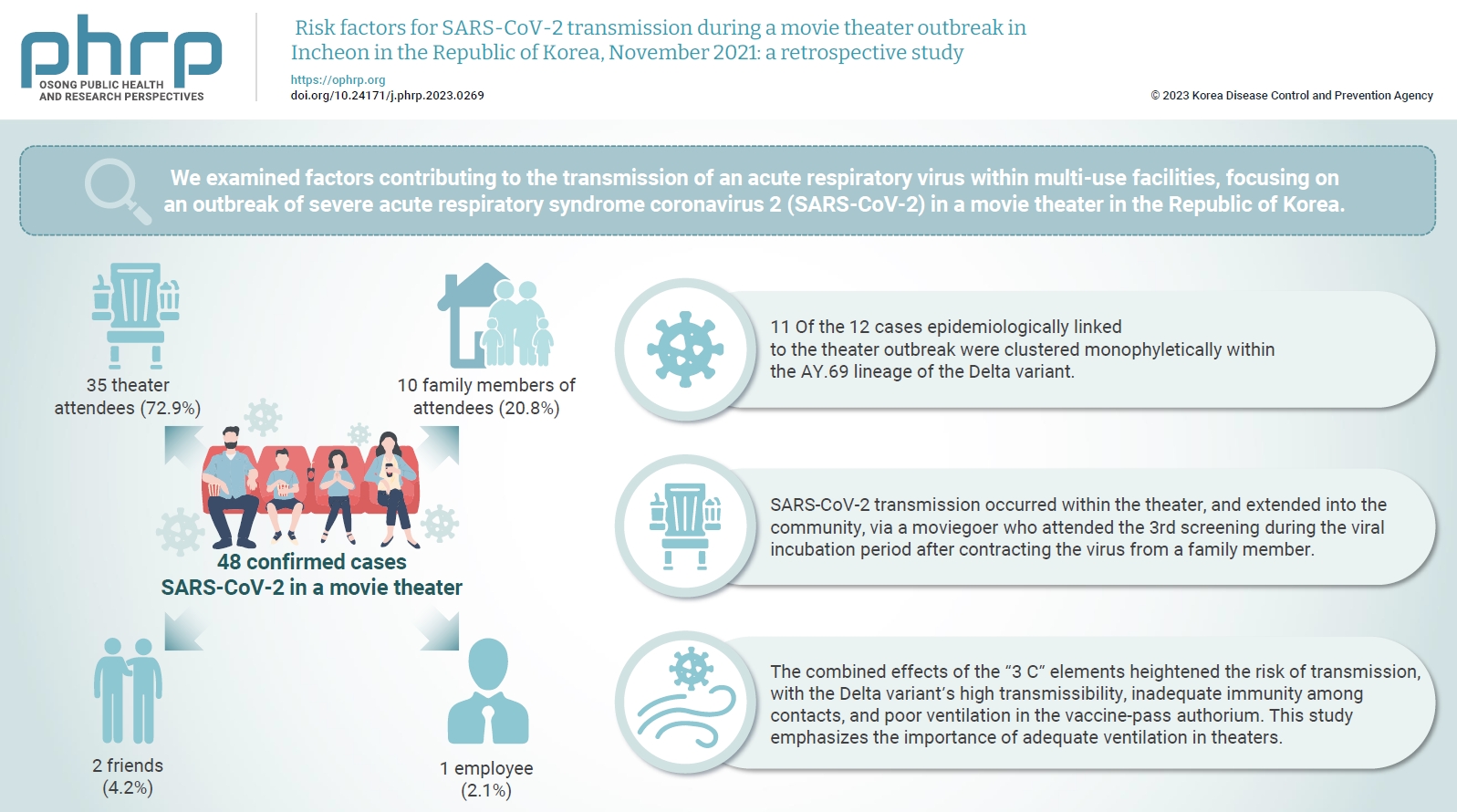
We examined factors contributing to the transmission of an acute respiratory virus within multi-use facilities, focusing on an outbreak of severe acute respiratory syndrome coronavirus 2 (SARS-CoV-2) in a movie theater in the Republic of Korea. Methods: This retrospective cohort study involved a descriptive analysis of 48 confirmed cases. Logistic regression was applied to a cohort of 80 theater attendees to identify risk factors for infection. The infection source and transmission route were determined through gene sequencing data analysis. Results: Of the 48 confirmed cases, 35 were theater attendees (72.9%), 10 were family members of attendees (20.8%), 2 were friends (4.2%), and 1 was an employee (2.1%). Among the 80 individuals who attended the 3rd to 5th screenings of the day, 35 became infected, representing a 43.8% attack rate. Specifically, 28 of the 33 third-screening attendees developed confirmed SARSCoV-2, constituting an 84.8% attack rate. Furthermore, 11 of the 12 cases epidemiologically linked to the theater outbreak were clustered monophyletically within the AY.69 lineage. At the time of the screening, 35 individuals (72.9%) had received 2 vaccine doses. However, vaccination status did not significantly influence infection risk. Multivariate analysis revealed that close contacts had a 15.9-fold higher risk of infection (95% confidence interval, 4.37–78.39) than casual contacts. Conclusion: SARS-CoV-2 transmission occurred within the theater, and extended into the community, via a moviegoer who attended the 3rd screening during the viral incubation period after contracting the virus from a family member. This study emphasizes the importance of adequate ventilation in theaters. Citations
Citations to this article as recorded by

Objectives
It is crucial to establish the characteristics of coronavirus disease 2019 (COVID-19) outbreaks at army training centers to develop preventive measures. Therefore, this study aimed to determine the COVID-19 transmission patterns and risk factors in a sequence of outbreaks at an army training center from June to August 2021. Methods This study included 1,324 trainees at an army training center where outbreaks occurred from June to August 2021. The outbreak was qualitatively analyzed according to the period, attack rate, demographic characteristics, vaccination history, and living areas. An aerodynamic experiment was performed to evaluate aerosol transmission in living areas. Results Three outbreaks occurred at the army training center from June to August 2021. The first, second, and third outbreaks lasted for 32, 17, and 24 days, and the attack rates were 12.8%, 18.1%, and 8.9%, respectively. Confirmed cases were distributed in all age groups. Recruits and the unvaccinated were at higher risk for COVID-19. The aerodynamic experiment verified the possibility of aerosol transmission within the same living area. Conclusion COVID-19 transmission at army training centers should be minimized through quarantine and post-admission testing during the latency period as part of integrated measures that include facility ventilation, vaccination, indoor mask-wearing, and social distancing. Citations
Citations to this article as recorded by
Objectives
This study investigated associations between building structure and managers’ knowledge, attitudes, and practices (KAP) regarding indoor air quality in welfare facilities for persons with disabilities, comparing facilities with and without coronavirus disease 2019 (COVID-19) cluster outbreaks. Methods: A web-based survey was conducted among managers of 242 welfare facilities for persons with disabilities in the Republic of Korea. Facilities were recruited from a national sampling frame of approximately 3,000 facilities, yielding a response rate of 8.1%. The 80-item questionnaire assessed building characteristics and air quality-related KAP scores. Logistic regression was used to identify factors associated with cluster outbreaks. Results: Of the 242 facilities, 50.8% had experienced cluster outbreaks. Facilities in complex/multi-use buildings had higher odds of outbreaks than those in detached buildings did (adjusted odds ratio, 2.21; 95% confidence interval, 1.25–3.91; p=0.006). For managerial factors, facilities with outbreaks tended to have lower attitude scores (p=0.02); however, this association did not remain statistically significant after Bonferroni correction (adjusted α=0.0083). No significant differences were observed in knowledge or practice scores. Conclusion: Building structure, particularly complex/multi-use configuration, was associated with COVID-19 cluster outbreaks. Managerial KAP scores were not definitively associated with outbreaks under the conservative significance threshold, but the observed trends suggest that institutional support, ventilation guidance, and practical training for facility managers may help strengthen future infection-prevention efforts.
|
|


