

| Jiyoon Lee | 2 Articles |
Objectives
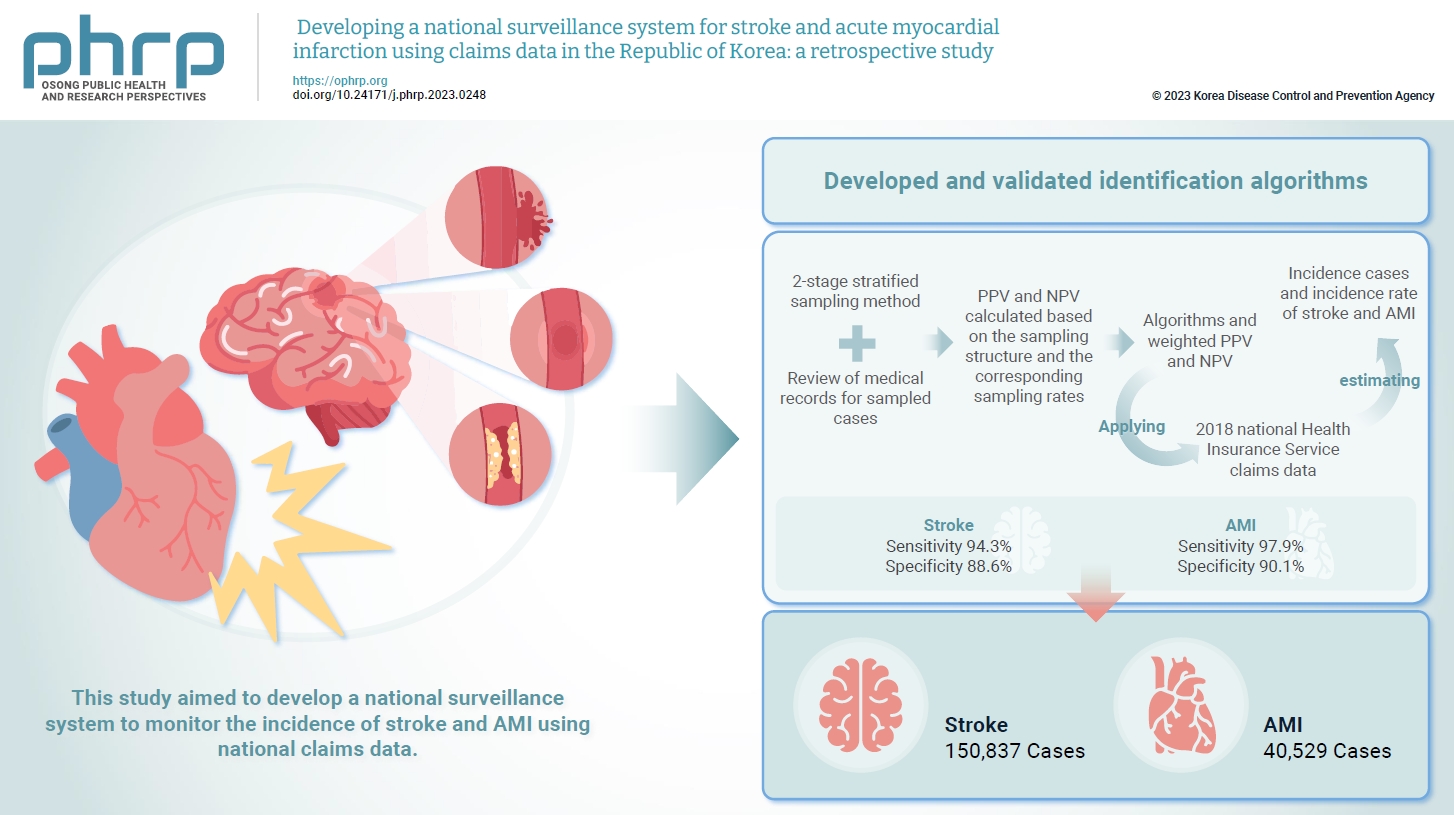
Limited information is available concerning the epidemiology of stroke and acute myocardial infarction (AMI) in the Republic of Korea. This study aimed to develop a national surveillance system to monitor the incidence of stroke and AMI using national claims data. Methods: We developed and validated identification algorithms for stroke and AMI using claims data. This validation involved a 2-stage stratified sampling method with a review of medical records for sampled cases. The weighted positive predictive value (PPV) and negative predictive value (NPV) were calculated based on the sampling structure and the corresponding sampling rates. Incident cases and the incidence rates of stroke and AMI in the Republic of Korea were estimated by applying the algorithms and weighted PPV and NPV to the 2018 National Health Insurance Service claims data. Results: In total, 2,200 cases (1,086 stroke cases and 1,114 AMI cases) were sampled from the 2018 claims database. The sensitivity and specificity of the algorithms were 94.3% and 88.6% for stroke and 97.9% and 90.1% for AMI, respectively. The estimated number of cases, including recurrent events, was 150,837 for stroke and 40,529 for AMI in 2018. The age- and sex-standardized incidence rate for stroke and AMI was 180.2 and 46.1 cases per 100,000 person-years, respectively, in 2018. Conclusion: This study demonstrates the feasibility of developing a national surveillance system based on claims data and identification algorithms for stroke and AMI to monitor their incidence rates. Citations
Citations to this article as recorded by

Objectives
Chronic degenerative diseases are closely related to daily eating habits, nutritional status, and, in particular, energy intake. In clarifying these relationships it is very important for dietary surveys to report accurate information about energy intake. This study attempted to identify the prevalence of the under-reporting of energy intake and its related characteristics based on the Korean National Health and Nutrition Examination Survey conducted in the years 2007–2009. Methods The present study analyzed dietary intake data from 15,133 adults aged ≥19 years using 24-hour dietary recalls. Basal metabolic rates were calculated from the age- and gender-specific equations of Schofield and under-reporting was defined as an energy intake <0.9, represented by the ratio of energy intake to estimated basal metabolic rate. Results Under-reporters (URs) accounted for 14.4% of men and 23.0% of women and the under-reporting rate was higher in the age group 30–49 years for both men and women. The results from an analysis of the age-specific socioeconomic characteristics of participants classified as URs showed that under-reporting was high in women living alone and in women with only elementary school education or no education. The results from an analysis of the health-specific characteristics of URs showed that a large proportion of URs had poor self-rated health or were obese, or both, compared with non-URs. The proportion of participants who consumed less than the estimated average requirements for nutrients was significantly higher in URs compared with non-URs. Conclusion The under-reporting of energy intake was associated with age, gender, education level, income level, household status (single-person or multi-person), self-rated health, physical activity, and obesity. Citations
Citations to this article as recorded by
|
|


