

| Jieun Kim | 5 Articles |

Objectives
In the Republic of Korea, the previous surveillance system for zoonotic tuberculosis (TB) involved the X-ray testing of humans in contact with Mycobacterium bovis-infected livestock. In contrast, the updated surveillance system incorporates the genotyping of cultured Mycobacterium isolates for high-risk occupational groups. This study aimed to systematically document the detection, diagnosis, assessment, and response in the epidemic investigation of zoonotic TB in a laboratory worker in the Republic of Korea. Methods M. bovis was confirmed using spoligotyping and whole genome sequencing. Clinical characteristics were reviewed through epidemiological investigation and interviews with the affected individual. Transmission routes and secondary spread were assessed via field epidemiological investigations and contact evaluations using chest X-ray and interferon gamma release assay for latent TB infection. Results A 56-year-old laboratory worker presented with chest X-ray findings compatible with TB and subsequently tested positive for M. bovis. She had no clinical or family history of TB and remained asymptomatic. She completed a 6 month treatment regimen of isoniazid, rifampin, ethambutol, and pyrazinamide without hospitalization. Although no direct transmission pathways for zoonotic TB were identified, her work in a laboratory, processing specimens for zoonotic TB, indicated potential laboratory related exposure. Conclusion This case underscores the importance of stringent use of personal protective equipment among high-risk occupational groups and the implementation of an enhanced surveillance system to report zoonotic TB. These findings highlight the need for a One Health approach and proactive surveillance, emphasizing the necessity of refining and strengthening surveillance systems for precise monitoring and an effective response. Citations
Citations to this article as recorded by


Objectives
Between July 2, 2021, and September 20, 2022, a Mycobacterium bovis outbreak occurred among exhibition animals at a zoo in the Republic of Korea. This study was conducted to assess the likelihood of M. bovis transmission to human contacts through a contact investigation and to implement preventive treatment for latent tuberculosis infection (LTBI). Methods: In this descriptive study, the Korea Disease Control and Prevention Agency conducted a contact investigation, which included interviews, interferon-gamma release assay (IGRA) tests, and chest X-rays. Contacts underwent IGRA testing on 2 occasions: initial testing of 29 contacts (15 in the first cluster of infection and 14 in the second cluster) and follow-up testing of the 15 contacts in the first cluster. Results: The study included 29 participants, 18 of whom were male (62.1%) and 11 female (37.9%). The mean participant age was 37.3 years (standard deviation, 9.6 years). In the initial IGRA tests, 6 of the 29 participants tested positive, indicating a prevalence of 20.7%. Following prolonged exposure, 1 additional positive case was detected in follow-up testing, raising the prevalence of LTBI to 24.1%. None of the contacts had active tuberculosis. Among the 7 individuals with positive results, 2 (28.6%) underwent treatment for LTBI. Conclusion: This study faced challenges in confirming the transmission of M. bovis infection from infected animals to humans in the Republic of Korea. Nevertheless, adopting a One Health approach necessitates the implementation of surveillance systems and infection control protocols, particularly for occupational groups at high risk of exposure. Citations
Citations to this article as recorded by
Objectives
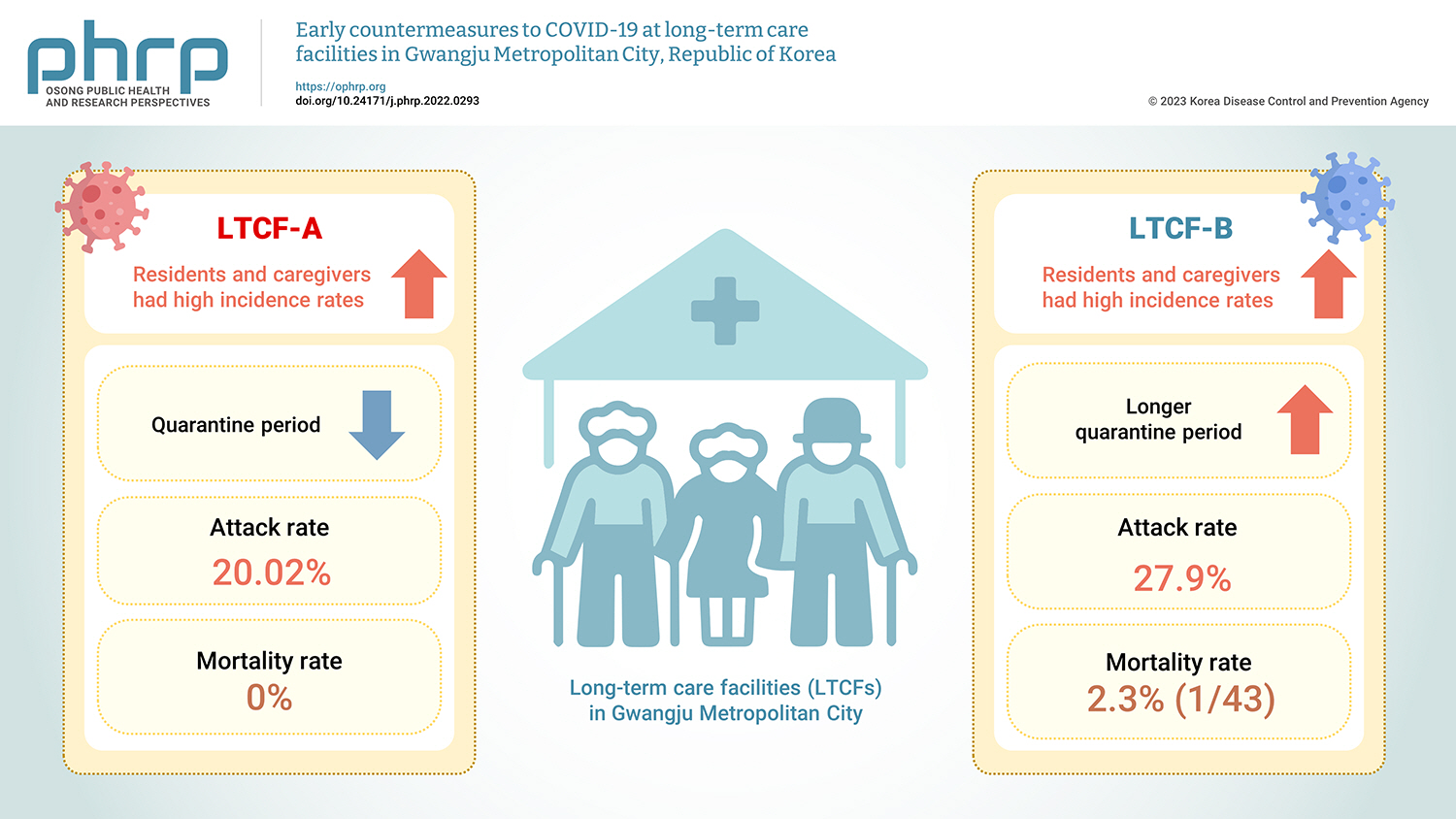
The coronavirus disease 2019 (COVID-19) pandemic has continued since its first detection in the Republic of Korea on January 20, 2020. This study describes the early countermeasures used to minimize the risk of COVID-19 outbreaks during cohort quarantine and compares the epidemiological characteristics of 2 outbreaks in long-term care facilities (LTCFs) in Gwangju Metropolitan City in summer 2020. Methods: An epidemiological investigation was conducted via direct visits. We investigated epidemiological characteristics, including incidence, morbidity, and mortality rates, for all residents and staff members. Demographic characteristics were analyzed using a statistical program. Additionally, the method of managing infection in LTCFs is described. Results: Residents and caregivers had high incidence rates in LTCF-A and LTCF-B, respectively. LTCF-B had a longer quarantine period than LTCF-A. The attack rate was 20.02% in LTCF-A and 27.9% in LTCF-B. The mortality rate was 2.3% (1/43) in LTCF-B, the only facility in which a COVID-19 death occurred. Conclusion: Extensive management requires contact minimization, which involves testing all contacts to mitigate further transmission in the early stages of LTCF outbreaks. The findings of this study can help inform and prepare public health authorities for COVID-19 outbreaks, particularly for early control in vulnerable facilities. Citations
Citations to this article as recorded by
<p>This study describes the epidemiological characteristics of coronavirus disease 2019 (COVID-19) based on reported cases from long-term care facilities. As of April 20<sup>th</sup>, 2020, 3 long-term care facilities in a metropolitan area of South Korea had reported cases of COVID-19. These facilities’ employees were presumed to be the sources of infection. There were 2 nursing hospitals that did not report any additional cases. One nursing home had a total of 25 cases, with an attack rate of 51.4% (95% CI 35.6–67.0), and a fatality rate of 38.9% (95% CI 20.3–61.4) among residents. The results from this study suggest that early detection and maintenance of infection control minimizes the risk of rapid transmission.</p>
Citations
Citations to this article as recorded by
Objectives
This study aimed to check the status of the contact investigation in congregate settings to eradicate tuberculosis (TB) in the Republic of Korea. Methods The “Integrated System for Disease and Public Health Management” is used for care and follow-up for patients and contacts of TB. We downloaded data for contact investigations conducted from January to December 2013. Results A total of 1,200 contact investigations in congregate settings were carried out by 25 field investigators in 2013. We performed the status of contact investigation, TB, and LTBI rate by age, accept rate of LTBI treatment, and complete rate of LTBI treatment during 2013. A total of 1,547 index TB patients, 149,166 contacts, and 259 additional TB patients were found through the investigation. Kindergartens showed the highest LTBI rate, 19.8%, among educational facilities. The second highest was in elementary schools and the subtotal LTBI rate of educational facilities was 7.8%. Social welfare/correctional facilities and workplaces showed relatively high LTBI rates of 23.8% and 23.6%, respectively. By age, individuals >35 years showed the highest LTBI rate, followed by those aged 0–4 years, 30–34 years, and 5–9 years, with rates of 18.1%, 16.4%, and 15.4% respectively. When comparing the tuberculin skin test (TST) positive conversion ratio by facility, middle school and high school were relatively high compared to the others. The accept rate of LTBI treatment in the workplace was lowest at 63% and the complete rate in elementary schools was lowest at 76.5%. Conclusion TB contact investigation is considered as a meaningful strategy for preventing TB outbreaks in congregate settings and decreasing the prevalence of TB in young people. Results of this study could be used to establish the LTBI management policy. Citations
Citations to this article as recorded by
|
|


