
Skip to contents Skip to Global Navigation Menu
  • KDCA
  • Contact us
  • E-Submission

PHRP : Osong Public Health and Research Perspectives

OPEN ACCESS. pISSN: 2210-9099. eISSN: 2233-6052

Page Path

4
results for

"Indonesia"

Article category

Keywords

Publication year

Authors

Funded articles

"Indonesia"

Original Articles
Child health problems and social determinants as predictors of postpartum depression: a cross-sectional study using 2023 Indonesia Health Survey data
Tri Wurisastuti, Santi Martini
Received March 10, 2026  Accepted April 28, 2026  Published online May 27, 2026  
DOI: https://doi.org/10.24171/j.phrp.2026.0223    [Epub ahead of print]
Objectives
This study examined the predictive role of child health problems and social determinants in postpartum depression (PPD), with the aim of supporting early screening strategies and more comprehensive maternal health policies.
Methods
This cross-sectional study used secondary data from the 2023 Indonesia Health Survey, conducted by the Indonesian Ministry of Health. The analysis included 26,656 postpartum women aged at least 15 years who had given birth within the previous 24 months. PPD was assessed using the Mini International Neuropsychiatric Interview. Multiple logistic regression was used to analyze the data.
Results
Child health problems were among the strongest factors associated with PPD in Indonesia. Having had an unplanned pregnancy was associated with higher odds of PPD (adjusted odds ratio [aOR], 3.90; 95% confidence interval [CI], 2.90–5.25; p<0.001), as was having a child with chronic illness (aOR, 2.30; 95% CI, 1.01–5.26; p=0.048). Social risk factors, including younger maternal age, divorce or separation from a partner, unemployment, and lack of social support, were also associated with PPD in Indonesia.
Conclusion
Child health problems and adverse social conditions were significantly associated with postpartum mental health in Indonesia. Integrating early screening into maternal and child health services and strengthening maternal support systems may help reduce the burden of PPD.
  • 825 View
  • 42 Download
Rural-urban differences in common mental disorders among Indonesian youth: a cross-sectional national survey
Marizka Khairunnisa, Diah Yunitawati, Leny Latifah, Diyan Ermawan Effendi, Yunita Fitrianti, Sri Handayani, Hastin Dyah Kusumawardani
Osong Public Health Res Perspect 2024;15(5):440-450.
Published online August 21, 2024
DOI: https://doi.org/10.24171/j.phrp.2023.0385
Rural-urban differences in common mental disorders among Indonesian youth: a cross-sectional national survey
Objectives
The onset of common mental disorders (CMDs) is most prevalent among youth; thus, mental health management is crucial. We examined differences in risk and risk factor determinants regarding CMDs prevalence among youth in rural and urban Indonesia. Methods: This cross-sectional study utilized data from the 2018 Indonesia National Health Survey. The population comprised 122,114 respondents, aged 15 to 24 years, who had completed the 20-item Self-Report Questionnaire along with providing demographic and health behavior data. Chi-square testing and logistic regression were employed for analysis. Results: The CMDs risk was higher among urban than rural youth. Risk factors impacting both populations included being female, having a lower education level, consuming fewer than 7 portions of vegetables weekly, smoking, and drinking alcohol (p<0.05). Consuming under 7 portions of fruit weekly and being in the highest or lowest wealth quintile were significant risk factors only in urban youth, while unemployment and divorce were significant only among rural respondents (p<0.05). Marriage was protective against CMDs among rural participants. Conclusion: Being male, possessing a college degree, consuming at least 7 portions of vegetables weekly, not smoking, and not consuming alcohol were associated with reduced CMDs risk in urban and rural youth. Among rural youth, marriage and employment were linked to decreased risk, whereas divorce displayed the opposite relationship. In urban populations, consuming at least 7 portions of fruit weekly and belonging to neither the highest nor the lowest economic quintile were protective factors. Management strategies for CMDs in young people must address these considerations.

Citations

Citations to this article as recorded by  Crossref logo
  • Sociodemographic and Geographic Influences of Mental Health Literacy: A Cross-Sectional Survey Among Community Health Clinic Attendees in Tshwane, South Africa
    Oratilwe Penwell Mokoena, Eric Maimela, Dumisile Priscilla Madlala, Thembelihle Sam Ntuli
    International Journal of Environmental Research an.2026; 23(2): 228.     CrossRef
  • Depression, Anxiety and Stress Among Students at the University of Pristina-Kosovska Mitrovica, Kosovo and Metohija, Serbia
    Danijela Ilic, Jovana Milosevic, Jovana Todorovic, Zorica Terzic-Supic, Ilija Dragojevic, Mirjana Stojanovic-Tasic, Emilija Novakovic, Tijana Spasojevic, Svetozar Memarovic, Milivoje Galjak, Kristina Rakic, Mirijana Virijevic, Kristina Stevanovic, Jelena
    Healthcare.2026; 14(7): 958.     CrossRef
  • Interrelated adolescent-level food insecurity and common mental health disorders in Harari Region, Ethiopia: A cross-sectional study
    Kasiye Shiferaw, Gari Hunduma, Yadeta Dessie, Tesfaye Assebe Yadeta, Biftu Geda, Negussie Deyessa, Othman A. Alfuqaha
    PLOS One.2026; 21(5): e0348774.     CrossRef
  • Development and Psychometric Evaluation of the MHI-9: A Brief Dual-Factor Mental Health Screener for Nonclinical Filipino University Students
    Benedict G. Antazo
    Measurement and Evaluation in Counseling and Devel.2025; : 1.     CrossRef
  • Healthcare, caregiver and human capital costs associated with anxiety and depression among Indonesian youths
    Karen Arulsamy, Elmeida Effendy, Sarah Mardhiyah, Mustafa M Amin, M Surya Husada, Vita Camellia, Anne-Claire Stona, Eric Andrew Finkelstein
    BMJ Paediatrics Open.2025; 9(1): e003632.     CrossRef
  • 7,099 View
  • 237 Download
  • 4 Web of Science
  • Crossref
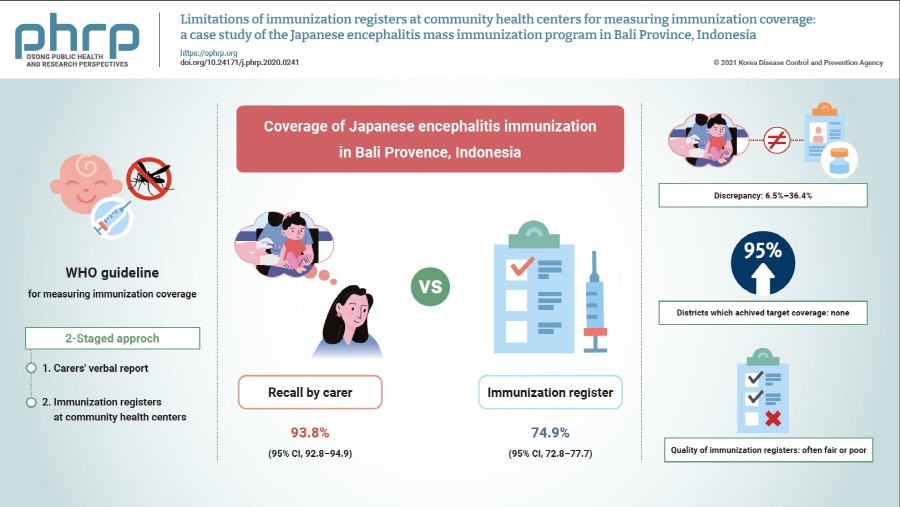
Limitations of immunization registers at community health centers for measuring immunization coverage: a case study of the Japanese encephalitis mass immunization program in Bali Province, Indonesia
Anak A. S. Sawitri, Putu C. D. Yuliyatni, Made D. Ariawan, Komang A. Kartika Sari, Raka Susanti, I Nyoman Sutarsa
Osong Public Health Res Perspect 2021;12(3):158-168.
Published online June 2, 2021
DOI: https://doi.org/10.24171/j.phrp.2020.0241
Limitations of immunization registers at community health centers for measuring immunization coverage: a case study of the Japanese encephalitis mass immunization program in Bali Province, Indonesia
Objectives
The aim of this study was to compare the coverage of Japanese encephalitis (JE) immunization obtained from a recall survey and immunization registers at community health centers (CHCs) in Bali Province, Indonesia.
Methods
A population-based survey was conducted, and random 2-staged selection of clusters of sub-villages was performed. The sample consisted of households with children aged 9 months to 15 years old. Interviews were carried out with carers to recall JE immunization status. The recall immunization status was considered valid when name, date, and confirmation of immunization were available in an immunization register at a CHC. Descriptive analysis was performed. The completeness of the information within immunization registers at CHCs was assessed.
Results
The coverage of JE immunization obtained from the recall survey was 93.8% (95% confidence interval [CI], 92.8–94.9). It decreased to 74.9% (95% CI, 72.8–77.2) after being validated against immunization registers. The recall coverage of JE immunization was significantly higher than immunization register data suggested. This discrepancy varied from 6.5% to 36.4% across 6 districts; however, none of these districts achieved the recommended target coverage of 95%. The quality of immunization registers varied across CHCs.
Conclusion
The use of an immunization register may result in underestimating the true coverage of vaccination programs, and its utilization for measuring immunization coverage requires further consideration.

Citations

Citations to this article as recorded by  Crossref logo
  • Japanese encephalitis in Bali, Indonesia: ecological and socio-cultural perspectives
    I Made Kardena, Anak Agung Ayu Mirah Adi, Nyoman Mantik Astawa, Mark O’Dea, Michael Laurence, Shafi Sahibzada, Mieghan Bruce
    International Journal of Veterinary Science and Me.2021; 9(1): 31.     CrossRef
  • 11,765 View
  • 173 Download
  • 1 Web of Science
  • Crossref
Nutritional Status of Indonesian Children in Low-Income Households with Fathers that Smoke
Maria Wijaya-Erhardt
Osong Public Health Res Perspect 2019;10(2):64-71.
Published online April 30, 2019
DOI: https://doi.org/10.24171/j.phrp.2019.10.2.04
<sec> <title>Objectives</title> <p>This study compared the nutritional status of children in low-income households in Indonesia whose fathers were either cigarette smokers or non-smokers.</p></sec> <sec> <title>Methods</title> <p>A cross sectional study of 482 children aged 2–6 years was conducted, stratified by whether the fathers were non-smoking (<italic>n</italic> = 138) or smoking (<italic>n</italic> = 340). Mothers and smoking fathers were interviewed about socioeconomic status and cigarette expenditure, respectively. The nutritional status of children was defined by weight-for-age, height-for-age and weight-for-height.</p></sec> <sec> <title>Results</title> <p>Both groups had similar income. Households with a father that smoked, spent 16.6% of their income on cigarettes. Children whose fathers did not smoke had higher height-for-age (−1.99 vs. −2.25 Z-score, <italic>p</italic> = 0.02) than children whose fathers smoked. Weight-for-age in children with fathers that did not smoke was greater (−1.49 vs. −1.64 Z-score) but not statistically significantly different to those children with fathers that smoked, nor was child weight-for-height (−0.46 vs. −0.45 Z-score). The prevalence of stunted growth was higher in the children with a father that smoked compared with those that had a father did not smoke (62.2 vs. 49.6%, <italic>p</italic> = 0.07, respectively). There were 28.3% of children underweight in homes where the fathers did not smoke, and 35.6% in households where the father smoked (<italic>p</italic> = 0.11). Wasting was observed in 4.4% children where fathers did not smoke and 4.7% where fathers did smoke.</p></sec> <sec> <title>Conclusion</title> <p>With similar income constraints, the degree of height growth faltering was less in children whose fathers did not smoke, compared to those whose fathers did smoke.</p></sec>

Citations

Citations to this article as recorded by  Crossref logo
  • Longitudinal Growth Patterns in Boys and Girls Aged 9–14 Years by Birth Season
    Arta Grabcika, Dzintra Kazoka, Janis Vetra, Mara Pilmane
    American Journal of Human Biology.2026;[Epub]     CrossRef
  • Nutrition Consumption and Impact on Stunting and Underweight among Children in the Tengger Community, East Java, Indonesia
    Lailatul Muniroh, Mahmud Aditya Rifqi, Diah Indriani, Chrysoprase Thasya Abihail, Annisa Socadevia
    Amerta Nutrition.2025; 9(1): 128.     CrossRef
  • THE ASSOCIATION BETWEEN PHYSICAL ACTIVITY, LEVEL OF STRESS, AND ECONOMIC STATUS WITH THE NUTRITIONAL STATUS AMONG ADOLESCENT FEMALES IN COASTAL REGIONS
    Kadek Ayu Dwi Wulandari, I I Putu Sudayasa, Sri Susanty
    The Indonesian Journal of Public Health.2025; 20(1): 120.     CrossRef
  • Crowding-out effect of tobacco consumption in Indonesia
    Arya Swarnata, Fariza Zahra Kamilah, I Dewa Gede Karma Wisana, Yurdhina Meilissa, Gita Kusnadi
    Tobacco Control.2024; 33(Suppl 2): s81.     CrossRef
  • Do parental Smoking Behaviors Affect Children's Thinness, Stunting, and Overweight Status in Indonesia? Evidence from a Large-Scale Longitudinal Survey
    Adrianna Bella, Teguh Dartanto, Dimitri Swasthika Nurshadrina, Gita Kusnadi, Faizal Rahmanto Moeis, Renny Nurhasana, Aryana Satrya, Hasbullah Thabrany
    Journal of Family and Economic Issues.2023; 44(3): 714.     CrossRef
  • Sustainable Iodized Salt Fortification Reduces the Risk of Underweight Among Under-Five Children
    Nadiyah, Idrus Jus'at, Devi Angeliana Kusumaningtiar, Anugrah Novianti
    Journal of Law and Sustainable Development.2023; 11(9): e1207.     CrossRef
  • Developmental trajectories of body mass index since childhood and health-related quality of life in young adulthood: Tehran Lipid and Glucose Study
    Parnian Parvin, Parisa Amiri, Mohammad Masih Mansouri-Tehrani, Leila Cheraghi, Amirali Zareie Shab-khaneh, Fereidoun Azizi
    Quality of Life Research.2022; 31(7): 2093.     CrossRef
  • Cigarette smoke exposure and increased risks of stunting among under-five children
    Dyah Dwi Astuti, Tri Widyastuti Handayani, Duwi Pudji Astuti
    Clinical Epidemiology and Global Health.2020; 8(3): 943.     CrossRef
  • The association between secondhand smoke exposure and growth outcomes of children: A systematic literature review
    Siti Nadhiroh, Kusharisupeni Djokosujono, Diah Mulyawati Utari
    Tobacco Induced Diseases.2020;[Epub]     CrossRef
  • 27,691 View
  • 273 Download
  • Crossref
Page of 1