Abstract
-
Objectives
The outbreak of Middle Eastern respiratory syndrome coronavirus (MERS-CoV) was one of the major events in South Korea in 2015. In particular, this study pays attention to formulating a mathematical model for MERS transmission dynamics and estimating transmission rates.
-
Methods
Incidence data of MERS-CoV from the government authority was analyzed for the first aim and a mathematical model was built and analyzed for the second aim of the study. A mathematical model for MERS-CoV transmission dynamics is used to estimate the transmission rates in two periods due to the implementation of intensive interventions.
-
Results
Using the estimates of the transmission rates, the basic reproduction number was estimated in two periods. Due to the superspreader, the basic reproduction number was very large in the first period; however, the basic reproduction number of the second period has reduced significantly after intensive interventions.
-
Conclusion
It turned out to be the intensive isolation and quarantine interventions that were the most critical factors that prevented the spread of the MERS outbreak. The results are expected to be useful to devise more efficient intervention strategies in the future.
-
Keywords:
Keywords
basic reproduction number; mathematical transmission model; Middle Eastern respiratory syndrome, coronavirus; parameter estimation
Introduction
One of the most significant events in South Korea in 2015 was the introduction and diffusion of Middle Eastern respiratory syndrome coronavirus (MERS-CoV). It is a novel coronavirus which was first identified in Saudi Arabia in September 2012
[1]. After that, MERS-CoV exhibited outbreaks in several regions and the last one was in South Korea (at the time of writing). It is known as having a high fatality rate and having a resemblance in clinical features with severe acute respiratory syndrome coronavirus (SARS-CoV)
[2], thus, it has drawn much concern both from the public health authority and the general public when the first index case was identified in May 2015, for the first time in Korea.
In the case of the outbreak in South Korea, it is characteristic in that a single importation of the pathogen sparked a large cluster of infected cases, while sporadic importations did not lead to local outbreaks in other regions
[3]. It was surprising because South Korea has been said to have one of the most advanced medical and public health systems in the world
[4], and it raises fears that the situation would be much worse in countries with less developed public health systems. Thus, the investigation of this study about the South Korean incidence is expected to give an invaluable lesson both to public health authorities around the world and the community of epidemiology researchers. Moreover, it might be able to provide a quantified result with mathematical modeling and statistical analysis, which is beneficial given that the studies about the South Korean case are largely comprised of epidemiological descriptions
4,
5.
It is not only in the South Korean case but also in MERS-CoV studies in general that case studies and epidemiological descriptions are the main approach. Assiri et al
[6] provided a detailed description of cases in the Middle East, Drosten et al
[7] and Guery et al
[8] analyzed the clinical features of infected cases, and Memish et al
[9] and Al-Tawfiq et al
[1] described the epidemiological data with respect to family clusters and hospitalized patient respectively. The most thorough description of the South Korean case is presented by Korea Centers for Disease Control and Prevention
[5], while it was briefly mentioned by Chowell et al
[3] and Cho and Chu
[4].
Other than these descriptive studies, a small number of literature tried to assess the transmissibility of MERS-CoV in a more quantified fashion. Cachemez et al
[10] estimated the incubation period and generation time from publicly available data and calculated the reproduction numbers both in animal-to-human and human-to-human transmission cases. Breban et al
[11] compared the possibility of MERS-CoV being pandemic by comparing the basic reproduction number (
Appendix) with that of SARS. Using MERS-CoV outbreak data, Chowell et al
[12] delved further and calculated two reproduction numbers based on different epidemiological scenarios: one is when all reported zoonotic cases are severe and the other is not. Chowell et al
[3] took a different approach that compared the reproduction numbers in SARS and MERS-CoV in large hospital clusters.
Since South Korea is where the largest number of cases was reported outside the Middle East, we need to pay more attention to the South Korean case. While a few researches have dealt with the South Korean case, as briefly mentioned above, research gaps still exist that need to be filled. First of all, whether some demographic characteristics, such as age or sex, and locations have influence on the possibility of being infected needs to be explored. Also, the transmissibility needs to be investigated with more detail. As done in some literature, transmissibility in hospitals and in general need to be calculated separately and it needs to be taken into consideration whether the transmissibility might change in time. Here, the SIR-type mathematical modeling is of great use, while there are very few in MERS-CoV studies. Its usefulness might be boosted if combined with real-world data, which will be done in the present study.
The purpose of this study is to uncover the characteristics of MERS-CoV transmission in South Korea in 2015. To this aim, a mathematical model will be built and analyzed. In particular, it will be observed whether there were any periods with different transmissibility and, if so, they will be estimated in general and hospital circumstances. Before this, some statistical analysis will be conducted in order to identify which group was more susceptible to MERS-CoV based on South Korean data.
Materials and methods
A mathematical model of MERS-CoV transmission in South Korea is suggested based on the model in Chowell et al
[12]. It categorizes each individual into one of six epidemiological classes; susceptible (
S), exposed (or high-risk latent) (
E), symptomatic and infectious (
I), infection but asymptomatic class (
A), hospitalized (
H), and recovery class (
R). It is assumed that only infectious and hospitalized individuals can infect others and asymptomatic individuals cannot. In Chowell et al
[12], the actual data of the zoonotic case were gathered so they were able to take secondary cases as well as index cases into account. By contrast, there was no zoonotic transmission except the primary case in South Korea, thus we do not consider the zoonotic case of MERS-CoV model in the present study. The model takes the following form:
where
β is the human-to-human transmission rate per unit time (day) and
l quantifies the relative transmissibility of hospitalized patients;
κ is the rate at which an individual leaves the exposed class by becoming infectious (symptomatic or asymptomatic);
ρ is the proportion of progression from exposed class
E to symptomatic infectious class
I, and
(1−ρ) is that of progression to asymptomatic class;
A;
γa is the average rate at which symptomatic individuals hospitalize and
γI is the recovery rate without being hospitalized;
γr isthe recovery rate of hospitalized patients. Using these parameters, we will estimate the transmission rate (
β) and transmissibility of hospitalized (
l) in next section.
In many epidemiological models, basic reproduction number is one of the key values that can predict whether the infectious disease will spread into a population or die out. It is the average number of secondary infectious cases when one infectious individual is introduced in a whole susceptible population. The basic reproduction number is calculated by the next generation matrix approach outlined in van den Driessche and Watmough
[13]. As a result, the basic reproductive number
R0 for our model is:
where the first term is the average number of secondary infected people from one infectious individual during his or her infectious period and the second term is the average number of secondary infected people from one patient during their hospital stay (the details of the derivation of
R0 are given in
Appendix).
Results
3.1 Identifying more susceptible groups
Other than calculating transmissibility, revealing more susceptible groups is one of the useful ways of characterizing the transmission of MERS-CoV in South Korea. It is done by conducting statistical analysis to publicly available MERS-CoV data in South Korea and its result is presented in
Table 1 (this is based on
Table A1,
Table A2 and
Figure A1,
Figure A2,
Figure A3).
First of all, it was tested whether age is related to the susceptibility and mortality of MERS-CoV using z-test. The average age of MERS-CoV confirmed cases is 55 years and that of death patients is 69.8 years, while that of the total population in South Korea is 38.9 years in 2015. These differences were statistically significant and age is related both to susceptibility and mortality of MERS-CoV. Next, Chi-square test was conducted in order to investigate whether sex, region, and/or visited hospital had any relationship with mortality of MERS-CoV. The result shows that mortality was different by region and visited hospital, while it was not by sex. We also tested whether patients' sex was different by age, region, and/or category of patients (health workers, epidemiological survey, or visitor/family). According to the result, the sex of patients was not related to age and region, but it was significantly different by the category of patients. Finally, we investigated whether sex, region, and mortality are related to the number of cases by generation; in other words, it was investigated whether mortality increased or decreased as the disease spread further. The result of Chi-square test demonstrates that the number of cases by generation was not related to age while it was different by region and mortality (more details are given in
Appendix).
3.2 Estimating transmission rates
The parameter estimation of system (1) to the incidence data of MERS-CoV in South Korea from May 6, 2015 to July 1, 2015 is conducted using the least-square method for this nonlinear system. Since the primary case was exposed to MERS-CoV during their stay in the Middle East, the patient and his wife are assumed to be in the exposed class of our system before the confirmation day (May 20, 2015).
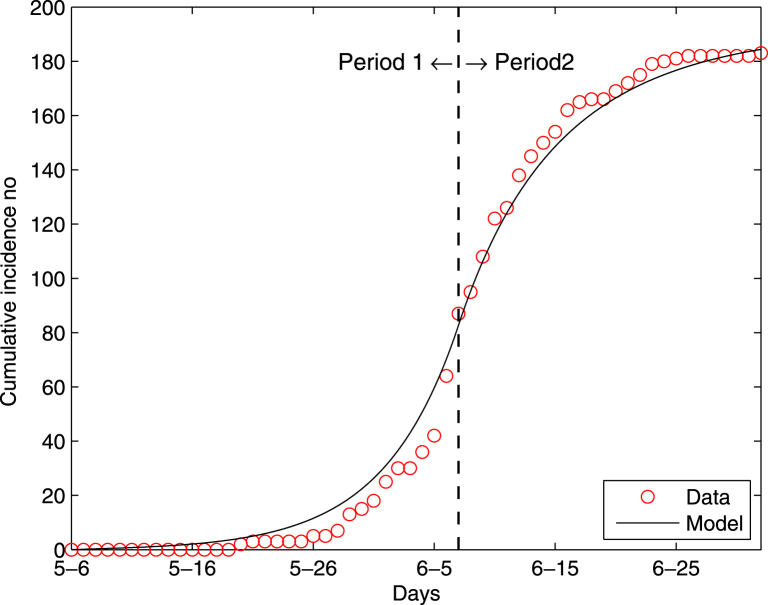
In
Figure 1, the data of MERS-CoV incidence (
∘) and its best fit (solid curve) of incidence Eq.
(1) are plotted from May 6, 2015 to July 4, 2015. The MERS-CoV incidence is defined as the number of newly infected individuals per day. The figure demonstrates that our fitted MERS-CoV model fits well to the reported incidence data. In the figure, we can see the trend of logistic curve; thus, we split up the time into two periods (May 6, June 7 and June 7, July 1) where the rate of change is in its increasing and decreasing trend respectively. Due to the implementation of intensive interventions at June 7, each period has its own remarkable trend, thus, parameters are estimated in each period. Two kinds of transmission rates are estimated—transmission rate
β and transmissibility of hospitalized patients
l—because many MERS-CoV patients are infected in hospitals and it is assumed that the value of hospitalized transmissibility
l is bigger than transmission rate
β. Parameter values used for simulation are listed in
Table 2.
As a result, the estimated value of the transmission rate β is 0.0835 [95% confidence interval (CI): 0.0835–0.0835] and the transmissibility of hospitalized patients l is 22 (95% CI, 18.7303–25.2697) in Period 1, and β is 0.036 (95% CI, 0.0306–0.0414) and l is 1 (95% CI, 0.1597–1.8403) in Period 2. Also, as mentioned in the previous section, the basic reproduction number is calculated. Using our estimated values of β and l, R0 is 5.3973(95% CI, 4.6057–6.1888) in Period 1 and 0.1351 (95% CI, 0.0403–0.2562) in Period 2. The remarkably larger value of R0 in Period 1 than in Period 2 is considered to be attributed to the superspreader.
Discussion
Due to the rapid development of nation-wide and world-wide transportation, it is more likely for a large-scale infectious disease outbreak to occur. This raises the importance of timely and accurate countermeasures. In order to devise efficient intervention strategies, it is critical to understand both the biological characteristics of the disease and the social response of the location where the disease spreads or is likely to spread. It is because these two aspects in combination determine the mode of diffusion of the infectious disease. In this regard, it is crucial to investigate the characteristics of MERS-CoV transmission in South Korea since it can demonstrate the current capability and the future potential of South Korea to resist infectious disease. This study tried to meet this need by examining which demographic group is more susceptible using incidence data and estimating transmission rates of general and hospitalized populations. The result of this study is expected to have theoretical and practical implications.
Further research can be suggested as follows. As seen in the result, the role of the superspreader might be decisive in the spread of MERS-CoV in South Korea. It can be explored what might happen if the superspreader was identified and isolated earlier or later, or if the spreading power was stronger or weaker. Also, the role of the media in the spread of MERS-CoV in South Korea can be investigated. How the Korean media covered MERS-CoV and how the lay person responded can be an issue, and how these two combined influence the spread of MERS-CoV may be examined.
Conflicts of interest
All authors have no conflicts of interest to declare.
AppendixThe basic reproduction number
The basic reproductive number is calculated by using the methodology (the next generation matrix approach). Now, we let
F(x) represent the rate of appearance of new infections. The net transition rates out of the corresponding compartment are represented by
V(x). Then, we find the Jacobian matrix of
F(x),
V(x), and denote
F=[∂F/∂xj] $ and
V=[∂V/∂xj] evaluated at disease free equilibrium point x
*, which consists of
S=N and the rest of them is zero.
The matrix
FV−1 has two zero eigenvalues and one positive eigenvalue.
Description of MERS-CoV data
We retrieved data for MERS-CoV in the Republic of Korea from public reported sources (the Korea Centers for Diseases Control and Prevention and the Korean Ministry of Health and Welfare). As of July 7, 2015, 186 laboratory-confirmed MERS-CoV cases and 36 fatal cases have been reported.
The earliest two confirmed cases were the primary case (68-year-old man) and his wife. The ongoing outbreak in South Korea began when the primary case developed respiratory illness on May 11, 2015 after returning on May 4, 2015 from the Middle East (April 24th–May 4th). Further epidemiological investigation showed that the primary case had also traveled to the Barain, United Arab Emirates, Saudi Arabia, and Qatar. The first symptom, which included fever, muscle aches, cough, and dyspnea, was detected on May 11th, 2015. On May 20th, 2015, he was diagnosed with MERS-CoV, so the patient was isolated and treated in hospital designated by the Korea government. After that, MERS-CoV spread in South Korea from the man, and we currently have 186 confirmed cases including 36 death cases (July 7, 2015).
Table A1
Table A1Characteristics of confirmed cases.
Table A1
| Characteristics |
All cases (n = 186) |
Fatal cases (n = 36) |
| Age group (y) |
| 0–18 |
1 |
0 |
| 19–39 |
39 |
0 |
| 40–59 |
71 |
7 |
| 60–79 |
66 |
22 |
| ≥ 80 |
9 |
7 |
| Sex |
| Male |
111 |
24 |
| Female |
75 |
12 |
| Occupation |
| Health workers |
39 |
2 |
| Epidemiological survey |
82 |
23 |
| Visitor/family |
65 |
11 |
shows three kinds of characteristics of confirmed cases; age group, sex, and occupation. In occupation, infected patients are classified into three groups; Health Workers, Epidemiologic Survey, and Visitor/Family. We can derive the mortality rates by occupation from the numbers in the table, which are 2.6% in health workers, 25.6% in Epidemiologic Survey, and 17% in Visitor/Family, and we can see that the mortality rate is the highest in Epidemiologic Survey.
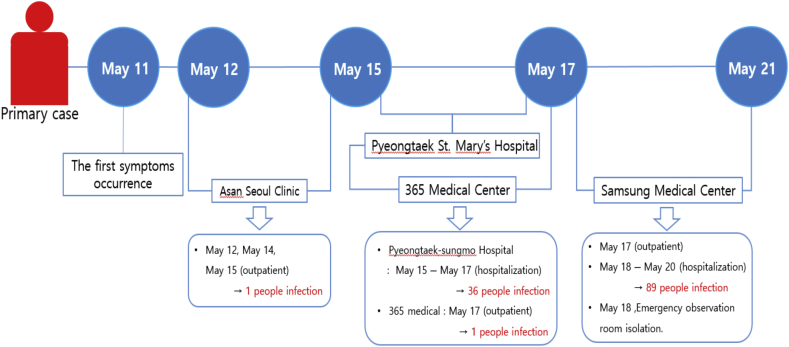
Figure A1
Figure A1The timeline of the primary patient before isolation.
presents the time, the location, and the number of infections by the primary patient until he was isolated, and
Table A2
Table A2The number of infections by the hospital that the primary patient visited.
Table A2
|
Asan Seoul Clinic |
365 Medical Center |
Pyeongtaek St. Mary's Hospital |
Samsung Medical Center |
| Secondary |
1 |
1 |
26 |
0 |
| 3rd
|
1 |
0 |
10 |
74 |
| 4th
|
0 |
0 |
0 |
3 |
displays the number of infected cases by the hospitals that the primary patient had visited before isolation. As the table shows, while it was Pyeongtaek St. Mary's Hospital where the primary case was confirmed, Samsung Medical Center was the location where the largest number of people were infected. It also draws attention that the number of cases decreases by the order of infection in Pyeongtaek St. Mary's Hospital while it tends to increase in Samsung Medical Center.
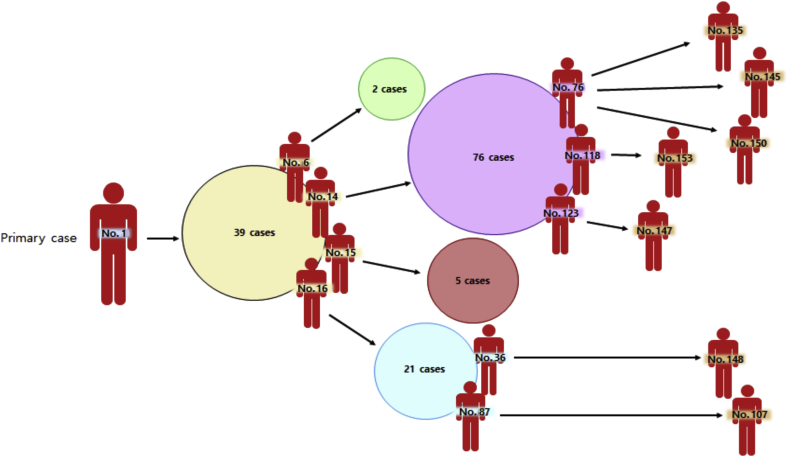
Figure A2
Figure A2Transmission tree of confirmed Middle Eastern respiratory syndrome coronavirus.
illustrates a transmission tree that MERS-CoV spread from primary case to 153 cases on June 15, 2015. The number of first-order infected cases is 39, that of second-order infected cases is 104, and that of third-order infected cases is seven. We omit some patients in
Figure A2 since the infection route of Patient No. 119 is unknown. Patient No. 126 stayed in the same location with Patients No. 14, No. 17, No. 26, and No. 108, so the infection of this patient cannot be attributed to one other infector. As the figure indicates, Patients No. 1, No. 14, and No. 16 have infected considerably more patients (39, 76, and 21 people, respectively) than usual cases, and we can see clearly that the MERS-CoV spread in South Korea is largely attributed to these superspreaders.
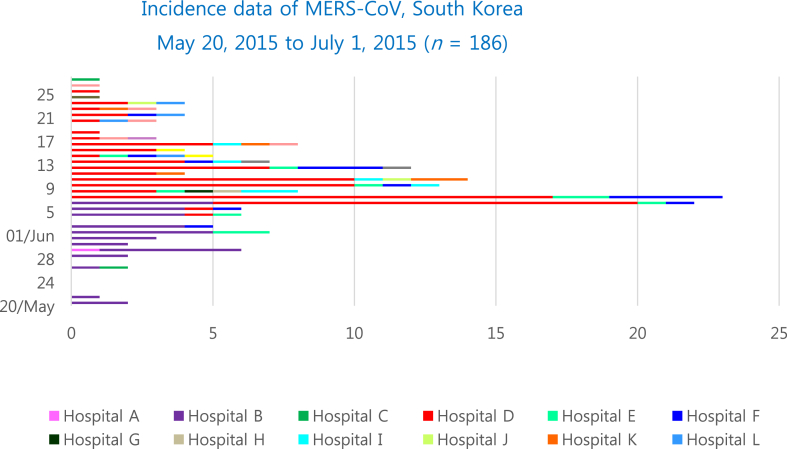
The number of patients of MERS-Cov on a daily basis from May 20, 2015 to July 1, 2015 and the hospital where those patients were confirmed are presented in
Figure A3
Figure A3Incidence data of Middle Eastern respiratory syndrome coronavirus. MERS-CoV = Middle Eastern respiratory syndrome coronavirus.
. As the figure illustrates, the number of patients reached its peak by 23 on June 7th, 2015. The figure also illustrates that the hospital where the largest number of patients were confirmed changed from Hospital B (Pyeongtaek St. Mary's Hospital) to Hospital D (Samsung Medical Center) by the peak day.
When it comes to the region where confirmed cases were infected, Gyeonggi-do, Seoul, and Daejeon are the three major infection areas where their total number of infected people is 147 which accounts for about 80% of the total number of infected people, and Seoul metropolitan area is the region where the majority of infections occurred (figure omitted). In each region, the hospitals where the most infections occurred are as follows: Samsung Medical Center in Seoul, Pyeongtaek St. Mary's Hospital in Gyeonggi-do, and Dae-Cheong Hospital and Konyang University Hospital in Daejeon. The numbers of hospital infections are 89, 36, 14, and 11, respectively. The combined number of infection in other hospitals is < 10.
References
- 1. Al-Tawfiq J.A., Hinedi K., Ghandour J.. Middle East respiratory syndrome coronavirus: a case-control study of hospitalized patients. Clin Infect Dis 59(2). 2014 Jul;160−165.
- 2. Arabi Y.M., Arifi A.A., Balkhy H.H.. Clinical course and outcomes of critically ill patients with Middle East respiratory syndrome coronavirus infection. Ann Intern Med 160(6). 2014 Mar;389−397.
- 3. Chowell G., Abdirizak F., Lee S.. Transmission characteristics of MERS and SARS in the healthcare setting: a comparative study. BMC Med 13:2015 Sep;210.
- 4. Cho H.W., Chu C.. Outbreak of Middle East respiratory syndrome in Korea? Osong Public Health Res Perspect 6(4). 2015 Aug;219−223.
- 5. Korea Centers for Disease Control and Prevention . Middle East respiratory syndrome coronavirus outbreak in the Republic of Korea, 2015. Osong Public Health Res Perspect 6:2015 Aug;269−278.
- 6. Assiri A., Al-Tawfiq J.A., Al-Rabeeah A.A.. Epidemiological, demographic, and clinical characteristics of 47 cases of Middle East respiratory syndrome coronavirus disease from Saudi Arabia: a descriptive study. Lancet Infect Dis 13(9). 2013 Aug;752−761.
- 7. Drosten C., Seilmaier M., Corman V.M.. Clinical features and virological analysis of a case of Middle East respiratory syndrome coronavirus infection. Lancet Infect Dis 13(9). 2013 Aug;745−751.
- 8. Guery B., Poissy J., Mansouf L.E.. Clinical features and viral diagnosis of two cases of infection with Middle East respiratory syndrome coronavirus: a report of nosocomial transmission. Lancet 381(9885). 2013 Jun;2265−2272.
- 9. Memish Z.A., Zumla A.I., Al-Hakeem R.F.. Family cluster of Middle East respiratory syndrome coronavirus infections. N Engl J Med 368(26). 2013 Jun;2487−2494.
- 10. Cauchemez S., Fraser C., Van Kerkhove M.D.. Middle East respiratory syndrome coronavirus: quantification of the extent of the epidemic, surveillance biases, and transmissibility. Lancet Infect Dis 14(1). 2013 Dec;50−56.
- 11. Breban R., Riou J., Fontanet A.. Interhuman transmissibility of Middle East respiratory syndrome coronavirus: estimation of pandemic risk. Lancet 382(9893). 2013 Aug;694−699.
- 12. Chowell G., Blumberg S., Simonsen L.. Synthesizing data and models for the spread of MERS-CoV, 2013: Key role of index cases and hospital transmission. Epidemics 9:2014 Dec;40−51.
- 13. van den Driessche P., Watmough J.. Reproduction numbers and sub-threshold endemic equilibria for compartmental models of disease transmission. Math Biosci 180(1–2). 2002 Nov;29−48.
- 14. Fisman D.N., Tuite A.R.. The epidemiology of MERS-CoV. Lancet Infect Dis 14(1). 2014 Jan;6−7.
- 15. Choi J.W., Kim K.H., Cho Y.M.. Current epidemiological situation of Middle East respiratory syndrome coronavirus clusters and implications for public health response in South Korea. J Korean Med Assoc 58(6). 2015 Jun;487−497.
Figure 1Data and parameter estimation of two periods.
Table 1Results of statistical analysis of Middle Eastern respiratory syndrome coronavirus data.
Table 1
|
DV
|
| Susceptibility |
Mortality |
Sex |
No. of cases by generation |
| IV |
Age |
z = 12.9 (p < 0.001)∗
|
z = 8.65 (p < 0.001)∗
|
χ2 = 62.1158 (p = 0.472) |
– |
| Sex |
— |
χ2 = 0.5818 (p = 0.4456) |
— |
χ2 = 0.9321 (p = 0.6275) |
| Region |
— |
χ2 = 11.1589 (p < 0.001)∗
|
χ2 = 6.3462 (p = 0.1747) |
χ2 = 52.9542 (p < 0.001)∗
|
| Mortality |
— |
— |
— |
χ2 = 4.591 (p = 0.1007)†
|
| Category |
— |
— |
χ2 = 12.6924 (p < 0.001)∗
|
— |
| Visited hospital |
— |
χ2 = 13.5511 (p < 0.001)∗
|
— |
— |
Table 2Parameter used in simulations for
Figure 1.
Table 2
| Parameter |
Description |
Value |
Refs |
| β |
human-to-human transmission rate |
Estimated |
|
| l |
transmissibility of hospitalized patients |
Estimated |
|
| κ |
leaving rate from E class |
1/(6.6) |
[14] |
| ρ |
fraction from E to I
|
0.585 |
[15] |
|
γa
|
average rate from I to H
|
0.6403 |
[15] |
|
γI
|
average recover rate without being hospitalized in I
|
1/5 |
[15] |
|
γI
|
Rate from H to R
|
1/7 |
[15] |
Citations
Citations to this article as recorded by

- Dynamical analysis and numerical assessment of the 2019-nCoV virus transmission with optimal control
Shuo Li, Tahir Khan, Qasem M. Al-Mdallal, Fuad A. Awwad, Gul Zaman
Scientific Reports.2025;[Epub] CrossRef - A fractional derivative approach to infectious disease dynamics: modeling and optimal control strategies
Sayooj Aby Jose, Raja Ramachandran, Jirawattanapanit Anuwat, Jinde Cao, Ravi P. Agarwal
Modeling Earth Systems and Environment.2025;[Epub] CrossRef - COVID-19 epidemic waves in Hungary and their regional distribution
Annamaria Uzzoli
Zbornik radova Departmana za geografiju, turizam i.2025; (54-1): 34. CrossRef - Computational analysis of the Covid-19 model using the continuous Galerkin–Petrov scheme
Rahila Naz, Aasim Ullah Jan, Attaullah, Salah Boulaaras, Rafik Guefaifia
Nonlinear Engineering.2024;[Epub] CrossRef - A higher order Galerkin time discretization scheme for the novel mathematical model of COVID-19
Attaullah, Muhammad Jawad, Sultan Alyobi, Mansour F. Yassen, Wajaree Weera
AIMS Mathematics.2023; 8(2): 3763. CrossRef - Insight into Oncogenic Viral Pathways as Drivers of Viral Cancers: Implication for Effective Therapy
Ahmed M. E. Elkhalifa, Showkat Ul Nabi, Ovais Shabir Shah, Showkeen Muzamil Bashir, Umar Muzaffer, Sofi Imtiyaz Ali, Imtiyaz Ahmad Wani, Nasser A. N. Alzerwi, Abozer Y. Elderdery, Awadh Alanazi, Fawaz O. Alenazy, Abdulaziz Hamdan A. Alharbi
Current Oncology.2023; 30(2): 1924. CrossRef - A Theoretical Investigation of the SARS-CoV-2 Model via Fractional Order Epidemiological Model
Tahir Khan, Rahman Ullah, Thabet Abdeljawad, Manar A. Alqudah, Faizullah Faiz
Computer Modeling in Engineering & Sciences.2023; 135(2): 1295. CrossRef - Modeling the epidemic trend of middle eastern respiratory syndrome coronavirus with optimal control
Bibi Fatima, Mehmet Yavuz, Mati ur Rahman, Fuad S. Al-Duais
Mathematical Biosciences and Engineering.2023; 20(7): 11847. CrossRef - Predictive Modeling and Control Strategies for the Transmission of Middle East Respiratory Syndrome Coronavirus
Bibi Fatima, Mehmet Yavuz, Mati ur Rahman, Ali Althobaiti, Saad Althobaiti
Mathematical and Computational Applications.2023; 28(5): 98. CrossRef - A pandemic by novel corona virus, seventh member of human coronavirus
Sohan A Patel, Nishith Patel
IP International Journal of Comprehensive and Adva.2023; 8(4): 231. CrossRef - On the analysis of Caputo fractional order dynamics of Middle East Lungs Coronavirus (MERS-CoV) model
Qura Tul Ain, Naveed Anjum, Anwarud Din, Anwar Zeb, Salih Djilali, Zareen A. Khan
Alexandria Engineering Journal.2022; 61(7): 5123. CrossRef - The transmission dynamics of Middle East Respiratory Syndrome coronavirus
Jia Rui, Qiupeng Wang, Jinlong Lv, Bin Zhao, Qingqing Hu, Heng Du, Wenfeng Gong, Zeyu Zhao, Jingwen Xu, Yuanzhao Zhu, Xingchun Liu, Yao Wang, Meng Yang, Li Luo, Qiuping Chen, Benhua Zhao, Yanhua Su, Jing-An Cui, Tianmu Chen
Travel Medicine and Infectious Disease.2022; 45: 102243. CrossRef - The asymptotic analysis of novel coronavirus disease via fractional-order epidemiological model
Tahir Khan, Saeed Ahmad, Rahman Ullah, Ebenezer Bonyah, Khursheed J. Ansari
AIP Advances.2022;[Epub] CrossRef - MODELING FRACTIONAL-ORDER DYNAMICS OF MERS-COV VIA MITTAG-LEFFLER LAW
HAIDONG QU, MATI UR RAHMAN, YE WANG, MUHAMMAD ARFAN, ADNAN
Fractals.2022;[Epub] CrossRef - Distinguishing viruses responsible for influenza-like illness
Julie A. Spencer, Deborah P. Shutt, S. Kane Moser, Hannah Clegg, Helen J. Wearing, Harshini Mukundan, Carrie A. Manore
Journal of Theoretical Biology.2022; 545: 111145. CrossRef - ON THE ANALYSIS OF FRACTAL-FRACTIONAL ORDER MODEL OF MIDDLE EAST RESPIRATION SYNDROME CORONAVIRUS (MERS-CoV) UNDER CAPUTO OPERATOR
LEI ZHANG, TAREQ SAEED, MIAO-KUN WANG, NUDRAT AAMIR, MUHAMMAD IBRAHIM
Fractals.2022;[Epub] CrossRef - Dynamics of Middle East Respiratory Syndrome Coronavirus (MERS-CoV) involving fractional derivative with Mittag-Leffler kernel
Tariq Mahmood, Fuad S. Al-Duais, Mei Sun
Physica A: Statistical Mechanics and its Applicati.2022; 606: 128144. CrossRef - Approximate solution for the nonlinear fractional order mathematical model
Kahkashan Mahreen, Qura Tul Ain, Gauhar Rahman, Bahaaeldin Abdalla, Kamal Shah, Thabet Abdeljawad
AIMS Mathematics.2022; 7(10): 19267. CrossRef - Modeling and Dynamics of the Fractional Order SARS‐CoV‐2 Epidemiological Model
Tahir Khan, Roman Ullah, Ali Yousef, Gul Zaman, Qasem M. Al-Mdallal, Yasser Alraey, M. De Aguiar
Complexity.2022;[Epub] CrossRef - Mathematical Modeling of COVID-19 Transmission in the Form of System of Integro-Differential Equations
Alexander Domoshnitsky, Alexander Sitkin, Lea Zuckerman
Mathematics.2022; 10(23): 4500. CrossRef - A New Mathematical Model of COVID-19 with Quarantine and Vaccination
Ihtisham Ul Haq, Numan Ullah, Nigar Ali, Kottakkaran Sooppy Nisar
Mathematics.2022; 11(1): 142. CrossRef - Product of natural evolution (SARS, MERS, and SARS-CoV-2); deadly diseases, from SARS to SARS-CoV-2
Mohamad Hesam Shahrajabian, Wenli Sun, Qi Cheng
Human Vaccines & Immunotherapeutics.2021; 17(1): 62. CrossRef - Analysis of the fractional corona virus pandemic via deterministic modeling
Nguyen Huy Tuan, Vo Viet Tri, Dumitru Baleanu
Mathematical Methods in the Applied Sciences.2021; 44(1): 1086. CrossRef - Mathematical analysis of SIRD model of COVID-19 with Caputo fractional derivative based on real data
Kottakkaran Sooppy Nisar, Shabir Ahmad, Aman Ullah, Kamal Shah, Hussam Alrabaiah, Muhammad Arfan
Results in Physics.2021; 21: 103772. CrossRef - COVID-19 outbreak, social distancing and mass testing in Kenya-insights from a mathematical model
Rachel Waema Mbogo, John W. Odhiambo
Afrika Matematika.2021; 32(5-6): 757. CrossRef - Fractal-fractional mathematical modeling and forecasting of new cases and deaths of COVID-19 epidemic outbreaks in India
Mansour A. Abdulwasaa, Mohammed S. Abdo, Kamal Shah, Taher A. Nofal, Satish K. Panchal, Sunil V. Kawale, Abdel-Haleem Abdel-Aty
Results in Physics.2021; 20: 103702. CrossRef - Mathematical analysis of COVID-19 via new mathematical model
Abdullah, Saeed Ahmad, Saud Owyed, Abdel-Haleem Abdel-Aty, Emad E. Mahmoud, Kamal Shah, Hussam Alrabaiah
Chaos, Solitons & Fractals.2021; 143: 110585. CrossRef - Modeling the transmission dynamics of middle eastern respiratory syndrome coronavirus with the impact of media coverage
BiBi Fatima, Manar A. Alqudah, Gul Zaman, Fahd Jarad, Thabet Abdeljawad
Results in Physics.2021; 24: 104053. CrossRef - Theoretical and numerical analysis for transmission dynamics of COVID-19 mathematical model involving Caputo–Fabrizio derivative
Sabri T. M. Thabet, Mohammed S. Abdo, Kamal Shah
Advances in Difference Equations.2021;[Epub] CrossRef - A computational tool for trend analysis and forecast of the COVID-19 pandemic
Henrique Mohallem Paiva, Rubens Junqueira Magalhães Afonso, Fabiana Mara Scarpelli de Lima Alvarenga Caldeira, Ester de Andrade Velasquez
Applied Soft Computing.2021; 105: 107289. CrossRef - Assessment of Prediction Models of Confirmed, Recovered and Deceased cases due to COVID-19
P Rakshit, S Debnath, J Mistri, S Kumar
Journal of Physics: Conference Series.2021; 1797(1): 012004. CrossRef - Modeling the dynamics of novel coronavirus (COVID-19) via stochastic epidemic model
Tahir Khan, Gul Zaman, Youssef El-Khatib
Results in Physics.2021; 24: 104004. CrossRef - Middle East respiratory syndrome coronavirus – The need for global proactive surveillance, sequencing and modeling
Jaffar A. Al-Tawfiq, Eskild Petersen, Ziad A. Memish, Stanley Perlman, Alimuddin Zumla
Travel Medicine and Infectious Disease.2021; 43: 102118. CrossRef - Mathematical model of COVID-19 in Nigeria with optimal control
Adesoye Idowu Abioye, Olumuyiwa James Peter, Hammed Abiodun Ogunseye, Festus Abiodun Oguntolu, Kayode Oshinubi, Abdullahi Adinoyi Ibrahim, Ilyas Khan
Results in Physics.2021; 28: 104598. CrossRef - The Effect of Feedback Controls on Stability in a Fractional-Order SI Epidemic Model
Saad Z. Rida, Ahmed A. Farghaly, Fatma Hussien
International Journal of Applied and Computational.2021;[Epub] CrossRef - Superspreading and heterogeneity in transmission of SARS, MERS, and COVID-19: A systematic review
Jingxuan Wang, Xiao Chen, Zihao Guo, Shi Zhao, Ziyue Huang, Zian Zhuang, Eliza Lai-yi Wong, Benny Chung-Ying Zee, Marc Ka Chun Chong, Maggie Haitian Wang, Eng Kiong Yeoh
Computational and Structural Biotechnology Journal.2021; 19: 5039. CrossRef - Middle East Respiratory Syndrome Coronavirus
Jaffar A. Al-Tawfiq, Esam I. Azhar, Ziad A. Memish, Alimuddin Zumla
Seminars in Respiratory and Critical Care Medicine.2021; 42(06): 828. CrossRef - Early warning signal reliability varies with COVID-19 waves
Duncan A. O'Brien, Christopher F. Clements
Biology Letters.2021;[Epub] CrossRef - Epidemiology of Coronavirus COVID-19: Forecasting the Future Incidence in Different Countries
Johannes Stübinger, Lucas Schneider
Healthcare.2020; 8(2): 99. CrossRef - Super-spreading events and contribution to transmission of MERS, SARS, and SARS-CoV-2 (COVID-19)
J.A. Al-Tawfiq, A.J. Rodriguez-Morales
Journal of Hospital Infection.2020; 105(2): 111. CrossRef - Mathematical modeling of COVID-19 transmission dynamics with a case study of Wuhan
Faïçal Ndaïrou, Iván Area, Juan J. Nieto, Delfim F.M. Torres
Chaos, Solitons & Fractals.2020; 135: 109846. CrossRef - A Generalized Overview of SARS-CoV-2: Where Does the Current Knowledge Stand?
Hiya Islam, Ahsab Rahman, Jaasia Masud, Dipita Saha Shweta, Yusha Araf, Md. Asad Ullah, Syed Muktadir Al Sium, Bishajit Sarkar
Electronic Journal of General Medicine.2020; 17(6): em251. CrossRef - Optimal control strategies for the transmission risk of COVID-19
Legesse Lemecha Obsu, Shiferaw Feyissa Balcha
Journal of Biological Dynamics.2020; 14(1): 590. CrossRef - A data-driven model to describe and forecast the dynamics of COVID-19 transmission
Henrique Mohallem Paiva, Rubens Junqueira Magalhães Afonso, Igor Luppi de Oliveira, Gabriele Fernandes Garcia, Martin Chtolongo Simuunza
PLOS ONE.2020; 15(7): e0236386. CrossRef - SEIR model for COVID-19 dynamics incorporating the environment and social distancing
Samuel Mwalili, Mark Kimathi, Viona Ojiambo, Duncan Gathungu, Rachel Mbogo
BMC Research Notes.2020;[Epub] CrossRef - Controlling the Spread of COVID-19: Optimal Control Analysis
Chinwendu E. Madubueze, Sambo Dachollom, Isaac Obiajulu Onwubuya
Computational and Mathematical Methods in Medicine.2020; 2020: 1. CrossRef - Fractional order mathematical modeling of COVID-19 transmission
Shabir Ahmad, Aman Ullah, Qasem M. Al-Mdallal, Hasib Khan, Kamal Shah, Aziz Khan
Chaos, Solitons & Fractals.2020; 139: 110256. CrossRef - Exploration of Superspreading Events in 2015 MERS-CoV Outbreak in Korea by Branching Process Models
Seoyun Choe, Hee-Sung Kim, Sunmi Lee
International Journal of Environmental Research an.2020; 17(17): 6137. CrossRef - Study of transmission dynamics of COVID-19 mathematical model under ABC fractional order derivative
Sabri T.M. Thabet, Mohammed S. Abdo, Kamal Shah, Thabet Abdeljawad
Results in Physics.2020; 19: 103507. CrossRef - A New Compartmental Epidemiological Model for COVID-19 with a Case Study of Portugal
Ana P. Lemos-Paião, Cristiana J. Silva, Delfim F.M. Torres
Ecological Complexity.2020; 44: 100885. CrossRef - Mathematical modeling, analysis, and simulation of the COVID-19 pandemic with explicit and implicit behavioral changes
Comfort Ohajunwa, Kirthi Kumar, Padmanabhan Seshaiyer
Computational and Mathematical Biophysics.2020; 8(1): 216. CrossRef - COVID-19 (Coronavirus Disease) Outbreak Prediction Using a Susceptible-Exposed-Symptomatic Infected-Recovered-Super Spreaders-Asymptomatic Infected-Deceased-Critical (SEIR-PADC) Dynamic Model
Ahmad Sedaghat, Amir Mosavi
SSRN Electronic Journal .2020;[Epub] CrossRef - Comparative Analysis of Eleven Healthcare-Associated Outbreaks of Middle East Respiratory Syndrome Coronavirus (Mers-Cov) from 2015 to 2017
Sibylle Bernard-Stoecklin, Birgit Nikolay, Abdullah Assiri, Abdul Aziz Bin Saeed, Peter Karim Ben Embarek, Hassan El Bushra, Moran Ki, Mamunur Rahman Malik, Arnaud Fontanet, Simon Cauchemez, Maria D. Van Kerkhove
Scientific Reports.2019;[Epub] CrossRef - Development of a recombinant replication-deficient rabies virus-based bivalent-vaccine against MERS-CoV and rabies virus and its humoral immunogenicity in mice
Hirofumi Kato, Mutsuyo Takayama-Ito, Itoe Iizuka-Shiota, Shuetsu Fukushi, Guillermo Posadas-Herrera, Madoka Horiya, Masaaki Satoh, Tomoki Yoshikawa, Souichi Yamada, Shizuko Harada, Hikaru Fujii, Miho Shibamura, Takuya Inagaki, Kinjiro Morimoto, Masayuki S
PLOS ONE.2019; 14(10): e0223684. CrossRef - Healthcare-associated infections: the hallmark of Middle East respiratory syndrome coronavirus with review of the literature
J.A. Al-Tawfiq, P.G. Auwaerter
Journal of Hospital Infection.2019; 101(1): 20. CrossRef - Middle East respiratory syndrome coronavirus in pediatrics: a report of seven cases from Saudi Arabia
Sarah H. Alfaraj, Jaffar A. Al-Tawfiq, Talal A. Altuwaijri, Ziad A. Memish
Frontiers of Medicine.2019; 13(1): 126. CrossRef - Asymptomatic Middle East Respiratory Syndrome Coronavirus (MERS-CoV) infection: Extent and implications for infection control: A systematic review
Jaffar A. Al-Tawfiq, Philippe Gautret
Travel Medicine and Infectious Disease.2019; 27: 27. CrossRef - Clinical predictors of mortality of Middle East Respiratory Syndrome Coronavirus (MERS-CoV) infection: A cohort study
Sarah H. Alfaraj, Jaffar A. Al-Tawfiq, Ayed Y. Assiri, Nojoom A. Alzahrani, Amal A. Alanazi, Ziad A. Memish
Travel Medicine and Infectious Disease.2019; 29: 48. CrossRef - Practical Guidance for Clinical Microbiology Laboratories: Viruses Causing Acute Respiratory Tract Infections
Carmen L. Charlton, Esther Babady, Christine C. Ginocchio, Todd F. Hatchette, Robert C. Jerris, Yan Li, Mike Loeffelholz, Yvette S. McCarter, Melissa B. Miller, Susan Novak-Weekley, Audrey N. Schuetz, Yi-Wei Tang, Ray Widen, Steven J. Drews
Clinical Microbiology Reviews.2018;[Epub] CrossRef - Agent-Based Modeling for Super-Spreading Events: A Case Study of MERS-CoV Transmission Dynamics in the Republic of Korea
Yunhwan Kim, Hohyung Ryu, Sunmi Lee
International Journal of Environmental Research an.2018; 15(11): 2369. CrossRef - Evaluation of visual triage for screening of Middle East respiratory syndrome coronavirus patients
S.H. Alfaraj, J.A. Al-Tawfiq, P. Gautret, M.G. Alenazi, A.Y. Asiri, Z.A. Memish
New Microbes and New Infections.2018; 26: 49. CrossRef - A multi-faceted approach of a nursing led education in response to MERS-CoV infection
Jaffar A. Al-Tawfiq, Siobhan Rothwell, Heather A. Mcgregor, Zeina A. Khouri
Journal of Infection and Public Health.2018; 11(2): 260. CrossRef - MERS transmission and risk factors: a systematic review
Ji-Eun Park, Soyoung Jung, Aeran Kim, Ji-Eun Park
BMC Public Health.2018;[Epub] CrossRef - Working experiences of nurses during the Middle East respiratory syndrome outbreak
Hee Sun Kang, Ye Dong Son, Sun‐Mi Chae, Colleen Corte
International Journal of Nursing Practice.2018;[Epub] CrossRef - Disaster medicine: current status and future directions of emergency medical team for overseas disaster crisis
Minhong Choa, Jiyoung Noh, Hyun Soo Chung
Journal of the Korean Medical Association.2017; 60(2): 149. CrossRef - Estimating and modelling the transmissibility of Middle East Respiratory Syndrome CoronaVirus during the 2015 outbreak in the Republic of Korea
Xu‐Sheng Zhang, Richard Pebody, Andre Charlett, Daniela de Angelis, Paul Birrell, Hunseok Kang, Marc Baguelin, Yoon Hong Choi
Influenza and Other Respiratory Viruses.2017; 11(5): 434. CrossRef - Influenza is more common than Middle East Respiratory Syndrome Coronavirus (MERS-CoV) among hospitalized adult Saudi patients
Jaffar A. Al-Tawfiq, Ali A. Rabaan, Kareem Hinedi
Travel Medicine and Infectious Disease.2017; 20: 56. CrossRef - Dynamics of scientific publications on the MERS-CoV outbreaks in Saudi Arabia
Ali A. Rabaan, Shamsah H. Al-Ahmed, Ali M. Bazzi, Jaffar A. Al-Tawfiq
Journal of Infection and Public Health.2017; 10(6): 702. CrossRef - Effects of Timely Control Intervention on the Spread of Middle East Respiratory Syndrome Coronavirus Infection
Ilsu Choi, Dong Ho Lee, Yongkuk Kim
Osong Public Health and Research Perspectives.2017; 8(6): 373. CrossRef - Serologic responses of 42 MERS-coronavirus-infected patients according to the disease severity
Jae-Hoon Ko, Marcel A. Müller, Hyeri Seok, Ga Eun Park, Ji Yeon Lee, Sun Young Cho, Young Eun Ha, Jin Yang Baek, So Hyun Kim, Ji-Man Kang, Yae-Jean Kim, Ik Joon Jo, Chi Ryang Chung, Myong-Joon Hahn, Christian Drosten, Cheol-In Kang, Doo Ryeon Chung, Jae-H
Diagnostic Microbiology and Infectious Disease.2017; 89(2): 106. CrossRef - Predictive factors for pneumonia development and progression to respiratory failure in MERS-CoV infected patients
Jae-Hoon Ko, Ga Eun Park, Ji Yeon Lee, Ji Yong Lee, Sun Young Cho, Young Eun Ha, Cheol-In Kang, Ji-Man Kang, Yae-Jean Kim, Hee Jae Huh, Chang-Seok Ki, Byeong-Ho Jeong, Jinkyeong Park, Chi Ryang Chung, Doo Ryeon Chung, Jae-Hoon Song, Kyong Ran Peck
Journal of Infection.2016; 73(5): 468. CrossRef - Middle East respiratory syndrome coronavirus disease is rare in children: An update from Saudi Arabia
Jaffar A Al-Tawfiq, Rana F Kattan, Ziad A Memish
World Journal of Clinical Pediatrics.2016; 5(4): 391. CrossRef