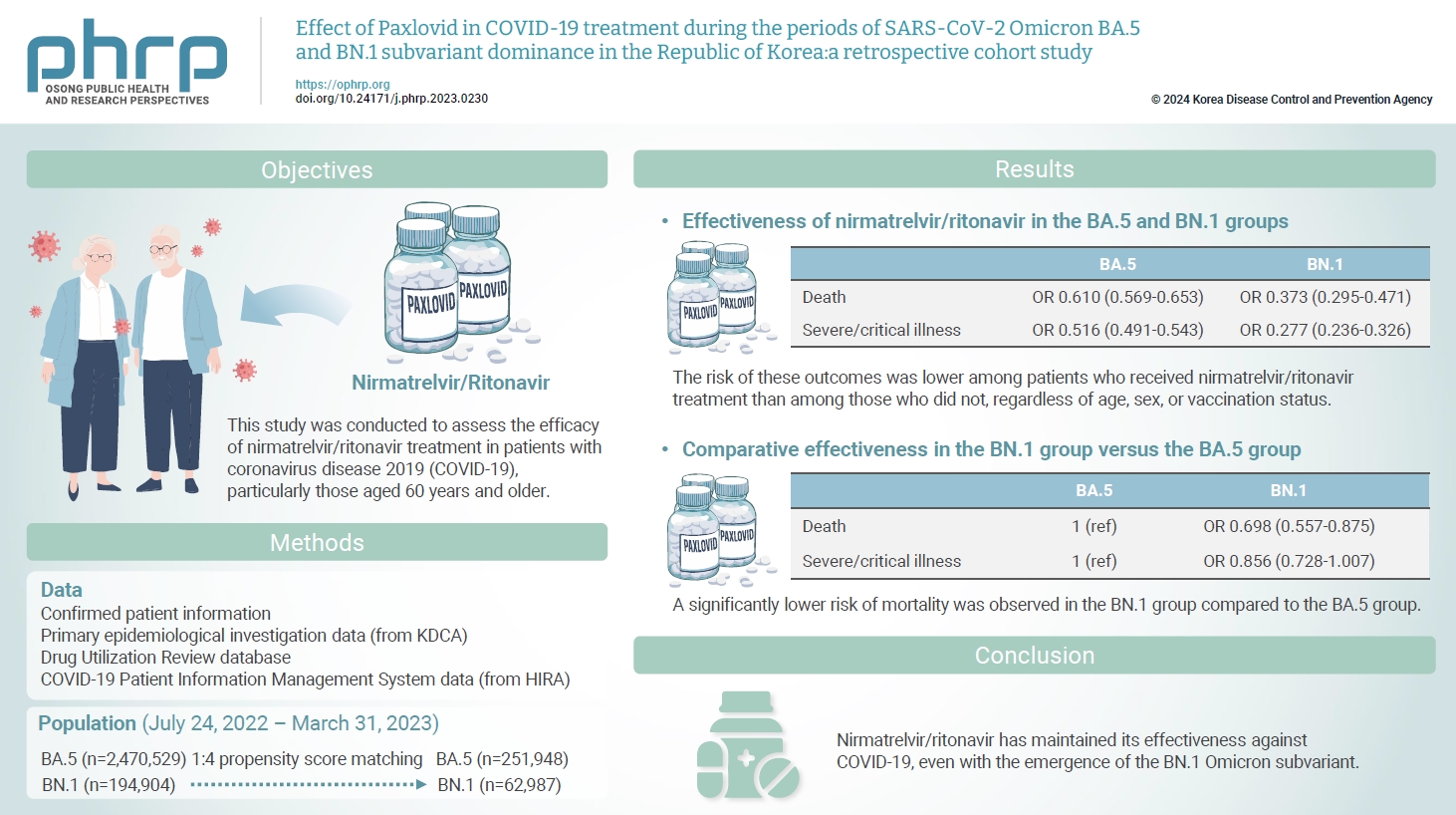
Objectives This study was conducted to assess the efficacy of nirmatrelvir/ritonavir treatment in patients with coronavirus disease 2019 (COVID-19), particularly those aged 60 years and older. Using real-world data, the period during which the BN.1 Omicron variant was dominant was compared to the period dominated by the BA.5 variant. Methods: In this retrospective cohort study, data were collected regarding 2,665,281 patients infected with severe acute respiratory syndrome coronavirus 2 between July 24, 2022, and March 31, 2023. Propensity score matching was utilized to match patients who received nirmatrelvir/ ritonavir in a 1:4 ratio between BN.1 and BA.5 variant groups. Multivariable logistic regression analysis was employed to assess the effects of nirmatrelvir/ritonavir within these groups. Results: Compared to the prior period, the efficacy of nirmatrelvir/ritonavir did not significantly differ during the interval of Omicron BN.1 variant dominance in the Republic of Korea. Among patients treated with nirmatrelvir/ritonavir, a significantly lower risk of mortality was observed in the BN.1 group (odds ratio [OR], 0.698; 95% confidence interval [CI], 0.557–0.875) compared to the BA.5 group. However, this treatment did not significantly reduce the risk of severe or critical illness, including death, for those in the BN.1 group (OR, 0.856; 95% CI, 0.728–1.007). Conclusion: Nirmatrelvir/ritonavir has maintained its effectiveness against COVID-19, even with the emergence of the BN.1 Omicron subvariant. Consequently, we strongly recommend the administration of nirmatrelvir/ritonavir to patients exhibiting COVID-19-related symptoms, irrespective of the dominant Omicron variant or their vaccination status, to mitigate disease severity and decrease the risk of mortality.
Citations
Citations to this article as recorded by
Effectiveness of Nirmatrelvir/Ritonavir for Outpatients in the Era of Omicron, Vaccination, and Previous Infection: A Meta-analysis Mark Ebell, Peter Kurotschka Journal of General Internal Medicine.2026; 41(12): 3516. CrossRef
Severity of COVID-19 Omicron Variants: A Global Systematic Review Deepa Malhotra, Rajeev M. Nepal, Irini Zografaki, Moe H. Kyaw, Pinelopi Nikolopoulou, Rodrigo Sini de Almeida, Santiago M. C. Lopez, Stephen Wiblin, Fraser Williams, Sophie Pope, Isabelle Whittle, Fiona Pearson, Daniel Curcio Infectious Diseases and Therapy.2026; 15(7): 1827. CrossRef
Nirmatrelvir/Ritonavir Efficacy in Immunocompetent Patients with Confirmed Omicron Variant of Severe Acute Respiratory Syndrome Coronavirus 2: An Updated Systematic Review and Meta-analysis Elnaz Khani, Hoda Afsharirad, Ali Taghizadeh Yadegari, Meysam Zarezadeh, Hila Asham, Hossein Bannazadeh-Baghi, Taher Entezari-Maleki Journal of Research in Pharmacy Practice.2026;[Epub] CrossRef
Objectives This study aimed to classify coronavirus disease 2019 (COVID-19)-related deaths according to whether COVID-19 was listed as the cause of death, and to investigate the differences in demographic characteristics and risk factors for COVID-19 death classifications.
Methods A total of 5,625 deaths in South Korea among patients with confirmed COVID-19 from January 20, 2020 to December 31, 2021 were selected. Excluding false reports and unnatural deaths, 5,597 deaths were analyzed. Based on death report data, deaths were classified according to whether the cause of death was listed as COVID-19 (CD) or not (NCD). The epidemiological characteristics and causes of deaths were investigated using descriptive, univariate, and multivariate statistical analyses. Odds ratios (ORs) and 95% confidence intervals (CIs) were calculated to analyze the risk factors.
Results The case fatality ratio was 0.89% and increased with age. Additionally, 96.4% of the subjects had an underlying disease, and 53.4% died in winter. The proportion of NCDs was 9.3%, of whom 19.1% died at home and 39.0% were confirmed to have COVID-19 after death. Malignant neoplasms (102/416 vs. 637/4,442; OR, 1.71; 95% CI, 1.36−2.16; p<0.001) were significantly associated with NCD.
Conclusion This is the first study to analyze risk factors by cause of death using COVID-19 death report data in South Korea. These results are expected to be used as evidence for establishing a death monitoring system that can collect timely information in a new infectious disease pandemic.
Citations
Citations to this article as recorded by
A Meta-Analysis of the Association between Apolipoprotein E Polymorphisms and SARS-COV-2 Risk/Severity in the Korean Population T.-Th.-D. Nguyen, M. Zayed, D.-I. Choi, Ch.-S. Lee, B.-H. Jeong Russian Journal of Genetics.2025; 61(8): 997. CrossRef
Shin Young Park, Gawon Choi, Hyeyoung Lee, Na-young Kim, Seon-young Lee, Kyungnam Kim, Soyoung Shin, Eunsu Jang, YoungSin Moon, KwangHwan Oh, JaeRin Choi, Sangeun Lee, Young-Man Kim, Jieun Kim, Seonju Yi, Jin Gwack, Ok Park, Young Joon Park
Osong Public Health Res Perspect 2020;11(4):259-264. Published online August 31, 2020
<p>This study describes the epidemiological characteristics of coronavirus disease 2019 (COVID-19) based on reported cases from long-term care facilities. As of April 20<sup>th</sup>, 2020, 3 long-term care facilities in a metropolitan area of South Korea had reported cases of COVID-19. These facilities’ employees were presumed to be the sources of infection. There were 2 nursing hospitals that did not report any additional cases. One nursing home had a total of 25 cases, with an attack rate of 51.4% (95% CI 35.6–67.0), and a fatality rate of 38.9% (95% CI 20.3–61.4) among residents. The results from this study suggest that early detection and maintenance of infection control minimizes the risk of rapid transmission.</p>
Citations
Citations to this article as recorded by
Factors influencing long-term care facility performance during the COVID-19 pandemic: a scoping review Eric Nguemeleu Tchouaket, Katya Kruglova, Josiane Létourneau, Emilie Bélanger, Stephanie Robins, Maripier Jubinville, Fatima El-Mousawi, Shiyang Shen, Idrissa Beogo, Drissa Sia BMC Health Services Research.2024;[Epub] CrossRef
Impact of the COVID-19 pandemic and corresponding control measures on long-term care facilities: a systematic review and meta-analysis Jun Zhang, Yushan Yu, Mirko Petrovic, Xiaomei Pei, Qing-Bao Tian, Lei Zhang, Wei-Hong Zhang Age and Ageing.2023;[Epub] CrossRef
A scoping review of the impacts of COVID-19 physical distancing measures on vulnerable population groups Lili Li, Araz Taeihagh, Si Ying Tan Nature Communications.2023;[Epub] CrossRef
Analysis of Concentrated COVID-19 Outbreaks in Elderly Facilities in Suita City, Osaka Prefecture, Japan Toshiyuki Shibata, Sawa Okano, Daisuke Onozuka, Etsuko Ohta, Satoshi Kutsuna International Journal of Environmental Research an.2023; 20(20): 6926. CrossRef
Factors relating to intention of use non-face-to-face services among family caregivers of persons with dementia: A cross-sectional study Myonghwa Park, Jinju Kim, Jihye Jung, Seonhwa Kim, Jinhee Lee, Dongyoung Lee Journal of Korean Gerontological Nursing.2023; 25(4): 377. CrossRef
Staffing Levels and COVID-19 Infections and Deaths in Korean Nursing Homes Jiyeon Lee, Juh Hyun Shin, Kyeong Hun Lee, Charlene A. Harrington, Sun Ok Jung Policy, Politics, & Nursing Practice.2022; 23(1): 15. CrossRef
An Experience of the Early Stage of COVID-19 Outbreak in Nursing Homes in Gyeonggi Province, Korea Gawon Choi, Na-young Kim, Seon-young Lee, Hae Deun Noh, Heeyoung Lee Korean Journal of Clinical Geriatrics.2022; 23(1): 27. CrossRef
The implications of the COVID-19 pandemic for long term care facilities Muh-Yong Yen, Jonathan Schwartz, Po-Ren Hsueh Current Opinion in Infectious Diseases.2022; 35(4): 370. CrossRef
Health impact of the first and second wave of COVID-19 and related restrictive measures among nursing home residents: a scoping review Marjolein E. A. Verbiest, Annerieke Stoop, Aukelien Scheffelaar, Meriam M. Janssen, Leonieke C. van Boekel, Katrien G. Luijkx BMC Health Services Research.2022;[Epub] CrossRef
Epidemiology and clinical features of COVID-19 outbreaks in aged care facilities: A systematic review and meta-analysis Mohammad Rashidul Hashan, Nicolas Smoll, Catherine King, Hannah Ockenden-Muldoon, Jacina Walker, Andre Wattiaux, Julieanne Graham, Robert Booy, Gulam Khandaker EClinicalMedicine.2021; 33: 100771. CrossRef
Protecting Nursing Homes and Long-Term Care Facilities From COVID-19: A Rapid Review of International Evidence Sally Hall Dykgraaf, Sethunya Matenge, Jane Desborough, Elizabeth Sturgiss, Garang Dut, Leslee Roberts, Alison McMillan, Michael Kidd Journal of the American Medical Directors Associat.2021; 22(10): 1969. CrossRef
Dementia Risk among Coronavirus Disease Survivors: A Nationwide Cohort Study in South Korea Hye-Yoon Park, In-Ae Song, Tak-Kyu Oh Journal of Personalized Medicine.2021; 11(10): 1015. CrossRef
Objectives
Measurement of the incidence of the human immunodeficiency virus (HIV) is very important for epidemiological studies. Here, we determined the recency period with the AxSYM avidity assay and the BED-capture enzyme immunoassay (BED-CEIA) in Korean seroconverters. Methods
Two hundred longitudinal specimens from 81 seroconverters with incident HIV infections that had been collected at the Korea National Institute of Health were subjected to the AxSYM avidity assay (cutoff = 0.8) and BED-CEIA (cutoff = 0.8). The statistical method used to estimate the recency period in recent HIV infections was nonparametric survival analyses. Sensitivity and specificity were calculated for 10-day increments from 120 days to 230 days to determine the recency period. Results
The mean recency period of the avidity assay and BED-CEIA using a survival method was 158 days [95% confidence interval (CI), 135–181 days] and 189 days (95% CI, 170–208 days), respectively. Based on the use of sensitivity and specificity, the mean recency period for the avidity assay and BED-CEIA was 150 days and 200 days, respectively. Conclusion
We determined the recency period to estimate HIV incidence in Korea. These data showed that the nonparametric survival analysis often led to shorter recency periods than analysis of sensitivity and specificity as a new method. These findings suggest that more data from seroconverters and other methodologies are needed to determine the recency period for estimating HIV incidence.
Citations
Citations to this article as recorded by
Western Blot-Based Logistic Regression Model for the Identification of Recent HIV-1 Infection: A Promising HIV-1 Surveillance Approach for Resource-Limited Regions Jiegang Huang, Minlian Wang, Chunyuan Huang, Bingyu Liang, Junjun Jiang, Chuanyi Ning, Ning Zang, Hui Chen, Jie Liu, Rongfeng Chen, Yanyan Liao, Li Ye, Hao Liang BioMed Research International.2018; 2018: 1. CrossRef
Objectives
From the introduction of HIV into the Republic of Korea in 1985 through 2012, 9,410 HIV-infected Koreans have been identified. Since 2000, there has been a sharp increase in newly diagnosed HIV-infected Koreans. It is necessary to estimate the changes in HIV infection to plan budgets and to modify HIV/AIDS prevention policy. We constructed autoregressive integrated moving average (ARIMA) models to forecast the number of HIV infections from 2013 to 2017. Methods
HIV infection data from 1985 to 2012 were used to fit ARIMA models. Akaike Information Criterion and Schwartz Bayesian Criterion statistics were used to evaluate the constructed models. Estimation was via the maximum likelihood method. To assess the validity of the proposed models, the mean absolute percentage error (MAPE) between the number of observed and fitted HIV infections from 1985 to 2012 was calculated. Finally, the fitted ARIMA models were used to forecast the number of HIV infections from 2013 to 2017. Results
The fitted number of HIV infections was calculated by optimum ARIMA (2,2,1) model from 1985–2012. The fitted number was similar to the observed number of HIV infections, with a MAPE of 13.7%. The forecasted number of new HIV infections in 2013 was 962 (95% confidence interval (CI): 889–1,036) and in 2017 was 1,111 (95% CI: 805–1,418). The forecasted cumulative number of HIV infections in 2013 was 10,372 (95% CI: 10,308–10,437) and in 2017 was14,724 (95% CI: 13,893–15,555) by ARIMA (1,2,3). Conclusion
Based on the forecast of the number of newly diagnosed HIV infections and the current cumulative number of HIV infections, the cumulative number of HIV-infected Koreans in 2017 would reach about 15,000.
Citations
Citations to this article as recorded by
Multidimensional Trends and AI-Based Forecasts of HIV Incidence in Korea, 1985–2024 Seungho Baek, Haneol Cho, Chansoo Kim, Yeonju Kim Journal of Epidemiology and Global Health.2026;[Epub] CrossRef
Evaluating Performance of Mathematical Models to Generate Short-Term Forecasts of Chlamydia and Gonorrhea in Georgia, 2017 to 2019 Radhika Prakash-Asrani, Amanda Bleichrodt, Kevin M. Maloney, Gerardo Chowell-Puente Sexually Transmitted Diseases.2026; 53(7): 419. CrossRef
A Detailed Study of ABC‐Type Fractal–Fractional Dynamical Model of HIV/AIDS Mansour A. Abdulwasaa, Esam Y. Salah, Mohammed S. Abdo, Bhausaheb Sontakke, Sahar Ahmed Idris, Mohammed Amood Al-Kamarany, Kuo Shou Chiu Computational and Mathematical Methods.2025;[Epub] CrossRef
CONSIDERATIONS ON THE EFFICIENCY OF TIME SERIES ANALYSIS IN FORECASTING NEW INFLUENZA CASES IN THE 2024-2025 SEASON Cristina-Gena Dascălu, Doriana Agop Forna , Magda Ecaterina Antohe Romanian Journal of Oral Rehabilitation.2025; 17(1): 923. CrossRef
Intelligent Health Care and Diseases Management System: Multi-Day-Ahead Predictions of COVID-19 Ahed Abugabah, Farah Shahid Mathematics.2023; 11(4): 1051. CrossRef
Prevalence of HIV in Kazakhstan 2010–2020 and Its Forecasting for the Next 10 Years Kamilla Mussina, Shirali Kadyrov, Ardak Kashkynbayev, Sauran Yerdessov, Gulnur Zhakhina, Yesbolat Sakko, Amin Zollanvari, Abduzhappar Gaipov HIV/AIDS - Research and Palliative Care.2023; Volume 15: 387. CrossRef
Integration models of demand forecasting and inventory control for coconut sugar using the ARIMA and EOQ modification methods Siti Wardah, Nunung Nurhasanah, Wiwik Sudarwati Jurnal Sistem dan Manajemen Industri.2023; 7(2): 127. CrossRef
Deep learning-based forecasting model for COVID-19 outbreak in Saudi Arabia Ammar H. Elsheikh, Amal I. Saba, Mohamed Abd Elaziz, Songfeng Lu, S. Shanmugan, T. Muthuramalingam, Ravinder Kumar, Ahmed O. Mosleh, F.A. Essa, Taher A. Shehabeldeen Process Safety and Environmental Protection.2021; 149: 223. CrossRef
Forecasting future HIV infection cases: evidence from Indonesia Maria Dyah Kurniasari, Andrian Dolfriandra Huruta, Hsiu Ting Tsai, Cheng-Wen Lee Social Work in Public Health.2021; 36(1): 12. CrossRef
Forecasting Confirmed Malaria Cases in Northwestern Province of Zambia: A Time Series Analysis Using 2014–2020 Routine Data Dhally M. Menda, Mukumbuta Nawa, Rosemary K. Zimba, Catherine M. Mulikita, Jim Mwandia, Henry Mwaba, Karen Sichinga, Hamidreza Karimi-Sari Advances in Public Health.2021; 2021: 1. CrossRef
An Adaptive Variational Mode Decomposition Technique with Differential Evolution Algorithm and Its Application Analysis Yuanxin Wang, Chaoqun Duan Shock and Vibration.2021;[Epub] CrossRef
A comparative study on the prediction of the BP artificial neural network model and the ARIMA model in the incidence of AIDS Zeming Li, Yanning Li BMC Medical Informatics and Decision Making.2020;[Epub] CrossRef
Forecasting the Monthly Reported Cases of Human Immunodeficiency Virus (HIV) at Minna Niger State, Nigeria Nwanne Christiana Umunna, Samuel Olayemi Olanrewaju Open Journal of Statistics.2020; 10(03): 494. CrossRef
Hybrid Decomposition Time-Series Forecasting by DirRec Strategy: Electric Load Forecasting Using Machine-Learning Branislav Vuksanovic, Davoud Rahimi Ardali International Journal of Computer and Electrical E.2019; 11(1): 1. CrossRef
Exploring an Ensemble of Methods that Combines Fuzzy Cognitive Maps and Neural Networks in Solving the Time Series Prediction Problem of Gas Consumption in Greece Konstantinos I. Papageorgiou, Katarzyna Poczeta, Elpiniki Papageorgiou, Vassilis C. Gerogiannis, George Stamoulis Algorithms.2019; 12(11): 235. CrossRef
APLIKASI METODE DOUBLE EXPONENTIAL SMOOTHING HOLT DAN ARIMA UNTUK MERAMALKAN VOLUNTARY COUNSELING AND TESTING (VCT) ODHA DI PROVINSI JAWA TIMUR Suci Retno Ningtiyas The Indonesian Journal of Public Health.2019; 13(2): 158. CrossRef
Research into the high-precision marine integrated navigation method using INS and star sensors based on time series forecasting BPNN Qiu Ying Wang, Kaiyue Liu, Zhiguo Sun, Minghui Zhang Optik.2018; 172: 494. CrossRef
Real-time predictive seasonal influenza model in Catalonia, Spain Luca Basile, Manuel Oviedo de la Fuente, Nuria Torner, Ana Martínez, Mireia Jané, Jeffrey Shaman PLOS ONE.2018; 13(3): e0193651. CrossRef
Using an Autoregressive Integrated Moving Average Model to Predict the Incidence of Hemorrhagic Fever with Renal Syndrome in Zibo, China, 2004–2014 Tao Wang, Yunping Zhou, Ling Wang, Zhenshui Huang, Feng Cui, Shenyong Zhai Japanese Journal of Infectious Diseases.2016; 69(4): 279. CrossRef
Time series analysis of influenza incidence in Chinese provinces from 2004 to 2011 Xin Song, Jun Xiao, Jiang Deng, Qiong Kang, Yanyu Zhang, Jinbo Xu Medicine.2016; 95(26): e3929. CrossRef
Modelling the prevalence of hepatitis C virus amongst blood donors in Libya: An investigation of providing a preventive strategy Mohamed A Daw World Journal of Virology.2016; 5(1): 14. CrossRef
Forecast analysis of any opportunistic infection among HIV positive individuals on antiretroviral therapy in Uganda John Rubaihayo, Nazarius M. Tumwesigye, Joseph Konde-Lule, Fredrick Makumbi BMC Public Health.2016;[Epub] CrossRef
The Use of an Autoregressive Integrated Moving Average Model for Prediction of the Incidence of Dysentery in Jiangsu, China Kewei Wang, Wentao Song, Jinping Li, Wu Lu, Jiangang Yu, Xiaofeng Han Asia Pacific Journal of Public Health.2016; 28(4): 336. CrossRef
Prevalence of hemorrhagic fever with renal syndrome in Yiyuan County, China, 2005–2014 Tao Wang, Jie Liu, Yunping Zhou, Feng Cui, Zhenshui Huang, Ling Wang, Shenyong Zhai BMC Infectious Diseases.2015;[Epub] CrossRef
Application of an autoregressive integrated moving average model for predicting injury mortality in Xiamen, China Yilan Lin, Min Chen, Guowei Chen, Xiaoqing Wu, Tianquan Lin BMJ Open.2015; 5(12): e008491. CrossRef
Back propagation neural network with adaptive differential evolution algorithm for time series forecasting Lin Wang, Yi Zeng, Tao Chen Expert Systems with Applications.2015; 42(2): 855. CrossRef
Direct Medical Costs of Hospitalizations for Cardiovascular Diseases in Shanghai, China Shengnan Wang, Max Petzold, Junshan Cao, Yue Zhang, Weibing Wang Medicine.2015; 94(20): e837. CrossRef
Changing Patterns of HIV Epidemic in 30 Years in East Asia S. Pilar Suguimoto, Teeranee Techasrivichien, Patou Masika Musumari, Christina El-saaidi, Bhekumusa Wellington Lukhele, Masako Ono-Kihara, Masahiro Kihara Current HIV/AIDS Reports.2014; 11(2): 134. CrossRef
What is Next for HIV/AIDS in Korea? Hae-Wol Cho, Chaeshin Chu Osong Public Health and Research Perspectives.2013; 4(6): 291. CrossRef
Objectives
The detection of HIV seroconverters increased annually since HIV antigen/antibody testing kits have been available widely in South Korea. This study aimed to identify the epidemiological characteristics of HIV seroconverters and their immune level at HIV diagnosis. Method
We analyzed the epidemiological and immunological characteristics of 341 HIV seroconverters among 6,008 HIV-diagnosed individuals from 1999 and 2009. The analysis of immune level and epidemiological factors of HIV seroconverters was conducted by using chi-square test on SAS version 9.1. Results
The seroconverters among newly-identified HIV cases each year increased from 0.5% in 1999 to over 5% or in 2009. The sex ratio of seroconverters was 18:1 (male:female), and 33% were in their 30s, and 28% were in their 20s. Reasons for HIV testing were involvement in voluntary test due to risky behaviors (43%), and health check-up (36%). Discovery of HIV infection occurred primarily in hospitals (84%). Among seroconverters, 55 percent had a CD4 T-cell count of more than 350/μl. Conclusion
Korean HIV seroconverters tended to be younger at diagnosis, diagnosed during a voluntary test, and their CD4+ T-cell counts at HIV diagnosis were higher than those of non-seroconverters aall HIV-infected individuals. This study of HIV seroconverters will be important foundational in future studies on HIV incidence, disease progress, and survival rate.
Citations
Citations to this article as recorded by
Characteristics of recent HIV infection among individuals newly diagnosed as HIV-positive in South Korea (2008–2015) Myeongsu Yoo, Jin-Sook Wang, Su-Jin Park, Jeong-ok Cha, Yoonhee Jung, Yoon-Seok Chung, Myung Guk Han, Byeong-Sun Choi, Sung-Soon Kim, Mee-Kyung Kee Scientific Reports.2022;[Epub] CrossRef
Evaluation of the Bio-Rad Geenius HIV 1/2 Confirmation Assay as an Alternative to Western Blot in the Korean Population: A Multi-Center Study Hee-Won Moon, Hee Jin Huh, Gwi Young Oh, Sang Gon Lee, Anna Lee, Yeo-Min Yun, Mina Hur, Herman Tse PLOS ONE.2015; 10(9): e0139169. CrossRef
Interferon-inducible protein 10 (IP-10) is associated with viremia of early HIV-1 infection in Korean patients SoYong Lee, Yoon-Seok Chung, Cheol-Hee Yoon, YoungHyun Shin, SeungHyun Kim, Byeong-Sun Choi, Sung Soon Kim Journal of Medical Virology.2015; 87(5): 782. CrossRef




 First
 Prev


